
By – Anubhi Srivastava
Abstract
India is undergoing a major demographic shift, with its elderly population expected to grow from 140 million to over 319 million by 2050. Unlike aging trends in developed nations, India faces distinct challenges due to its weak social security system, inadequate healthcare infrastructure, and a large informal workforce lacking pension coverage. As the dependency ratio rises, traditional family-based eldercare is declining, creating a pressing need for institutional support and policy innovation. This paper critically evaluates India’s existing policy responses such as the Centralised Pension Payment System (CPPS) and the National Programme for Health Care of the Elderly (NPHCE) highlighting gaps in implementation, accessibility, and integration. Drawing on international practices, including Japan’s Community-Based Integrated Care and Germany’s Universal Long-Term Care Insurance, the study outlines a roadmap for India to build a more inclusive and sustainable eldercare framework. The paper also emphasises the importance of technological innovation, public-private partnerships, and a robust regulatory framework to ensure quality and affordability in private eldercare services. A coordinated multi-stakeholder approach involving the state, private sector, and society is crucial to address the needs of India’s aging population and transform this demographic shift into an opportunity for inclusive development.
Introduction – The Scale of India’s Aging Challenge
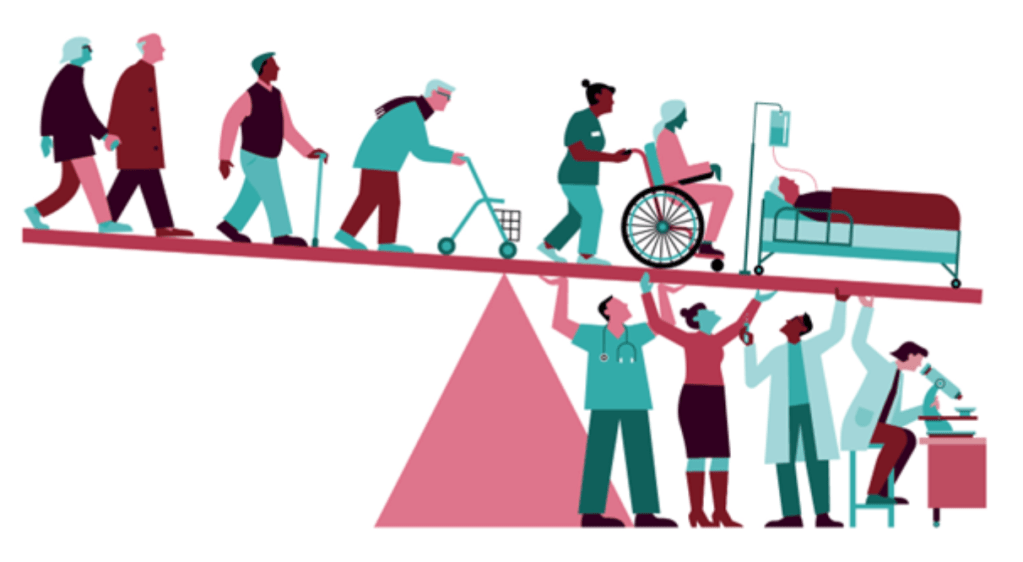
India is on the verge of a demographic shift, with its elderly population expected to rise in the coming decades. While aging populations have traditionally been associated with developed economies, India faces unique policy challenges due to problems in the social security system, inadequate healthcare infrastructure, and a predominantly informal workforce with limited access to pensions. The increasing dependency ratio raises critical concerns about financial sustainability, elderly care, and the growing role of both the state and private sector in supporting senior citizens. Additionally, the lack of a structured long-term care system leaves many elderly individuals reliant on family support, which is rapidly changing due to urbanisation and shifting societal norms. India’s demographic transition is unique. The country has over 140 million elderly citizens, estimated to rise to 319 million by 2050. This shift has been attributed to increased life expectancy and declining fertility rates. While a young workforce has long been the country’s economic advantage, a rapidly aging population poses new socio-economic challenges to ‘Young’ India. The dependency ratio, which measures the working population relative to dependents, is expected to increase, straining economic productivity and social welfare systems. As urbanisation gains momentum, traditional family-based elder care is declining, further underscoring the need for institutional support systems. Without adequate policy responses, India risks a demographic burden that could undermine its socio-economic stability.
Policies & Stakeholder Engagement:
- The Centralized Pension Payment System (CPPS) marks a significant shift from India’s traditional pension disbursement model, which was decentralised and dependent on a limited number of bank agreements in specific regions. By allowing pensioners to access their pensions from any bank nationwide without requiring physical verification, CPPS aims to increase financial accessibility and reduce bureaucratic inefficiencies. This reform is particularly crucial, as noting the rise in India’s elderly population, necessitating a more efficient and inclusive pension infrastructure. However, challenges remain in ensuring full digital literacy among pensioners and addressing technical issues in implementation. The success of CPPS will depend on seamless integration with the broader social security framework, ensuring that pensioners, especially those in rural and informal sectors, benefit equitably from the new system.
- The National Programme for Health Care of the Elderly (NPHCE) faces significant challenges due to India’s rapidly aging population. The demographic deviation, marked by reduced fertility, lower mortality, and increased life expectancy, has increased the demand for geriatric healthcare, yet the system remains unprepared to handle the growing elderly demographic, particularly in rural and semi-urban areas. A major concern is the lack of tertiary care infrastructure, including geriatric centers and rehabilitation facilities, limiting access to specialized healthcare. Furthermore, immunization and therapeutic approaches for older individuals remain inadequate, as there is no systematic geriatric assessment, vaccination programs for preventable diseases, or structured treatment methodologies to address age-related conditions effectively. Additionally, multi-dimensional treatments for elderly patients suffering from multiple chronic conditions, disabilities, and polypharmacy issues are impacted by a shortage of trained geriatric professionals, resulting in sub-optimal care. Emergency services for older adults are also lacking, especially in rural areas, as mobile healthcare services for acute medical crises such as strokes or falls remain largely unavailable. Another major obstacle is the lack of public-private partnerships (PPPs) in geriatric healthcare, where poor coordination between government initiatives and private healthcare providers restricts funding, service delivery, and accessibility. Additionally, the integration of elderly healthcare services into the existing Health and Wellness Centres (HWC) and national healthcare monitoring systems is limited, leading to gaps in research, age-friendly infrastructure, and sustainable service development. Mental health concerns among the elderly further complicate the issue, as chronic diseases, disabilities, and social stigma contribute to depression, anxiety, and dementia, yet mental healthcare services remain insufficiently developed. Despite the NPHCE’s efforts, the lack of trained professionals, weak emergency care services, and poor integration of geriatric programs into the broader healthcare framework continues to hinder effective elderly healthcare.
Therefore, given the scale of India’s aging population, both the public and private sectors must collaborate to enhance elderly care services. By encouraging PPPs, India can help expand infrastructure and improve service quality while maintaining affordability. A blended approach that leverages both state support and private investment is crucial for building a sustainable elderly care system while ensuring assistance in modern-day technology & invention.
Case Studies: Japan & Germany:
Several countries have successfully managed their aging populations through innovative policies. While direct replication may not be feasible, India can draw lessons from these models to develop an inclusive and sustainable aging policy framework.
Japan faces a rapidly aging population, with projections indicating that by 2025, individuals aged 75 and above will constitute a significant portion of society. In response, the government introduced the Community-Based Integrated Care System, aiming to provide comprehensive support encompassing healthcare, nursing care, preventive services, housing, and livelihood assistance within each community. This system emphasizes the importance of enabling the elderly to continue living in familiar environments, promoting aging in place. A notable initiative within this framework is the establishment of community cafés, which serve as “third places” beyond home and institutional settings. These cafés offer dementia care services and foster social interactions, thereby enhancing the quality of life for older adults. The financing of this integrated care approach is structured through a decentralized social insurance system. By focusing on community-based solutions and integrating various support services, Japan aims to address the challenges posed by its aging demographic, ensuring that elderly citizens receive accessible and affordable care within their communities.
Germany’s approach to long-term care is characterised by its universal Long-Term Care Insurance (LTCI) system. This program mandates coverage for the entire population, either through statutory or private insurance, ensuring that all individuals have access to necessary long-term care services. Eligibility for LTCI benefits is based on the degree of care dependency. Beneficiaries have the flexibility to choose between various forms of care, including cash benefits, in-kind services, or residential care, allowing for personalised care plans that align with individual preferences and needs. Germany has implemented measures such as increasing premiums, introducing subsidies for private insurance purchases, and establishing a demographic reserve fund. These strategies aim to maintain the LTCI system’s viability in the face of an aging population. Germany’s LTCI serves as a model for balancing comprehensive coverage with financial sustainability, providing valuable insights into the implementation of a universal long-term care system.
Recommendations:
To effectively address the financial and healthcare challenges of an aging population, India must implement comprehensive policy measures that ensure sustainability and accessibility. A crucial step is the adoption of a payroll-based long-term care insurance model, similar to Germany’s, to provide sustainable financing for elderly care and reduce dependency on family support or out-of-pocket expenses. Strengthening geriatric healthcare by increasing investment in primary healthcare centres specializing in elderly care is equally important, with an emphasis on preventive healthcare and chronic disease management to improve long-term health outcomes. Additionally, introducing government-subsidized health insurance schemes tailored to the specific needs of senior citizens can ensure affordable and equitable access to medical care, easing the financial burden on aging individuals and their families. Implementing these measures can help build a more resilient and inclusive healthcare system for India’s growing elderly population.
Promoting community-based and home care models is essential to reduce the pressure on institutional facilities. Home-based care programs should be rewarded through tax benefits and subsidies to encourage the growth of professional home-care services. Additionally, fostering community support networks by encouraging NGOs and local organizations to establish elderly support groups can provide social support to aging individuals. Technological interventions, such as AI-powered health monitoring, can increase remote care accessibility and ensure timely medical attention as well as reduce the workload on healthcare institutions.
With the involvement of the private sector in elderly care, it is crucial to have a strong regulatory framework to ensure both affordability and quality. Establishing a dedicated regulatory body to oversee private elder care facilities would help enforce compliance with quality standards, preventing substandard care and exploitation. Additionally, introducing affordability measures such as subsidies or tax incentives for private elderly care services would make them more accessible to a larger segment of the population.
Conclusion:
India is at a critical point in its demographic transition. Without proactive policy interventions, the rising elderly population could strain financial and healthcare systems, leading to widespread social and economic challenges. A multi-stakeholder approach involving the government, private sector, and communities is necessary to build a sustainable and inclusive elderly care system. By acting now, India can transform its demographic challenge into an opportunity, ensuring a dignified and secure aging experience for its senior citizens.
Author’s Bio
Anubhi Srivastava is a B.A. LL.B. student at Jindal Global Law School and a columnist at CNES.
Image Source : https://www.thefinancialworld.com/dangers-of-aging-population/
 NICKELED AND DIMED