
By : Vaidehi Sharma
Abstract
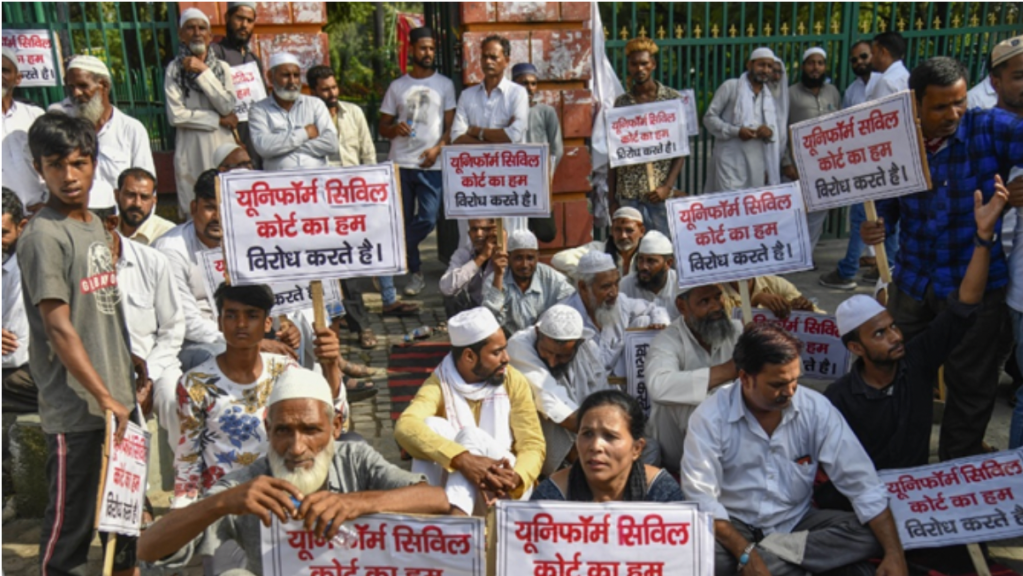
Uttarakhand implemented the much-controversial Uniform Civil Code on January 27, 2025. Facing criticism for formulating a ‘Hindu Code’ that allegedly targets religious minorities, the ruling party of Uttarakhand has hailed the Code as an important step towards women empowerment. This article aims to critically analyse such claims about the Code. The article examines the assertion that the Code will foster true gender justice and equality in light of widespread concerns that it is built on exclusion and religious bias.
Introduction
2025 has had an interesting start, with Uttarakhand implementing the Uniform Civil Code (hereinafter “the Code”) on January 27th. This makes it the second state after Goa—which follows a Uniform Civil Code based on the colonial Portuguese Civil Code—and the first state in post-independence India to do so. The Code aims to standardise personal laws irrespective of the religion followed by the people to whom the Code applies. The Code covers matters such as the conditions and ceremonies of marriage, nullity of marriage, restitution of conjugal rights, judicial separation, divorce, maintenance, succession, and live-in relationships.
Uniform Civil Code: A Forever Debate
Article 44 of the Constitution of India, which contains the Directive Principles of State Policy, promotes the implementation of a Uniform Civil Code (hereinafter “UCC”) throughout the territory of India. Its inclusion was highly debated in the Constituent Assembly and has remained a contentious issue ever since the adoption of the Constitution.
A constant argument in support of a UCC is that it will promote national integration along with ensuring true gender justice by eliminating personal laws that disproportionately harm women. This stance has been supported by the judiciary. The Supreme Court of India, in Mohd. Ahmed Khan v. Shah Bano Begum, while upholding the right of Muslim women to claim maintenance under Section 125 of the Code of Criminal Procedure, 1973, emphasised the need for a UCC and the duty of the State under Article 44 to implement the same. The Supreme Court again stressed the necessity of a UCC for matters like marriage, succession, and inheritance in Sarla Mudgal v. Union of India. In Shabnam Hashmi v. Union of India, while holding that adoption under the Juvenile Justice Act was permissible irrespective of whether personal laws allowed or recognised it, the Court termed it a “small step in reaching the goal enshrined by Article 44 of the Constitution.”
However, it is also argued that since personal laws are deeply rooted in religious customs and practices, a UCC could undermine religious freedom. There is also apprehension that a UCC may end up harming the personal laws of religious and cultural minorities. In fact, in 2018, the 21st Law Commission, headed by former Supreme Court judge Balbir Singh Chauhan, stated that a UCC was “neither necessary nor desirable,” hailing differences as a sign of a robust democracy.
Whatever the stances of various stakeholders may be, the truth is that Article 44 has long awoken from its slumber and the UCC is now a reality. The implementation of a UCC first appeared in the Bharatiya Janata Party’s election manifesto in 1996 and has since then remained a constant feature, even in its most recent manifesto for the 2024 Lok Sabha Elections. With Uttarakhand’s Uniform Civil Code finally coming into effect and the state governments of Assam and Gujarat—both double-engine governments—showing open and keen interest in the implementation of a UCC in their states, it seems the BJP has finally been able to tick off the implementation of a UCC from its to-do list.
The Chief Minister of Uttarakhand, Mr. Pushkar Singh Dhami, has followed up on his election promise and hailed the Code as an attempt to ensure women empowerment. This has been the most common narrative—or rather, shield—against the criticism of the Code, which is being labelled a regressive “Hindu Code” targeting religious minorities, especially Muslims. The typical narrative employed by the proponents of the Code is that it has come as a saviour for women suffering from injustice caused by varied personal laws; that with the UCC as a saving grace, equality and justice will now be ensured in their true sense. This article aims to explore the Code’s potential and whether it can be considered a step forward in achieving true gender justice.
Exclusionary Definitions Unmask Code Shortcomings
Section 3(1)(j) of the Code defines a person as a “female or male” individual, using the expressions “she/he, her/his, her/him, and herself/himself.” With this one definition, the UCC has excluded from its ambit any identity beyond this rigid dichotomy. Through such blatant exclusion of transgender individuals, the Code has created confusion regarding their rights and undone the progressive work achieved through judgments like Supriyo v. Union of India, where the Supreme Court upheld the right of transgender individuals in heterosexual relationships to marry.
Though it is no surprise that the Code does not recognise same-sex marriages, it goes a step further by defining live-in relationships strictly as a relationship between a man and a woman cohabiting in a shared household in the nature of marriage. This is despite the fact that judgments like Navtej Singh Johar v. Union of India, and Supriyo v. Union of India, recognised the right of same-sex couples to cohabit with each other. The Code does not acknowledge homosexual relationships at all.
Marriage and Divorce
Under Section 5 of the Code, a marriage may be solemnised in accordance with different religious practices, but the fact that the conditions for a valid marriage given under Section 4 of the Code largely mimic those under Section 5 of the Hindu Marriage Act, 1955, does little to counter the argument that it is a “Hindu Code.” This also holds true for the sections on the nullity of marriages and divorce, which have been almost entirely replicated from the HMA.
That said, there are some promising changes. A marriage where either party was below the marriageable age of 18 and 21 is now voidable under Section 24(b) for all communities. However, it is again questionable whether simply making child marriage voidable and punishable—rather than rendering it void ab initio without the need for a petition—is an effective measure.
Section 32(1)(ii) prescribes punishment for extrajudicial modes of divorce like Triple Talaq and Panchayati divorces, which leave women vulnerable to arbitrary separation. Section 30 has struck down the imposition of Nikah Halala, meaning women now have the right to remarry their divorced spouse without any conditions, such as marrying a third person before remarriage.
However, while addressing these issues, the Code has also replicated HMA provisions that harm the interests of parties, especially women—understandably raising the question of whether its primary aim is to enhance gender justice or to target specific customary practices of certain communities.
Under Section 21, which mirrors Section 9 of the HMA, the Code has retained the provision for Restitution of Conjugal Rights (RCR), allowing a court to order a spouse who has withdrawn from the other’s society “without reasonable excuse” to restore conjugal rights. The Code has completely ignored landmark judgments like T. Sareetha v. T. Venkata Subbaiah, which have criticised RCR for undermining the sexual and bodily autonomy of women by forcing an unwilling party to cohabit with the other. Though the judgement was overruled by Saroj Rani v. Sudarshan Kumar, its analysis of the RCR is particularly relevant in understanding its impact on the parties.
Lastly, Section 28 of the Code does not allow divorce petitions to be filed unless one year has elapsed since the date of marriage. The only exceptions are cases of “exceptional hardship,” which will inevitably vary from case to case. Occasional physical violence, which married women are very commonly subjected to, may be deemed “exceptional” by one judge but not by another. If a party is subjected to mental or physical suffering, this one-year restriction will only prolong their distress. The right to file a divorce petition on the grounds of cruelty under Section 25(1)(ii) also remains vague, with a lot of scope for the judge’s discretion. Moreover, instead of granting a divorce, the Court may pass a decree of judicial separation under Section 26, further extending the mental agony of the parties and causing unnecessary inconvenience.
Intestate and Testamentary Succession
In the case of intestate succession, the Code under Section 49 divides heirs into three categories: Class I, II, and III. Class I heirs include the surviving spouse, children, and parents of the deceased, with each party holding an equal share—except for the parents, who will collectively hold one share in equal proportion. The succession rules are gender-neutral, ensuring that heirs of both men and women receive an equitable share of the property rather than following a system of fixed shares that disproportionately harms women and favours male heirs.
However, when it comes to testamentary succession, the Code does not impose any limits on the amount of property that can be willed away. Since an individual can bequeath their entire property at their discretion—and given the prevalent preference for sons and male relatives over daughters—many daughters may end up being disinherited from their parents’ property. The Code could have restricted the proportion of property that can be willed away and mandated a fixed portion to be distributed among the legal heirs of the deceased, as is done under Muslim personal law. It could have ensured the equitable distribution of such a fixed portion among all heirs, preventing any heir from being left completely destitute or deprived of property. However, the Code has generally shown reluctance in adopting helpful practices from minority communities.
Additionally, Section 3(1)(e) of the Code, which defines “estate,” has eliminated the distinction between joint/ancestral property and separate property followed under Hindu law. Daughters were granted coparcenary rights under the 2005 Amendment to the Hindu Succession Act, and the ruling in Vineeta Sharma v. Rakesh Sharma ensured that daughters had the same share as sons in the parents’ joint property. However, with this distinction now removed, daughters can be more easily disinherited from the entirety of the property.
Live In Relationships
The Code explicitly recognises live-in relationships and, under Section 388, grants women deserted by their live-in partner the right to claim maintenance from their partner. The Code, under Section 379, also recognises the children born out of such relationships as the legitimate children of the couple. Though this step is welcome, the public has raised several concerns regarding the overregulation of live-in couples and the potential misuse of its provisions.
Section 378 of the Code mandates people in live-in relationships to get themselves registered. Under Section 385(1), the Registrar, upon receipt of the statement of live-in relationship, is to share the same with the officer in charge of the local police station, thus increasing the risk of police intrusion and harassment of such couples. Also, the UCC Rules have made it obligatory for landlords to ask for a copy of the Certificate of live-in relationship before entering into a rent agreement with persons in a live-in relationship and to duly verify the authenticity of the rental agreement with the police, thus discouraging landlords from providing accommodation to live-in couples or even friends of the opposite gender.
Under Section 381(2), the Registrar is also to conduct a summary inquiry to check the “‘veracity” of the information given by the registrants. The application for registration can also be rejected by the Registrar, after which comes a cumbersome appeal process. If a couple stays in a live-in relationship for more than one month without registration, Section 387 prescribes imprisonment for three months or a fine of ten thousand rupees. Registrants also need to register the termination of their live-in relationship.
There is significant potential for moral policing and intrusion by family members who may not support interfaith, intercaste, or relationships outside of marriage. People may try to harass such couples by procuring information from landlords and filing false complaints to the local police. Women often face the burden of upholding the sexual morality and sanctity of a family and will undoubtedly, in particular, bear the brunt of such harassment. To add to the problem, if the registrants are between the ages of 18–21, the Registrar, under Section 385(1), is to inform the parents or legal guardians of the individual about the receipt of registration as well as the termination of live-in relationships. Such uncalled-for infantilisation of adults has also raised concerns regarding the regulation of live-in relationships.
The Right to Privacy has been recognised as a fundamental right by the Supreme Court in KS Puttaswamy v. Union of India. By policing live-in relationships through an intrusive registration process and increasing State interference in live-in relationships, the Code is not just depriving individuals of the flexibility offered by live-in relationships by trying to make such relationships mimic marriage; the Code is also violating the right to privacy and personal liberty.
Conclusion
The Uttarakhand Uniform Civil Code is a missed opportunity when it comes to true women’s empowerment and gender justice. Its lack of recognition of transgender individuals and same-sex couples is an obstacle to achieving true gender justice. While the UCC has prohibited practices like triple talaq, Panchayati divorce, child marriage, and Nikah halala across all communities, it has simultaneously retained insensitive provisions from the HMA.
The sections on testamentary succession fail to account for the real-world preference for male heirs. Furthermore, the Code excludes Scheduled Tribes from its ambit, meaning that ST women will not benefit from any of its protections or advantages.
For other states considering the implementation of a UCC, it would be highly advisable to conduct extensive public consultations and draft fresh, inclusive codes that truly integrate the most equitable practices from all communities, rather than relying primarily on the personal laws of a single religion.
Author’s Bio
Vaidehi Sharma is a second-year BA LLB student at Jindal Global Law School.
 NICKELED AND DIMED