
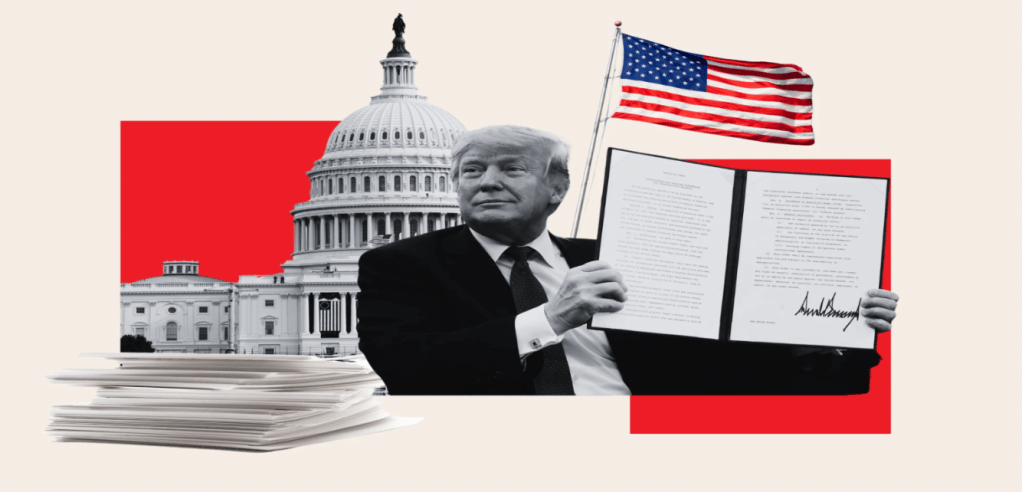
By : Mohit Kathuria.
Abstract
Donald Trump’s return to the White House could potentially mark an era in which the US weaponised its position as the world’s largest economy, with tariffs, sanctions, and supply chain restrictions as the key instruments of its foreign policy. This article examines how Trump’s second Presidency could strain global strategic alliances, disrupt the defence preparedness of affected countries and create new clusters and grouping of nations by forcing them to re-align their alliances as the US squares up to face the challenge from a rising China for supremacy. The intensification of international trade tensions could turn away allies, make them seek newer partnerships in the face of US coercion, and herald the emergence of a multi-polar world order in international politics. This analysis explores the current developments under the Trump 2.0 administration and the likely consequences on the balance of power equation.
Introduction
The global trade landscape, which has been led and shaped by the US since 1945 after defeating Nazi Germany in World War II, has been characterised by globalisation and free trade for almost seventy-five years. The period from 1945 to 2008 saw unprecedented freedom of movement, immigration, and advancements in high technology – particularly in computer science and information technology, which seemed to benefit both America’s businesses and its people initially. However, the 2008 subprime mortgage banking crisis marked an inflexion point for the American population. This crisis led them to doubt the direction of their politicians’ leadership, as its many failed diplomatic, economic, and military ventures began to affect them adversely.
Donald Trump, a complete outsider to Washington politics, was elected to office in 2017 and now again in 2025 because of his image as a plain-speaking non-politician who was catapulted to power by his outsider status and wanted to ‘Make America Great Again’. His message of putting the American people first over immigrants and allies resonated with voters who had now started to believe that mainstream Politicians in the US were more concerned with their ideology rather than people.
Trump’s nativist vision of America is defined by some as an isolationist approach, emanating from an ‘America First Policy‘ to solve all of America’s employment, industrial, economic, and political problems. This has found resonance in large sections of America, that agree with Trump’s Make America Great Again (M.A.G.A) vision. However, in fairness, these isolationist sentiments are limited not only to the Trump-following voter base of the Republican Party but also exist within large sections of the left-wing Democratic Party.
Neorealism: Trade as a tool of Power
Once perceived as a pathway to economic prosperity and increased levels of international cooperation, international trade has been weaponised by rich nations of the Global North to coerce compliance from other countries to their needs. Financial instruments, supply chains, technological prowess, and economic dependencies are essential for gaining the upper hand in negotiations.
Neorealism, an International Relations theory created by Dr Kenneth Waltz, posits that states exist in an anarchic world where uncertainty about other’s intentions fosters an environment of persistent covert or overt threats. His position on international relations is that all nations are self-serving; they will not want to be dominated by others, and instead, they aspire to become global hegemons themselves. This means that nations are driven to become self-sufficient because of systemic factors so that they can not only fend off threats from other countries but also have other nations subservient to them for their own needs.
Under the Neorealist framework, pursuing national security aims by using economic power against economically weaker nations is a justified means of statecraft. Recent developments in the international arena, such as the U.S – China trade war and export controls on semiconductors, exemplify the growing trend of economic coercion. Other examples of economic coercion that have enormous implications for the international world order but are not as widely discussed are Russia’s restriction of gas to Europe and China’s ban on Australian coal, which indicate how common the weaponisation of trade is becoming to the international economy.
The Economic background
A recent United States Joint Economic Committee report estimates that as of 7th February 2025, the US national debt stands at $36.22 trillion—an alarming figure, considering its GDP is valued at $23.4 trillion. Some observers, like Ruchir Sharma, have pointed out that it now takes 1.8 dollars of debt to produce every 1-dollar product in the US, whereas it used to take only 70 cents earlier. In addition to the high debt, the cost-of-living crisis is hurting America’s middle class, which has been continuously shrinking since 1970 when its share of the aggregate income 62% has now fallen to 42% in 2020. The economic issues have compounded the job market in the US, where companies are now laying off massive numbers of employees to retain their competitiveness by automating their businesses using Robots and Artificial Intelligence agents so that the American people can continue to buy their products despite reduced levels of income and job security. On the other side, while the middle-class income share is shrinking, the upper class has seen its share rise from 29% to 50% in the same period, pointing out fundamental flaws in the US economy.
The United States economy is in a crisis because of the structural legacy shaped by decades of near-zero interest rates and the US dollar’s global reserve currency status. Fostering a false sense of economic invulnerability, creating a situation where long-term economically counterproductive actions such as offshoring manufacturing and services industries to developing economies, allowing businesses to capitalise on lower labour costs and leveraging the dollar’s higher relative value against weaker national currencies has inevitably led to a domestic industrial decline and increased its economic vulnerabilities.
Decades of declining Western birth rates have diminished Western population numbers, so they can no longer create the large armies that once existed—effectively ruling out the possibility of physically colonising other nations again. The only option for them to retain their relevance or dominance is to use their relative advancement of economy/trade and technology and to protect these advances, they will have to use the tactics of financial subjugation and restrictions on capital movement to the developing world and export/transfer of essential technologies such as semiconductors to try and retain their pre-eminent position within the world order for as long as possible. However, success in this competition for global dominance is not guaranteed, as the rest of the world is playing hard to catch up.
Trade as a Strategic Weapon: Evolution of Trump’s Trade Policies
The Trump 2.0 policy combines sweeping tariffs and unilateral trade policies and questions the cost/benefits of its existing defence alliances. It is using all levers at its command to get its trading and alliance partners to comply with America’s plan of reducing its national debt.
Trump’s first term (2017-2021) redefined America’s trade policy and transformed its economic hegemony to gain strategic leverage, prioritising bilateral agreements over multilateral cooperation. His administration withdrew from the Trans-Pacific Partnership (T.T.P) and negotiated the North American Free Trade Agreement (N.A.F.T.A) into an economically nationalist United States-Mexico-Canada Agreement (U.S.M.C.A). The US-China trade war (2018-2020), where Trump’s administration imposed over $ 370 billion tariff on Chinese goods entering the US, restricted semiconductor exports to China and curbed Huawei’s expansion in the US market. At the same time, the protections under section 232 of the Trade Expansion Act to put tariffs on steel and aluminium imports into the US negatively impacted even their allies in the North Atlantic Treaty Organization (N.A.T.O.), Canada and Japan. Furthermore, the Trump administration pressured their allies to increase their defence spending to shake them down at the start of a period of geopolitical instability, immediately before the beginning and during the COVID-19 pandemic and the Russia-Ukraine conflict.
Trump 2.0 is continuing from where it left off, albeit more aggressively. Canada and Mexico have been put on notice for both trade and illegal immigration issues. Panama has acquiesced, under American pressure, to deny the Chinese any stake in the Panama Canal. Europe has been side-lined in the Russia-Ukraine peace parleys. The U.S. has imposed tariffs on China and issued a warnings to sign, India. The administration is transforming US trade and foreign policy into a tool of coercion, signalling a shift to a new phase of American economic and foreign policy.
Trump 2.0 administration is now pushing its alliance partners to take their share of responsibility instead of completely passing the burden to the American taxpayer. However, forcing allies to increase their contributions to military alliances like the North Atlantic Treaty Organisation (N.A.T.O.) during global economic and geopolitical stress due to the Russia-Ukraine war has not gone well with the member states of America’s member alliances, potentially negatively impacting America’s existing partnerships and sending its allies into a huddle looking for solutions.
Impact of Trump’s Approach to Diplomacy on India: Economic and Defence Preparedness
Trump’s transactional approach to diplomacy can profoundly impact India’s economy and defence preparedness. There is a convergence of interests in keeping India strong as it is an effective counter to an aggressive China. A militarily strong India in competition with China is in America’s best strategic interests.
Despite this, in the previous Trump administration, the US imposed trade restrictions on India, including placing tariffs on India’s aluminium and steel under Section 232 of the Trade Expansion Act, andrevoking India’s Generalized System of Preferences (G.SP.) status in 2019 and effectively disrupting India’s export market and its booming industrial development. This trend will likely continue in Trump 2.0 as more access to the Indian market on equal terms is on the cards. The US will impose matching tariffs on India, which India applies to American goods.
However, Trump’s policies concerning defence exports were a different story in the previous regime. Trump’s administration strengthened defence ties with India through key arms deals, including a $3 billion agreement to supply Apache and MH-60R Seahawk helicopters (2020). India was allowed entry into the elite Wassenaar Arrangement (2017), an international regime regulating the International Trade of long-distance missiles and their components. Trump’s firm stance on China’s aggression towards its neighbours brought India much-needed strategic support.
While issues persisted, the most critical of them was the phase when the Trump administration pressurised India to stop importing Russia’s S-400 missile systems via the Countering America’s Adversaries Through Sanctions Act (CAATSA). Despite India not towing the American line on this issue, relations in the defence realm remained on an even keel throughout the first term, and it appears this trend will continue.
However, Trump Administration 2.0 is signaling that while it is willing to ramp up defensive cooperation (which got a bit of a body blow during Biden’s time), it will not relent on its America First policy on economic matters.
Conclusion
Under Trump, the US appears ready to face the reality of a multi-polar world, so it is re-arranging the chess board to get its best deal.
Trump’s approach is known for its transactional and isolationist approach, but there is a strategy behind it. Very often, Trump has used extreme pressure to win deals with friends and foes alike, but he has also shown the ability to pull back when required. His leadership style is fearless and unapologetic, because he is not a politician. He is trained in the high-stakes environement of corporate boardrooms and dislikes operating in areas of grey.
His actions will get his allies and foes thinking about whether they need to build redundancy in their relationship with the US. America’s closest allies are likely to plan their countermeasures, given the inevitable readjustment of their strategic ties with the U.S. Trump 2.0, from its allies needs to factor the impact of its decisions as it presses ahead with its strategic objectives
About the Author:
The author of the article is a full-time PHD Scholar enrolled in the Jindal School of International Affairs (O.P. Jindal Global University. His research interests include China’s Foreign Policy and Indo-Pacific Studies).
Image Source : https://southasiatimes.org/trump-2-0-and-india-us-relations-what-to-expect/
 NICKELED AND DIMED