By : Aditi Lazarus
Abstract
This article examines the evolution of Sufism, focusing on its doctrinal, moral, and political dimensions. It traces Sufism’s origins from early ascetic movements to its institutionalization through silsilahs and khanqahs, shaping Islamic spirituality and ethics. The article also analyzes the complex relationship between Sufism and political power, highlighting the state’s attempts to regulate, patronize, or suppress Sufi influence.
Introduction:
The mystical tradition of Sufism is a multifaceted and esoteric aspect of Islam, making it difficult to define with precision. However, many scholars, including Murray Titus, assert that Sufism embodies “an attitude of mind and heart toward God and the problems of life.” The earliest circles of Sufism emerged between 660 and 850 C.E., followed by a second phase from 850 to the tenth century, coinciding with the Islamic Golden Age, a period when rationalism became deeply entrenched in Islamic society. From the tenth century onward, Sufism became a widely respected discipline, adopting tariqahs (orders) that provided moral and ethical frameworks for self-purification. Abd al-Rahman ibn Mohammad Ibn Khaldun (1332–1406) argues that in the first three generations of Islam, Sufism was too widely diffused to be recognised as a distinct tradition. Rooted in this, Sufism (or Tawassuf) fosters a mystical understanding of its relationship with morality and power, shaping spiritual, social, and political dimensions.
The praxis of Sufism and Morality
Islam consists of two aspects at play. One, the outer (dhahir), pertains to the commands and prohibitions embedded in the divine law (sharia) or derived by the jurists; the other, the inner (batin), is about the movements of one’s soul that resonate with the true reality surpassing the outward appearances. The latter’s aim is the realisation of God along with a moral vision to perceive his unbounded presence. Those agents who have acquired access to this divine presence have been given titles as “qutb al zaman” or the “axis of the age” as “they are believed to have reached this mystical awareness and thus have come to be reckoned as Muslim saints, known as allies of God (awliya’ allah) on account of their closeness to Him.”
The sufi emphasis on inner life is to vanquish the evil inclinations of one’s soul and to discern the movements of the soul—between God and the self. As a baser element, the renunciation (zuhd) of self-interest is a necessary preparation. If one acts upon self-interest, the action may not deem any moral worth at all. For one’s actions to hold moral worth, free from any self-interest, they must yield their possession of the soul to the God, through annihilation in God, (spiritually), so that “not the affair of oneself” but only the singular divine presence of God shall prevail in the inner chambers of the soul. Whilst some claim that such detachment from self may foster apathy, Sufi tradition stresses on the belief that moral indifference is not an option, propounding that sufism in the case of Islam is to be other-centered to be God-centered instead of self-centered. Complementing the inclination of self-interest is another aspect that is critiqued in sufism: Greed. The desire to gain in any form or shape despite having positive outcomes is considered as morally dubious, as it may become an insatiable need of the soul. Due to this, Sufism also condemns reducing religiosity to a commercial exchange, as it erodes spiritual sincerity and fosters hypocrisy where faith is driven by profit. One of Sufism’s key motivations is to eliminate afflictive emotions or impurities of heart like greed that may further engender pride and vengeance, threatening individual and communal harmony. By eroding the self’s ownership of virtue and surrendering moral agency to divine will, it fosters transcendental ethics that negates both egocentricity and commodified devotion. In doing so, it reorients the soul toward an existence where moral action is not dictated by worldly consequences but by singular devotion to God’s presence—at this juncture, moral attitudes like selflessness and complete surrender to God become essential to Sufism, enabling it to exert moral and political influence throughout Islamic history.
Indoctrinating Practices: Divine, Moral, and Political
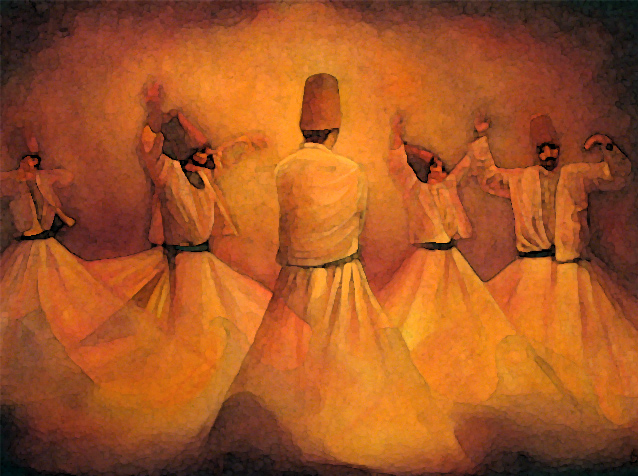
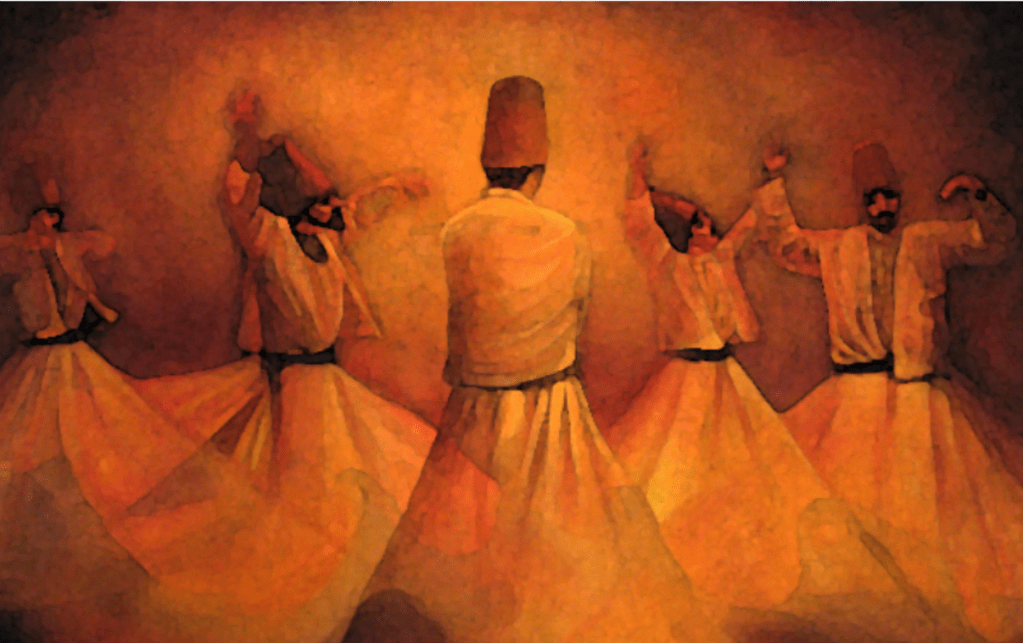
The relationship between Sufism and political power was deeply shaped by cultural practices, mystic traditions, doctrinal beliefs, and institutional developments, leading to a complex interplay of influence and resistance. Early Sufis often embraced an ascetic lifestyle, distancing themselves from political authorities and worldly concerns, focusing instead on inner purification and divine love. It is crucial to note that the development of fundamental doctrines of Sufism stretched over centuries, with the earliest articulated in the 8th C.E. The doctrine in the initial phases of sufism was characterized by simplicity without theorizing Sufi practices. Their spiritual practices, such as dhikr (remembrance of God through rhythmic chanting or breath control), sama (spiritual music and dance, particularly among the Chishti and Mevlevi orders), and khalwa (spiritual retreat and meditation), were central to their mystical journey and played a crucial role in shaping their relationship with society and the state. These practices not only distinguished them from the more rigid religious orthodoxy of the ulama but also created a distinct cultural identity that often placed them at odds with political and religious elites. However, the following centuries (8th and 9th C.E.) witnessed doctrinal growth wherein Sufi practices were theorized.
As Sufism institutionalized through the formation of silsilahs (spiritual lineages) and khanqahs (Sufi lodges), its interaction with rulers became more structured. Some Sufis, like Hasan al-Basri and Ibrahim ibn Adham, rejected state patronage and openly criticized rulers. However, others, such as Shaykh Shihab al-Din al-Suhrawardi, engaged with political authorities, influencing governance and religious policies. This engagement often resulted in the state incorporating Sufi institutions into its power structures, offering land grants (waqf) and appointing Sufi masters as mediators between the populace and the ruling elite. In return, rulers sought Sufi endorsement to strengthen their legitimacy, portraying themselves as spiritual protectors of Islam. Many rulers even adopted elements of Sufi mysticism, participating in dhikr sessions or claiming divine sanction through association with revered Sufi masters.
Doctrinally, Sufism’s emphasis on fana (annihilation of the self in God) and baqa (subsistence in divine presence) clashed with the legalistic approach of the ulama, who viewed religious authority as grounded in Sharia. Some Sufis, like al-Hallaj, were executed for their mystical expressions that were deemed heretical—his proclamation of “Ana al-Haqq” (I am the Truth) being seen as a claim to divinity rather than an expression of divine unity. This reflected the power struggle between esoteric spirituality and exoteric religious law. However, Sufis also played a role in cultural indoctrination, embedding their teachings within local traditions through storytelling, rituals, and communal gatherings. Their emphasis on divine love, self-purification, and service to humanity fostered a religious culture that appealed to both the elite and commoners, bridging gaps between different social classes. Sufi poetry, particularly through figures like Rumi, Attar, and Ibn Arabi, used metaphor and allegory to convey mystical truths while subtly critiquing oppressive rulers and rigid orthodoxy.
Over time, as Sufi orders gained prominence, they shaped not only religious beliefs but also political ideologies. Some Sufi masters functioned as kingmakers, offering spiritual legitimacy to rulers, while others withdrew into opposition, using poetry and symbolism to critique oppression. The institutionalization of Sufism under dynasties like the Seljuks, Mamluks, and later the Ottomans regulated both religious mysticism and state control, often resulting in state interference in Sufi affairs. Sufism remained a parallel source of authority, often challenging state power when rulers strayed from justice.
Ultimately, the relationship between Sufism and political authority was a dynamic exchange of mysticism and power. Sufi practices provided a spiritual counterbalance to the materialistic ambitions of rulers, while the state, in turn, sought to control or absorb Sufi influence. The mystic ideals of divine justice and inner enlightenment became both a tool for spiritual transformation and a subtle means of political resistance, shaping the broader cultural, doctrinal, and institutional fabric of Islamic societies.
Conclusion
To conclude, Sufism’s evolution reflects its intricate balance with morality, spirituality, and political power. While it began as an ascetic movement focused on inner purification, its institutionalisation through silsilahs and khanqahs led to deeper interactions with the state. While some Sufi orders remained distant from political authorities, others engaged with rulers, shaping governance and religious policies. The tension between Sufi mysticism and legalistic Islam often led to conflicts, yet Sufism remained influential through cultural practices such as dhikr, sama, and poetry. Despite state attempts to regulate or co-opt Sufism, it persisted as both a legitimizing force for rulers and a challenge to centralized authority. Ultimately, Sufism’s adaptability and resilience allowed it to endure as a parallel source of religious and moral authority, shaping societies beyond political structures.
About the Author
Aditi Lazarus is a second year B.A. Diplomacy and Foreign Policy student at O. P. Jindal Global University. She has a strong affinity for researching art, literature, politics and economics.
Image Source : https://sabrangindia.in/sites/default/files/sufism-iran-traveling-center.jpg?337
 NICKELED AND DIMED