
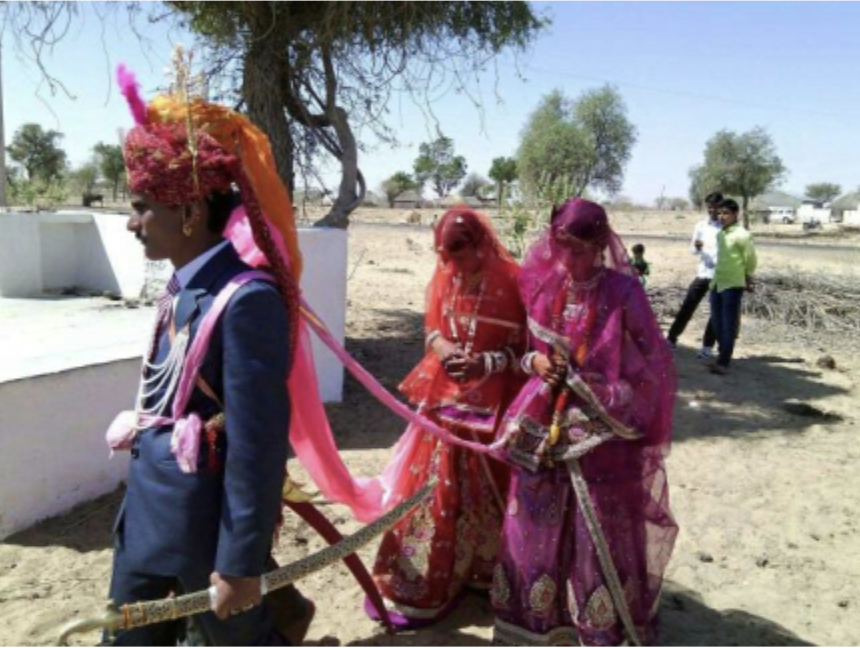
By : Gauri Yadav
Abstract
Despite outlawing bigamy in India, loopholes in the law have impeded the inheritance rights of second wives. While the prohibition of bigamy was ostensibly enacted to protect women, its implementation has reinforced the further subjugation of second wives. This article contends that the current legal framework, which prioritises monogamy as a means of upholding Brahmanical and patriarchal moral norms, reinforces structural gender inequalities.
Introduction
Legal theory has long debated the relationship between law and society. Kelsen’s ‘pure’ theory of law posits, legal norms as self-contained and devoid of societal norms. However, scholars such as Catherine MacKinnon and Foucault argue that law is an instrument of social control manipulated by existing power structures. Nowhere is this clearer than in marriage laws, which reflect and reinforce prevailing patriarchal norms. The introduction of the Hindu Marriage Act, 1955 (HMA), was a focal moment in India’s legal history. It aimed to shift Hindu marriage practices toward monogamy to allegedly protect women from the vulnerabilities of polygamy. However, the law has paradoxically corroborated the systemic marginalisation of second wives. The societal expectation that women remain in legally “valid marriages” to access legal protections creates a stark dichotomy: while first wives are granted certain legal safeguards, second wives are often rendered legally invisible, magnifying their economic and social vulnerability.
Pre-1955 Legal Context: Gendered Nature of Polygamy
Historically, polygamy in Hindu society served as a status symbol, allowing affluent men to establish political alliances and expand their lineage. The Upanishads, Puranas, and epics such as the Ramayana and Mahabharata depict polygamy as a male privilege, reinforcing a gendered hierarchy where women had limited agency in marital decisions. However, the honor of chastity was the sole duty of the woman to uphold.
Throughout human history, the evolution of mating and marriage institutions has been influenced by economic factors, leading affluent men to pursue polygamous marriages for reproductive success. This inclination towards polygamy gradually became a dominant societal norm, for a significant period. Prior to legal interventions such as Section 494 of the Indian Penal Code, 1860, and Section 17 of the Hindu Marriage Act (HMA), 1955, only Hindu men had the right to marry multiple wives, each with equal legal status. Consequently, even second wives were entitled to an equal share of property, maintenance, and the option of divorce.
Although legally bigamy was permitted, the Brahmanical ritual of Saptapadi, elemental to Hindu unions advocated monogamy. Implicit in these vows is the commitment to monogamy, as the husband pledges to regard all other women as family members be it as sisters, daughters, or mothers henceforth. However, patriarchal societies over time restricted these obligations and vows of a monogamous relationship, predominantly to women. While women were expected to uphold marital fidelity, men retained the freedom to take additional wives. Hence, under polygamy, “markets for wives are sellers’ markets, where men can participate multiple times but women can only do so once at a time.” This glaring double standard perpetuates women’s subordination within marital unions, fostering structural inequalities and eroding the sanctity of monogamous relationships. Contrary to any benefits, it detrimentally impacts their economic, social, and emotional well-being.
The Bigamy Ban and Its Feminist Critique
In response to gender disparities and the complexities surrounding inheritance and divorce litigation involving one man and multiple wives, the HMA, 1955, was enacted. This landmark legislation unequivocally abolished and criminalized Hindu polygamy. Section 5(1) prohibits bigamy, Section 11 declares bigamous marriages void, and Section 17 renders it punishable under IPC Sections 494 and 495(Section 70 and 80 BNS). While this reform was heralded as a victory for women’s rights, in effect, it largely served to uphold dominant patriarchal interests. Despite efforts to promote gender equality within marriage, the actual outcomes frequently fall short, resulting in the unintended erosion of women’s rights.
The state’s preference for monogamy did not arise from concern for women but from a need to consolidate legal uniformity under Brahmanical norms. The ban effectively erased second wives from legal discourse, depriving them of financial security, inheritance, and social legitimacy. Instead of granting second wives legal protection, the system rendered them invisible, placing them in a precarious position where they are neither wives nor legally recognized individuals.
Aftermath of the Ban of Bigamy
1. Exploiting Legal Variance: A significant loophole exploited by Hindu men stems from the divergent legal frameworks governing Hindu and Muslim marriages in India. While Hindu law staunchly prohibits bigamy, Islamic law permits Muslim men up to four wives concurrently. Consequently, some Hindu men convert to Islam to bypass bigamy provisions, ensuring the legitimacy of subsequent unions under Islamic law. The Supreme Court in Sarla Mudgal v. Union of India and Lily Thomas v. Union of India, established that such conversions do not dissolve prior marriages. However, these judgments failed to account for the plight of second wives, who entered marriages under fraudulent pretenses and were subsequently denied legal recourse. In striving to protect the integrity of the first marriage, the legal system has disparaged the rights of the second wife, leaving her without legal recourse against a deceiving husband. Both the landmark judgments conspicuously overlooked the plight of the second wife. The courts neglected to acknowledge that they also established a precedent for second wives who unwittingly enter into marriages with men already bound by subsisting unions.
2. Requirements of a Hindu ‘Valid’ Marriage: Second marriages often disadvantage second wives due to legal biases favouring the invalidation of unions, typically benefiting husbands. Courts have reinforced patriarchal and casteist interpretations of Hindu marriage by emphasising rituals such as Saptapadi and Homa as essential for validity. This disproportionately disadvantages second wives, who often lack formal ceremonies. Bhaurao Shankar Lokhande v. State of Maharashtra set the precedent that ‘marriage’ under IPC Section 494 requires full adherence to “Hindu” rituals, effectively invalidating second marriages where such rites were absent. Second wives bear the burden of proof, particularly in cases lacking marriage registration, allowing husbands to exploit this gap by challenging the second marriage’s validity. Even if registration were mandated, administrative obstacles remain. Additionally, first wives are reluctant to contest second marriages, fearing repercussions on their own unions.
Further, the decision in Bhaurao Shanker reflects a judicial imposition of a Brahmanical conception of marriage as the singularly valid form within Hinduism. The court implicitly positioned Brahmanical rituals, specifically Saptapadi and Homa, as the universal standard for Hindu marriages. This narrow interpretation disregarded the diverse matrimonial customs practiced by various Hindu communities and castes, many of which follow distinct rituals rooted in their own traditions and theological understandings. By privileging one ritual over others, the court not only excluded non-Brahmanical practices from legal recognition but also reinforced a hierarchical and homogenised vision of Hindu marriage, effectively erasing the pluralism inherent in Hindu jurisprudence.
Similarly, in Kanwal Ram v. Himachal Pradesh Administration, the burden of proving a ‘valid’ marriage was placed on the wife, further entrenching gendered legal biases. Women who lack evidence of rituals are denied recognition, leaving them ineligible for maintenance, property rights, or legal remedies. This rigid adherence to Brahmanical norms disproportionately impacts lower-caste and rural women, who may follow different customs that courts refuse to acknowledge.
Courts have erroneously upheld Brahminical customs as the norm, overlooking the diversity within Hindu traditions, advantageous to bigamous men. Recent cases demonstrate courts’ insistence on exhaustive evidence of marriage, requiring strict adherence to all customary and scriptural rites by both parties. Should the first marriage be deemed void, the second would not constitute bigamy, and conversely, if the second marriage were invalid, the first would remain valid.
3. The Burden of Proof and the Legal Silencing of Women: Section 7 of HMA delineates the marriage ceremonies that officially give a marriage the status of a legal union, but it also carves out the exception of custom. The expectation that women must prove marriage validity, rather than men proving its illegitimacy, reflects the patriarchal bias embedded in legal proceedings. In Lingari Obulamma v. L. Venkata Reddy, the Supreme Court placed the onus on the wife to prove the legitimacy of her marriage. This effectively shifts the burden from the state to women, reinforcing a structure where men can deny responsibility without consequence. The legal journey for second wives hinges on establishing the validity of their marriage, providing any overriding customs, and providing sufficient evidence before seeking remedies. By placing the mantle of evidence on an already disadvantaged party, approaching the Court for redressal, our legal system proudly showcases their patriarchal “customs”.
Conclusion
Second wives in India exist at the crossroads of legal neglect and social ostracization. The societal excommunication endured by second wives, compounded by legal intricacies, renders them vulnerable and neglected. Historically, they have grappled with profound betrayal and suffered immensely without legal recourse. Legislators must prioritize addressing their rights and implementing concrete measures to combat bigamy in India. Instead of fixating solely on marriage validity, the legislative focus should shift toward ensuring justice for women.
Efforts to safeguard women through legislation often disadvantage them, irrespective of the type of marriage. Under Hindu law, men can engage in polygamy until the performance of Saptapadi or homa rituals, granting them an unfair advantage. Meanwhile, both wives face significant risks: the first jeopardizes marriage validity, while the second forfeits rights, including maintenance. This legal framework exacerbates the challenges faced by Hindu women, prompting a critical examination of legal consistency.
Despite provisions like Sections 17 of the Hindu Marriage Act and 494 of the Indian Penal Code, which aim to empower and protect women, legal loopholes allow for circumvention to the detriment of both wives. Overemphasis on evidence and “valid solemnization” biases the legal system in favor of husbands, further disadvantaging wives. Moreover, the acknowledgment by the Supreme Court in 2005 that many Hindu marriages persist as bigamous underscores the ineffectiveness of the bigamy ban, exacerbating the situation for women, particularly second wives. In India, many women prioritize familial roles over education and career opportunities, leaving them vulnerable when marriages are nullified due to legal loopholes. This exacerbates their economic vulnerability, depriving them of financial support and legal recourse, amplifying their challenges and uncertainty.
A glimmer of hope emerges with recent judgments like Smt. N. Usha Rani and Anr. v. Moodudula Srinivas, where the Supreme Court recognized that denying maintenance to Usha Rani would undermine the very purpose of Section 125 Cr.P.C. The Court underscored the necessity of interpreting “wife” broadly, extending its protection to women in void marriages, particularly when the second husband was aware of the subsisting first marriage. However, the general dominant law still subjugates the rights of the second wife. It is high time that our legal system serves all women, not just those who fit within its narrow definitions of legitimacy.
Author’s Bio
Gauri Yadav is a third-year BA LLB Honours student at Jindal Global Law School. She is passionate and keen on the subjects of Jurisprudence, Gender Studies, Sociology and Constitutional Law.
Image Source : https://vedkabhed.com/index.php/2018/05/05/polygamy-in-hindu-dharma/
 NICKELED AND DIMED