
By Prof. Tridivesh Singh Maini
Introduction
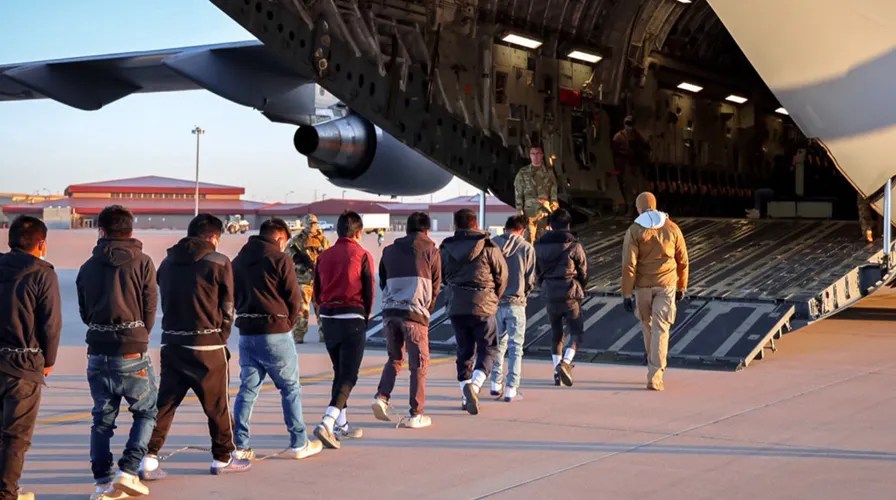
On February 5, 2025 a US C17 military aircraft with 104 Indian nationals, who were illegal immigrants, landed in Amritsar. Amongst the deportees were 19 women and 13 minors. It is likely that 487 Indian nationals are to be deported from the US soon. India’s Foreign Secretary, Vikram Misri in a press conference, on February 7, 2025 said, “We’ve been told there are 487 presumed Indian citizens with final removal orders”.
While media attention is invariably focused on illegal immigration from Punjab, the number of deportees who hailed from Gujarat and Haryana were 33 each and 30 of the deportees were from Punjab. Three of the deportees were from Maharashtra, three from Uttar Pradesh (UP) and two from Chandigarh.
Push factors overshadow the pull factors
It is interesting to note, that deportees are from states – Gujarat, Punjab and Haryana – which are considered economically prosperous.
Today, the exodus of large numbers of Indian youth from several states, not just a handful which get coverage, is not driven by better opportunities overseas. Many developed nations themselves are facing economic challenges, but the perceived lack of economic opportunities back home – along with other daily challenges – are compelling the youth from Indian states to take the risk of migrating via illegal routes. It is thus, clearly the push factors, and no longer the pull factors, which are compelling several young Indians to move overseas. A strong reiteration of this point is that even individuals who are from reasonably privileged backgrounds are keen not just to move out – but even use illegal means if necessary to move overseas. While doing so, they put their own lives at risk and stake not only their personal earnings, but the hard-earned financial assets of their parents
In the aforementioned scenario even inhuman treatment was meted out to these individuals wherein, all the deportees were handcuffed during the flight. Apart from this, the fact that the deportees were sent by a military plane has drawn scathing criticism from several opposition leaders.
This has drawn significant attention. External Affairs Minister, S. Jaishankar said, “..(there’s) no change from past procedures for the flight undertaken by the US on February 5, 2025.” Foreign Secretary, Vikram Misri during his press conference said that “valid concerns” were being raised regarding the treatment meted out to the deportees.
Political reactions on the issue
Shashi Tharoor- former minister, senior Congress leader and MP from Thiruvananthapuram made important points. While the US was within its right to deport illegal immigrants they (i.e. the immigrants) could have been sent by a commercial plane, said Tharoor.
“We are protesting the way in which this was done. They have every legal right to deport people who are illegally in their country and we, if they are proven to be Indians, have an obligation to receive them … But to send them like this abruptly…”
Senior Congress leader and MP from Chandigarh, Manish Tewari even suggested that PM Modi should cancel his visit to the US as a mark of protest against the treatment meted out to the deportees (PM Modi is to travel to the US from February 12, 2025- February 14, 2025 to meet with US President Donald Trump).
Said Tiwari:”One can search the public records, but I don’t recall a single case where Indians were handcuffed, shackled, denied basic human rights, boarded onto a military plane, and dumped in India after 40 hours”
India’s External Affairs Minister, S Jaishankar while speaking in the Parliament, on the issue, made some important points. “It is in our collective interest to encourage legal mobility and discourage illegal movement..”, said Jaishankar. He also said that the government is engaging with the US to ensure that deportees are not “mistreated”.
Given the US President Donald Trump’s firm stance on illegal immigration, the deportation of illegal immigrants is likely to continue. In fact, in the near future other western countries could also take a leaf out of Trump’s book and take a strong stance vis-à-vis illegal immigration.
It would be pertinent to point out here that Colombian President, Gustavo Petro had stopped a US military aircraft with Colombian illegal migrants from landing, as a mark of protest against the handcuffing of the deportees. Colombia then sent its air force planes to bring back the Colombian nationals.
It is important to find short term and long-term solutions for India’s central and state governments to the problem of illegal immigration. The short-term solution is to ensure that those being deported are treated with dignity and are also provided with support and hand holding once they return. It is also important to bear in mind that migration is a reality and efforts should be made to ensure that youngsters are not duped by travel agents and they do not use illegal means to migrate.
The Government of India is contemplating what has been tentatively called the Overseas Mobility (Facilitation and Welfare) Bill, 2024. This legislation seeks to facilitate “safe, orderly, and regular migration for overseas employment”.
Apart from this, it is important for all individuals to also explore possible opportunities in Non-Western countries which need skilled labour as well as professionals.
Conclusion
As discussed earlier, there is no escape from creating economic opportunities and an ecosystem which can channelise and harness the talent and skills of the youth. It is also important to bear in mind that illegal immigration is not restricted to a few states – though some states get more attention – state and central governments need to work together in the spirit of cooperative federalism and come up with solutions – long term and short term as flagged earlier. In conclusion, hopefully the debate about illegal immigration will not end in a few stories in the print media or fiery discussions on social media.
About the Author:
Prof. Tridivesh Singh Maini is an Assistant Professor at the Jindal School of International Affairs. He was also a Public Policy Scholar with The Hindu Centre for Politics and Public Policy and Asia Society India-Pakistan Regional Young Leaders Initiative. He was also a former South Asian Voices (SAV) Visiting Fellow (Winter 2016) with the Stimson Centre, Washington DC.
Image Source: Migrants | The National
 NICKELED AND DIMED