By Rufaid Imtiaz
Abstract:
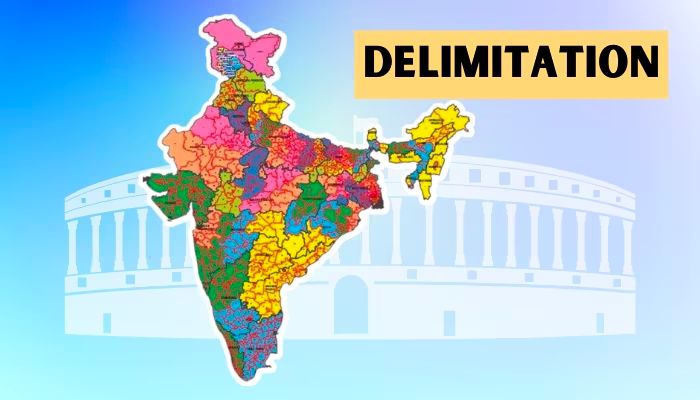
As a population control measure, the delimitation of seats was frozen with the 1971 census. The past couple of decades have shown a standoffish result with an uneven explosion of population around the country. Demands for delimitation have risen within the previous few years. However, the 84th Amendment has already extended it to 2026, and in the normal course of events, it will only be possible with the 2031 census (the 2021 census being postponed). Nonetheless, the horizons of delimitation have been under scrutiny, considering its pluses and minuses.
In this article, we will analyze the viability of delimitation in India. We will closely explore its application in such a ‘diverse’ and ‘asymmetric’ federal nation (India). From the historical structure of the nation to a paradigm shift in the later years, we will try to take a holistic approach throughout this article.
Introduction:
The principle of ‘one person one vote’ is fundamentally rooted in people’s assurance of electoral democracy. Every individual in an electoral civic maintains the right to designate their representative. The constitutional framework with its bolstering Article 14 supplements such individual rights by carving equality and equal treatment of law, isolated from their background.
Nonetheless, in electoral democracies like India, there remains the question of whether such individual rights need to be exercised absolutely or can be restrained desirably. The majority of constitutional writers believe a holistic approach toward electoral representation would work far better than an isolated cocoon of individual rights. We have already invoked the Constitution by bringing in Article 14, complementing the argument on individual rights. In this paper, we will move with the perspective that questions the need for representation in India with its questionable federal structure.
- Is India’s Federal Structure purely absolute?
While discussing the populous proportionate where representation whether individual or collective, takes the key hold. Such representation gets a stronger bed from the federal structure of state affairs. The advocates of delimitation, who often claim equal representation go with the inbuilt argument of India’s federalism. Similar arguments can be seen in the paper “India’s Emerging Crisis of Representation”, the authors in the paper have cautiously yet conjectured the federal structure of the state while countenancing for delimitation. Before we move forward with the argument, it is rather important to establish the form of federalism that India aligns with. In the terms of Rekha Saxena, who in her paper coins India as an asymmetric federal state not just de jure but also de facto. She furthers her claim by stating that such imbalances vary on an individual level by the constitutional individual rights on an equitable level.
The significance of the representation of the marginalized group cannot be swayed away as it assists with striking a balance between the groups. These communities can be marginalized on cultural, religious, ethnic, or/or geographical. Several approaches have been taken forward by states with such representational problems including India. Such a position can be witnessed in the Constitution itself. Schedules 5 and 6 of the Indian Constitution provide exceptions for tribal groups and even certain states. Through such an approach, a more holistic outcome is desired where community representation takes the place of individual representation, countering the underrepresentation with a more proportional onset. Will delimitation be able to make an exception in such cases? We will move further considering the cost of delimitation.
- The Divide: India’s South and North:
Yogendra Yadav categorically highlights the disparity between India’s South and North in his paper, “the widening gap between India’s North and South.” In the paper, the author has emphasized the limitations of delimitation. The projected studies undertaken have showcased that the worst sufferers of such a policy implementation would majorly be the Southern states of India such as Kerala and Tamil Nadu, leaving more for the Hindi heartland states like Bihar, Madhya Pradesh, and Uttar Pradesh. Yogendra Yadav has further stated the adverse effect of delimitation on regional parties. In a study forwarded in the paper, it was highlighted that if such delimitation had taken place before 2014, NDA would have gained around a couple of dozen seats at the cost of regional parties. Needless to say, regional parties hold a significant role in guarding the federal fabric of a state.
- The Caste Ghettoization: An Indirect Suppression:
Furthering the question on the viability of delimitation, another barrier to encounter is the reserved seats for backward classes, that get targeted next. It is factually relevant to highlight that several states are not largely populated in general but, hold comparatively a larger population of backward classes. If such a delimitation is imposed, they would be left without a remedy for underrepresentation. Moreover, historical facts showcase that candidates from the SC/ST community have rarely been fielded from unreserved seats. If we leave away except for a few political laureates like B.P. Maura and Kanshiram, people from such communities have been mostly unsuccessful in unreserved seats. Analyzing such a pattern, it can be presumed how detrimental delimitation would be for such classes.
- Is the Bicameral Solution efficient enough?
To expound on this model, we will consider bicameral legislation, such as the United States and Australia. Within this model, seats are bifurcated into two groups, one where the allocation is done purely based on population, on the other hand, concerning the other group it is based on different grounds (including languages, geography, and other relevant considerations). Advocates of such a model claim it to be a vigorous representational system. Concerning the Indian legislative system, similar arguments are forwarded for application, where delimitation should be based on a population basis, the bifurcation being placed between Lok Sabha on a population basis and other grounds being considered for Rajya Sabha. In counting terms, it sounds rewarding, however, whether such a representation will do better is questionable.
Iterating the factual composition of the Rajya Sabha where members are indirectly elected to represent states, even if they do not belong to that it. Additionally, the overpowering issue lies with the authoritarian composition of the houses. The houses run with an inbuilt hierarchy where Lok Sabha takes a lead in significant matters that include, money bills or opinion crises among the houses. Henceforth, presuming a detrimental effect of such a model would not be baseless. Eventually, if we decide to have its application, it will lead to the dominance of population-based distribution (Lok Sabha) over other factors (Rajya Sabha).
Conclusion: The Plausible resolution:
Solely disregarding population as a criterion for representation would indeed be detrimental to an electoral democracy like India, after all, Lok Sabha registers people’s voices that should not be subjected to suppression. However, not accounting for other factors while delimiting would also lead us to inefficient proportionate representation. As highlighted above, there are multiple other factors that we need to include in the model to make it more representative-responsive. Pondering upon the bicameral solution should not be done away with. Even though the allocation of seats on a pure population basis may not serve the purpose, however, empowering the Rajya Sabha and making it more equitable, and on a similar footing when compared to the Lok Sabha. In an asymmetric federalism as of India, the asymmetric representation would be best suited to consider.
Author’s Bio:
Rufaid Imtiaz is a fifth-year law student at O.P. Jindal Global University. He has a keen interest in law and its intersection with other subjects including religion, history, and political science. He enjoys writing on law and politically lineated issues.
Image Source: https://primelegal.in/wp-content/uploads/2024/02/WhatsApp-Image-2024-02-20-at-21.42.11.jpeg
 NICKELED AND DIMED