
By Aditi Lazarus
Abstract:
This article examines Satyajit Ray’s Shatranj Ke Khilari (1977), using the game of chess as a motif for political and cultural power struggles during British colonialism in India. Through the portrayal of characters like Wajid Ali Shah and the apathetic Mirza and Mir, the film critiques the Indian elite’s detachment from political resistance. Ray intertwines colonial dynamics with the game’s strategic moves, illustrating the gradual erosion of Awadh’s sovereignty and the passive complicity of its aristocracy.
Introduction:
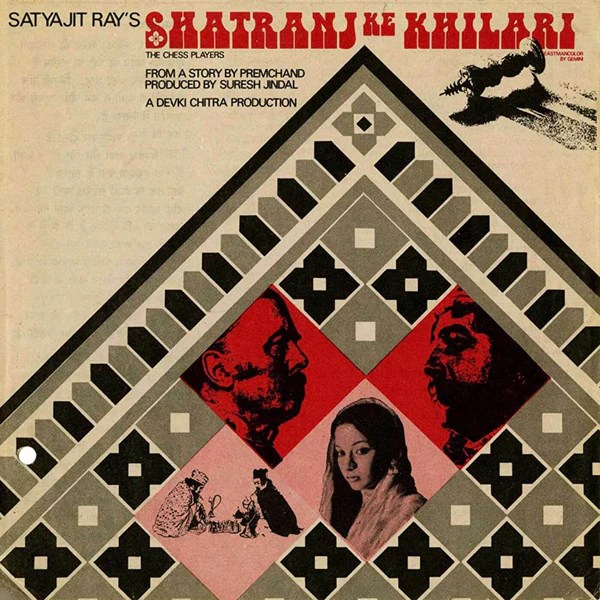
‘White moves first. And the board is left to its schemes, where pawns march and the kings retreat.’ Such are the grand machinations of the chess game. The origins of chess trace back to ancient India, where the precursor game Chaturanga developed during the Gupta Empire in the 6th century. Its component pieces were representations of the chariots, the cavalry, the elephants, and the infantry, reflecting the four limbs of an Indian army. The game eventually spread to Persia, China and the rest of Europe, where it acquired cultural adaptations in its rules and other terminology, which became standardized by the British over time. Satyajit Ray’s understanding of this cultural evolution and its intersection with British colonialism in India is critically represented in his movie, Shatranj Ke Khilari (1977). Originally adapted from Premchand’s book, Shatranj Ke Khilari, published in 1923, Ray’s interpretation not only brings to life the visual history of the British annexation of Awadh in 1856 but also situates the power struggle between the Indian elites and colonial powers as a series of calculated moves and countermoves, mirroring the maneuverings on the chessboard.
Setting the mise-en-scene: The Awadh Crisis
Awadh was situated over the north bank of the Ganges River, possessing 24000 square miles of fertile soil along with an approximate population of 10,000,000, making it one of the most prosperous provinces in north India. It was strategically positioned between the East India Company’s expanding presence along the Ganges from Calcutta and the Mughal capital at Delhi. The ruler of the region served as the Nawab-Wazir or as the Chief minister to the Mughal Emperor. However, following the Nawab’s military defeat to the Company in 1764, he also became the Company’s chief ally in north India.
In 1815, the newly appointed General Hastings began devising schemes to curtail the British support given to the Mughal Empire and to encourage regional rulers to abrogate their bonds to the emperor. Hasting’s fixation on Awadh stemmed not only from the Nawab’s agreement to his plan but also from Awadh’s prominence, its complete military dependence on the Company, and its territorial isolation from the Mughal Empire (surrounded on three sides by Company controlled territories). As a consequence, the Awadh coronation of 1819 marked the provincial governor of Awadh being crowned as its monarch, shifting the dynamics of power and governance in the region.
Satyajit Ray’s character, Wajid Ali Shah, holds graceful prominence in the background of the movie as the Awadh king who ascended the throne in 1847. Renowned as the last king of Awadh, Wajid Ali Shah’s rule presided under a Dual Government, where the British Resident at Lucknow interfered in all affairs of the state – court appointments, judicial decisions, and executive matters that suited British interests. The conflict between the King and the British intensified when Hastings opposed key ministerial appointments, such as Ali Naqi Khan in 1847, and rejected Bazur al Rahim’s ambassadorship to Calcutta, violating the Treaty of 1837. Eventually, Colonel Outram got appointed as the British Resident, and as the solemn antagonist in Ray’s movie, who portrayed the most gloomy picture of the state’s administration to the government of India in 1855. By January 30, 1856, he finalized plans to strip King Wajid Ali Shah of all powers under the pretext of misrule and proposed a treaty that annulled previous agreements (such as of the Treaty of 1801) vesting Awadh’s administration solely in the British. Outram, later, secretly mobilized troops to Lucknow and prepared British officers for the takeover, and offered the King limited concessions – a pension, a nominal title, and restricted judicial powers, leaving no room for resistance to the Company’s authority. This sequence of events forms the historical climax of Ray’s narrative, where the colonial chessboard mirrors the calculated moves and countermoves of power and resistance.
Mir and Mirza: Indulgent or Apathetic?
Ray’s film showcases the two main characters, Mirza Sajjad Ali and Mir Roshan Ali—jagirdars or landed gentry—in the foreground of the movie. The pair is showcased to spend all their time in the leisurely pursuit of playing chess. They are flat characters with an arc that revolves around their all-consuming obsession with the game. In one scene, the city’s munshi visits to inform them about rumors of the British annexation of Awadh. However, the pair feigns boredom and disinterest. To capture their attention, the munshi steers the conversation toward the British rules of chess, such as the pawn’s ability to take two steps at first and its capability of becoming the queen or wazir. The pair immediately ridicule these rules and launch into a tirade against the British qualities they detest, such as their obsession with “speed,” “desire for wealth,” and “efficiency.” Mir, in a moment of bravado, brags about using his ancient ‘cutlass’, an ancestral heirloom, to fight the British if necessary. Although, his clumsy handling of weapons—demonstrated by his awkward wielding of the cutlass and his inept firing in the film’s climax when he is labeled a cuckold—ironically underscores his incapability to measure up to his ancestors’ valor or to even be a useful soldier.
Another instance of emasculation occurs when Mirza’s wife, Khurshid, summons him to her room under the guise of a migraine. Attempting to seduce him, she criticizes his obsession with chess when he fails to respond to her desires. Mirza, instead of addressing her frustration, defends the game by claiming it has increased his power of thinking a hundredfold. However, he soon returns to his friend, and the pair resume their game. Through these interactions, Ray juxtaposes Mir and Mirza’s neglect of domestic affairs with the broader socio-political climate of Awadh, which is on the brink of annexation. Their indifference to their wives and the looming British threat symbolizes a deeper apathy, which can be interpreted as a willful submission to British tactics, masked as socio-political inertia.
In the film’s climax, as British troops close in, Mir and Mirza retreat to an old mosque in a village to continue their game undisturbed. Their quarrel escalates into a fight, prompting the realization that their inability to manage their domestic lives renders them equally incapable of defending Awadh. However, as the British annex Awadh, the pair are once again seen playing chess, this time with British rules. Although they may not be direct accomplices to the political upheaval, their ineptitude and self-absorption serve as an advantage to the British cause. Mir and Mirza’s symbolic embrace of British chess rules naturalizes colonial dominance, reflecting the futility of their own strategies when juxtaposed against the calculated, methodical tactics of the British. Their actions metaphorically demonstrate the impotence of their resistance and their gradual assimilation into the new colonial order.
Wajid Ali Shah: The Defeated King
The character of Wajid Ali Shah beautifully and anguishedly portrays how a king gets checkmated in real life. His interests mainly revolved around the appreciation of the arts—poetry, dance, and music. In the start, Wajid Ali Shah is often seen playing the flute, enjoying lavish dance performances, and reciting poetry even during crucial moments like a court trial. To Colonel Outram, this behavior becomes a subject of ridicule, filtered through an orientalist mindset. Outram emasculates Wajid’s, mocking his interests and deeming him unfit to rule Awadh. This calculated narrative aligns with colonial agenda to delegitimize his rule, portraying him as decadent and incapable of governance. Yet, these facets of Wajid’s personality transcend mere kingship. His poetry, music, and patronage of the arts are embraced by his courtiers, ministers, and the ordinary citizens of Awadh. In one pivotal scene, Wajid recites a poem during a court trial, an act devoid of any practical connection to the proceedings. This moment represents an unspoken appeal for recognition, first as a poet and then as a ruler. This symbolic act underscores his unique identity, one that fuses artistic expression with kingship.
The climax intensifies as Wajid learns from his weeping Prime Minister, Ali Naqui, that British Resident General Outram is arriving to demand his peaceful surrender. Despite the emotional gravity, Wajid reprimands Ali Naqui for displaying “unmanly” tears in public, asserting that only poetry and music should evoke such emotions. His response highlights his unwavering belief in the cultural and artistic legitimacy of his reign, even in the face of imminent defeat. Wajid eloquently challenges Outram’s accusations of unfitness by asserting, “If the British think I am unfit to rule, can they produce a single English monarch who composes poetry and music of a high order?” He further declares, “The common people sing my songs, and they love my poetry because of its candor.”
This multifaceted portrayal intrigues Outram, who, through a colonial lens, deconstructs Wajid as irrational, effeminate, and unmanly. Outram represents the ‘primary discourse’ of denunciation, framing Wajid as unfit through a framework of British administrative policy. By contrast, Captain Weston—more attuned to Awadh’s culture—offers a ‘secondary discourse’ of resistance, appreciating Wajid’s artistic accomplishments and defending his unique kingship. This interplay mirrors a chess game, with each character’s moves and countermoves reflecting their position within the colonial power dynamics. In the end, Wajid’s defeat becomes inevitable under the secretive maneuvers of the British. His kingdom’s annexation serves as the final checkmate, a stark reminder of the imbalance of power and the colonial tactic of dismantling indigenous sovereignty. In this context, Wajid Ali Shah’s loss in the end is not just a personal tragedy but also a symbol of the larger colonial conquest, where art, culture, and individuality are sacrificed to ruthless acquisition in the pursuit of imperial dominance.
Conclusion:
In conclusion, Shatranj Ke Khilari tactfully uses chess as both a literal and symbolic motif to represent the broader political and cultural dynamics of colonial India. The game of chess is not just a pastime for the characters but an intricate metaphor for power struggles, manipulation, and resistance. For Wajid Ali Shah, chess reflects his intellectual and artistic pursuits, however his failure to engage in the more practical affairs of governance mirrors the erosion of his kingdom. Mirza and Mir, obsessed with the game, represent the complacency and detachment of the Indian elite in the face of colonial encroachment. Their disregard for the looming British annexation is symbolized by their continuous play, even as the country around them falls into turmoil. The strategic moves on the chessboard parallel the calculated maneuvers of the British, who checkmate the sovereignty of Awadh. Chess, in Ray’s film, becomes a profound metaphor for the cultural and political chess game of colonialism, highlighting the futility of self-indulgence and the harsh reality of imperial conquest. Through this representation, Ray critiques both the colonial imposition and the passive resistance of the Indian elites.
About the Author: Aditi Lazarus is a second year B.A. Diplomacy and Foreign Policy student at O. P. Jindal Global University. She has a strong affinity for researching art, literature, politics and economics.
Image Source: (https://www.tallengestore.com/products/shatranj-ke-Khilari-satyajit-ray-movie-graphic-poster-art-prints)
 NICKELED AND DIMED