

By Aditi Lazarus
Abstract:
This article explores Satish Gujral’s powerful artistic response to the Partition of 1947, a traumatic event that profoundly shaped his work. Gujral’s Partition Series, created in the aftermath of this division, is a haunting visual narrative that captures the widespread human suffering and brutality of the time. Through insightful exploration of his paintings—such as “Mourning en Masse,” “Despair,” and “Days of Glory”—the article delves into how Gujral’s use of somber tones, distorted forms, and symbolic gestures conveys the deep anguish experienced by the refugees. The aim of this article is to discuss the evocative power of Gujral’s Partition Series as a testament to the horrors of partition.
Introduction:
The partition of 1947, a sanguine division en masse of India, left fissures that not only imprinted skin and mind but canvas too. The loss and the chaos experienced by the refugees were encapsulated deftly in the evocative body of work, ‘The Partition Series’, by Satish Gujral. He curated this series driven by the impetus of his own experience and rumination in post-partition Punjab, during the years of schism. This was Gujral’s first art debut, which was exhibited in Delhi in 1952 after he migrated to Delhi post-partition. The renowned deaf artist created more than 20 visceral paintings in the series, each with its own dimension of loss, human suffering and the partition experience.
The Artist:
Born pre-independence in 1925 in Jhelum, present-day Pakistan, Satish Gujral spent his childhood immersed in art and literature, due to his family’s rich cultural background. Due to a childhood swimming accident that rendered him with a hearing disability, Gujral found solace in drawing. Eventually, his passion further inspired him to study art formally. He initially studied art at the Mayo School in Lahore and then at the JJ School of Art in Bombay. He also joined the Progressive Artists Group which aspired to propagate modernism (modern art) in India. He later on came to be the renaissance man of India, through the recognition of his mastery in creating murals, paintings, texts, sculptures and architectural sites such as the Belgian Embassy in New Delhi. His engagement with art across mediums defined the intricacy of his expression, often inspired by the atmosphere around him.
Glimpsing Brutality:
Residing in Jhelum for a couple of years after the partition, Gujral witnessed the savage atrocities around him due to refugee skirmishes. As a young man of 25, Gujral worked as a volunteer helping refugees all the while attesting to the distress and agony of the victims. Moreover, his house in the village had become a refugee camp, due to the desolation of the whole village. Gujral’s house accommodated refugees to evacuate and rehabilitate those who wanted to move from Pakistan to India. As he witnessed sufferings of the victims up-close everyday, Gujral’s sensibility and sensitivity transformed forever.
Whilst in the larger political mise en scene of the post-partition period, migration of communal groups to West Punjab (Pakistan) and East Punjab (India) had been accelerated due to the increasing bloodshed everyday. The question of significance was to accommodate and rehabilitate a large number of refugees in the implementation of new borders. The containment of this violence through the enforcement of police forces and other rescue operations did not succeed in restraining the criticalities of the situation. Massive violence had led to the death toll of two to five hundred everyday, and recorded killings of more than a million Punjabis during the immediate post-partition period. This tragedy conclusively inspired Gujral to capture the theme of “…the brutality of man to man…” in his paintings later when he moved to Shimla.
MOURNING EN MASSE: AGONY OF WOMEN

One of the foreboding paintings of this series, which depicts anguish of the women, had been titled, ‘Mourning en masse’. The painting showcases grief-stricken women in enlarged shrouded figures that mourn the loss of their loved ones, and highlights the torment borne by them. The canvas also represents the aftermath of daily violence with incrementing death tolls in Punjab. Gujral captures this grief and agony of losing loved ones with a rustic palette with different shades of mahogany, umber and sable brown along with ochre. These earthy tones are mirrored in most of his other oil paintings in the series that represent the suffering of the victims and loss of human life. In the foreground of the portrait, the women are shown to cradle their shrouded heads along with their stomachs. This placement of the figures demonstrates their cry of agony along with sorrow crowding their postures. The hand of the woman at the front is seen to be on her lap, almost cradling the stomach but lying inert, representing the mourning of her children and loved ones, in addition to helplessness. The woman on the right is seen to be wiping her tears, sharing similar grief. Through the quivered mouths adorned with wrinkles on the women’s faces, Gujral further evokes pathos and anguish in the mind of the viewer. His experiences, of witnessing grief spread across the mass, are embedded in this painting.
THE DESPAIR: ANGUISH OF THE MAN
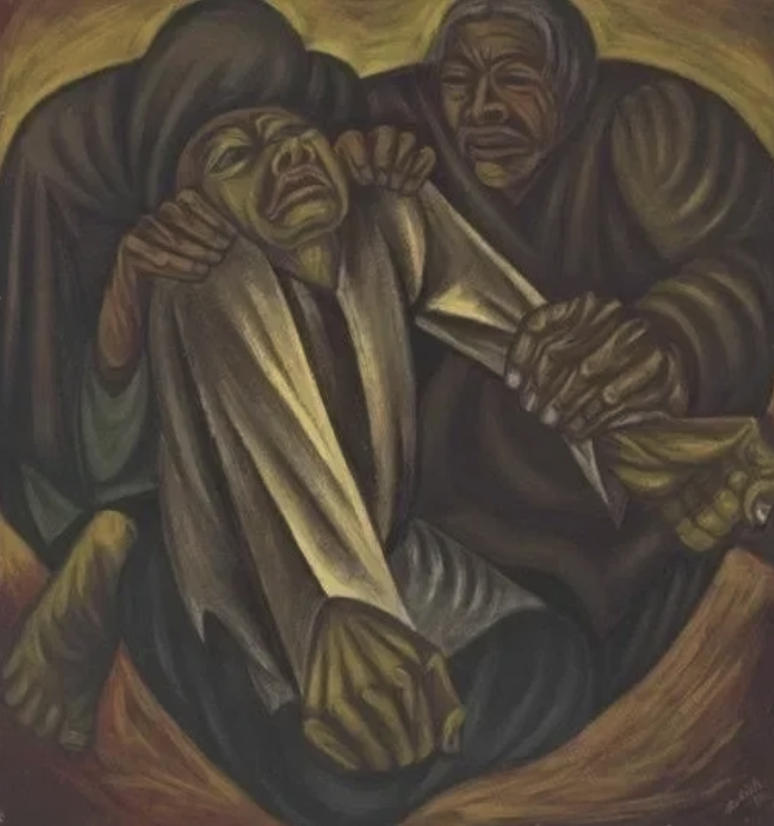
In another one of his paintings, titled ‘Despair’, Gujral again evokes the emotion of sorrow and misery amongst the lot by showcasing suffering, hopelessness and anguish. The painting depicts a young man, writhing in despair, gazing upward in agony with balled fists, while the other two men are holding him steady. The figures along with the background are again painted in a rustic somber palette creating an atmosphere of grimness around the figures. The young man in the center with closed fists and face contorted in agony showcases the frustration of being rendered helpless and undefended by the impact of violence inflicted on the refugees. The men, on either side of the young man in the foreground, are parallelly seen to have hunched shoulders along with tensed body language. By holding the young man’s arms and shoulders, their actions symbolize support, strength and commiseration. The consistent depiction of heavy-lidded eyes and dejected mouths across faces demonstrate the hopelessness amongst the people, whilst the man with his face covered further makes the viewer wonder about the suffering of the plethora of people gone unnoticed and unwitnessed. The tones of ochre and brown surrounding the men symbolize a halo of agony drawing them and other refugees deeper into it. Gujral attempts to showcase the depth of suffering in this painting while centering hopelessness and frustration in it.
DAYS OF GLORY: REMINISCING GRIEF

Gujral vividly captures the austerity of the refugees in one of his paintings titled, ‘Days of Glory’, provoking the viewers to honor the brutal memories of the partition and the tragic consequence of the divide. This is an iconic juxtaposition that Gujral curates as he titles the painting. The painting depicts a man and a woman shrouded in clothing that covers their heads and shoulders huddled by the roadside. The color palette is again seen to mimic the rustic somber palette except for the vivid red of the woman’s shawl. The huddled figures mirror the body language of the people observed in the previous paintings. Their hunched shoulders and inwardly contorted postures signify the emotional burden created by the partition, in contrast, their close huddling and being covered underneath heaps of clothing further emphasize their attempts to seek comfort and solace. One of the most prominent symbols and techniques that Gujral utilizes in this series is the enlargement of the hands and the feet of the refugees relative to their overall size. They reflect the mental condition of the figures by strongly expressing their emotions. As the woman opens her one hand in the painting to beg, there is utter blackness in the middle of her palm, it represents the depth of her grief and the hopelessness she experiences, while her other hand lies inert depicting helplessness. Such symbolic gestures further intensify and complicate grief, for instance, the painting also showcases how differently men and women experience grief. As the man holds in his dignity by shrouding his hands and not begging, the woman wears her vulnerability openly and asks for help. Gujral consistently conveys deep meanings through these symbols in his series, where the complexity of emotions is layered. This painting pivotally reminisces the suffering of the refugees and the brutality of the post-partition period in the series.
Conclusion
“This experience sunk in me so deep that after Partition when I began to paint without any conscious effort, this human suffering, this brutality of man to man, became my theme.” Satish Gujral’s Partition Series is more than a collection of paintings; it is a visceral glimpse into human suffering that is rendered in graphic and emotive details. Each canvas in the series stands as a silent witness to the brutality and grief that accompanied the division of a nation. Gujral’s use of somber, earthy tones and the distorted, anguished forms of his subjects capture the torment of those who lived through this dark chapter in history. His art is not just a reflection of his personal pain but a powerful embodiment of collective trauma. Through his evocative brushstrokes, Gujral immortalizes the anguish of an entire generation, transforming the canvas into a space where the horrors of Partition are etched, leaving an ever-lasting impact on the viewer.
About the Author
Aditi Lazarus is a second year B.A. Diplomacy and Foreign Policy student at O. P. Jindal Global University. She has a strong affinity for researching art, literature, politics and economics.
 NICKELED AND DIMED