By Anu Chauhan
Abstract
Sudan is undergoing a transition from the long-serving rule of President Omar al-Bashir to a democratic government. However, this process has been characterised by tension and instability. This article explores the fractured military landscape of Sudan, with a focus on the rivalry between the Sudan Armed Forces (SAF) and the Rapid Support Forces (RSF) since the ousting of President Omar al-Bashir in 2019. The article also examines the power struggle between Generals Abdel Fattah al-Burhan and Mohammed Hamdan “Hemedti” Dagalo, highlighting the internal divisions and competing interests within Sudan’s military and political spheres.
Introduction
Sudan is a country located in northeast Africa and it is one of the largest countries on the continent, covering 1.9 million square kilometres, a strategic country that connects the Sahel, North Africa, the Horn of Africa and the Red Sea. The country has been experiencing tensions and instability since 2019, following the removal of its long-serving president, Omar al-Bashir. Al-Bashir had come to power in a coup in 1989 and ruled Sudan for 30 years until he was removed by the military in April 2019. This came after months of street protests against his rule and the army eventually intervened with a coup to get rid of him.
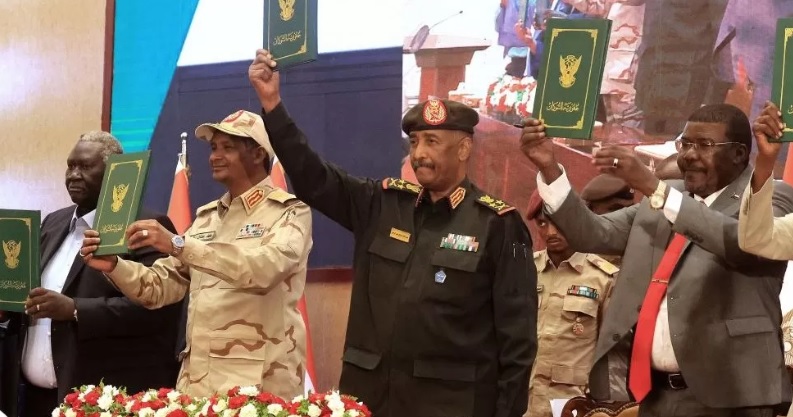
Following the removal of Bashir, the citizens of Sudan desired to establish a democratic government. In August 2019, the ruling generals agreed to share power with civilians who represented the protest movement during a transitional period prior to elections. However, the situation did not remain stable for long. In October 2021, Sudan’s fragile democratisation process came to an abrupt end when the leaders of the army (SAF), Abdel Fattah al-Burhan, and the RSF commander, Mohammed Hamdan “Hemedti” Dagalo, staged a coup and seized power to remove the civilian prime minister and cabinet and suspended the constitution. Tensions escalated when both generals started to assert their authority, leading to a power struggle.
Background
Sudan is currently facing a lot of turmoil due to internal divisions, power struggles, and competing interests. There are two main players in this tumultuous environment: the Sudan Armed Forces (SAF) and the Rapid Support Forces. The focal point of the conflict is Generals Abdel Fattah al-Burhan and Hemedti. The primary issues of disagreement involve integrating the 100,000-member RSF into the army and determining the leadership of the newly formed forces.
The Sudanese Armed Forces (SAF) is a military force in Sudan that comprises land, air, and navy forces, including the Republican Guard. Established in 1956, SAF has held significant influence over Sudanese politics and national security. As the country’s primary military institution, SAF has historically aligned itself with the ruling regime, exerting its influence through its hierarchical command structure and extensive resources. Currently, Muhammad Othman al-Hussein serves as the Chief of Staff, and Abdel Fattah al-Burhan is the Commander-in-Chief. The SAF is estimated to have about 200,000 active personnel. The Sudanese Armed Forces procure equipment from foreign and domestic suppliers such as China, Russia, Belarus, Iran, Ukraine, and Venezuela. Their arsenal includes tanks, artillery, and more.
The Rapid Support Forces (RSF) is a paramilitary group that was formed in 2013 under the command of Sudan’s National Intelligence and Security Services (NISS). The Rapid Support Forces (RSF) were formed as an extension and counterweight to the Sudanese Armed Forces (SAF) a decade ago. They evolved from the Janjaweed militias, supported by al-Bashir to combat secessionism in Darfur. Lt. Gen. Mohamed Hamdan is the leader of the Rapid Support Forces (RSF), an ambitious military group in Sudan. He was once a Janjaweed leader and had the backing of former President al-Bashir. He insisted on giving the group an official look. In 2013, it was renamed the R.S.F. and sent to Yemen as mercenaries for a Saudi-led coalition after serving as border guards. The RSF is believed to have a force of 70,000 to 150,000 fighters. Recently, General Hamdan has been recruiting more fighters from the eastern and northern parts of the country in an attempt to expand his support base. In 2015, the RSF was incorporated into the state’s coercive apparatus under the command of Hemedti, subordinate only to al-Bashir and his National Intelligence and Security Service.
Hemedti’s Political ambitions
In 2021, General Hamdan and the army chief, Gen. Abdel Fattah al-Burhan, staged a coup together. Although the two had been sharing power, as Gen. Hamdan’s influence grew, he began to harbor aspirations to lead the country, and the two generals ultimately became enemies. Additionally, Hamdan has strengthened his ties to foreign powers, including visiting Russia at the start of the war in Ukraine, partnering with the Wagner mercenary group to mine for gold in Sudan, and deploying troops in Yemen to support Saudi Arabia’s interests, as well as in Libya on behalf of the United Arab Emirates.
The Rapid Support Forces (RSF) had several revenue streams, including private companies owned by Hemedti and his family members. Moreover, the RSF had an advantage over the Sudanese Armed Forces (SAF) as its members were recruited from Arab tribes in Darfur. This made the RSF more cohesive culturally, ethnically, and religiously than the SAF. Since al-Burhan was unable to establish a political base that would support his regime, the RSF’s original role as mutiny insurance evolved into a significant coup risk. Hemeti’s style of leadership and the rapid expansion of the RSF raised concerns both domestically and internationally. There were accusations of human rights abuses and involvement in illicit activities, including the massacre of more than 120 protestors in June 2019. Despite these controversies, Hemeti’s influence within Sudanese politics continued to grow, challenging the traditional dominance of the SAF.
Stakes in the Region
Sudan is located in a volatile region that borders the Red Sea, the Sahel region, and the Horn of Africa. The country’s strategic location and agricultural wealth have attracted regional power struggles, complicating the chances of a successful transition to a civilian-led government. Sudan shares borders with several countries, including Ethiopia, Chad, and South Sudan, all of which have been affected by political upheavals and conflicts. Sudan’s relationship with Ethiopia has been particularly strained over issues such as disputed farmland along their border. Due to recent fighting, Sudanese refugees have fled to neighboring countries, including thousands who have crossed into Chad.
The conflict in Sudan has escalated to a global level, with various powerful countries such as Russia, the US, Saudi Arabia, and the United Arab Emirates fighting for influence in the area. Sudan has also become a battleground for the ongoing disputes between Ukraine and Russia. According to a report by The Wall Street Journal, the military leader of Sudan, Lt. Gen. Abdel Fattah al-Burhan, sought assistance from Ukrainian President Volodymyr Zelenskyy as he faced challenges from the paramilitary Rapid Support Forces (RSF), also known as “Hemedti”. President Zelenskyy has reportedly responded to this call for aid.
According to media reports, there are small units of the Ukrainian army fighting alongside al-Burhani’s army. The reason behind this could be to repay al-Burhani’s support to Ukraine in 2022 by providing weapons during the war with Russia. Additionally, Russia is believed to be backing the rebel group in Sudan, which could be another reason for Ukraine’s support.
Conclusion
The conflict between Sudan’s Sudan Armed Forces (SAF) and the Rapid Support Forces (RSF) highlights the deep-rooted divisions within the country’s military and political landscape. As Sudan navigates through its transition phase after the removal of President Omar al-Bashir, the situation in the region has become increasingly challenging. President Omar al-Bashir’s three decade rule left Sudan with a legacy of political repression, economic mismanagement, and ethnic conflicts, particularly in regions like Darfur. The ousting Bashir in April 2019 by a military coup created a power vacuum, intensifying the struggle between the SAF and RSF for dominance. One such instance, on June 03, 2019 the Khartoum massacre, where RSF forces violently dispersed a peaceful sit-in killed over 1000 protestors. These incidents highlighted the complex and volatile nature of Sudan’s transition period. The Sudanese conflict has caused significant damage to life, livelihood, property, and infrastructure. The World Food Programme has warned that Sudan may face the biggest hunger crisis ever. To tackle the difficult issues confronting Sudan, both local and global players need to work together. To start with, Sudanese groups should give priority to dialogue and reconciliation to overcome the differences between SAF and RSF and create a unified and inclusive governing system. Supporting Sudan’s transition process requires the international community to facilitate negotiations between conflicting parties and provide assistance to address the humanitarian needs of the Sudanese people affected by the conflict.
Author’s Bio
Anu Chauhan is a first-year Master’s student pursuing studies in diplomacy, law, and business. She completed her undergraduate degree in History Hons. from the University of Delhi. Currently, she is working as a research intern at NKCSEAS and also interning at a political consultancy called PPGF. Her area of interest lies in International Relations, and her professional knowledge of history provides her with a unique insight into matters through the historical lens.
Image Source: https://www.assahifa.com/english/wp-content/uploads/2022/12/Sudan.jpg
 NICKELED AND DIMED