
By Dheemant Anil
Abstract
The Kargil conflict of 1999 reveals a nexus of political ambition, military strategy, and geopolitical tension, epitomised by General Pervez Musharraf’s calculated manoeuvring to consolidate power in Pakistan. This essay delves into the backdrop of Pakistan’s political turmoil in the 1990s, Musharraf’s clandestine orchestration of the conflict, and the strategic intricacies surrounding the Kargil operation. It explores the enigmatic behaviours of key actors, such as the Pakistan Air Force and the deployment of the Northern Light Infantry, shedding light on the calculated nature of the conflict. Ultimately, Kargil serves as a cautionary tale against personal agendas overshadowing transparent leadership in international affairs.
Introduction
Sometimes wars are never fought because of reasons that seem lost to the common man. And sometimes, we forget the bigger prize which is always hidden behind the motives of those who start it. One such enigma is General Musharaff. Was he, as is popularly considered, a bumbling buffoon who led his country to a disastrous war, or was he a political genius, who used a war to crown himself as the president of Pakistan?
For this, we would need to know the background of Pakistan in the 90s. The 1990s marked a crucial period for Pakistan’s democratic trajectory, marred by the dominance of a military-bureaucratic oligarchy hindering functional democracy. Following Zia’s demise, civilian leadership had a chance to fortify democratic institutions but failed, leading to the 1999 coup.
Both PPP’s corruption and PML-N’s power play exacerbated the situation. Dr. Akmal Hussain’s 2004 paper highlighted the staggering cost of corruption, with estimates suggesting it amounted to 20-25% of GDP in 1996-97.
Background
PML-N, led by Nawaz Sharif, attempted to assert control over various institutions, triggering a power struggle. Sharif’s moves, including constitutional amendments and attempts to influence judicial appointments, sparked conflict with the apex court. This culminated in a showdown, with PML-N supporters storming the court during Sharif’s contempt trial. The president’s reluctance to intervene forced him to resign, consolidating power in Sharif’s hands.
Sharif’s ambitions extended to the media and military, but his confrontation with the latter backfired, leading to the court’s validation of the coup. Amidst this turmoil, the economy suffered neglect, amplifying the plight of the common citizen.
Prime Minister Sharif faced growing disapproval due to perceived power-hungry behaviour and suspected corruption. His actions, including the removal of the chief justice of the Supreme Court and the army chief following the Eighth Amendment revision, and crackdowns on dissenting press, fuelled concerns. Suspicion of corruption intensified as his family’s company, Ittefaq Industries, thrived during economic downturns. Army Chief Jehangir Karamat, alarmed by Sharif’s increasing influence, demanded military involvement in decision-making to balance civil governance. Karamat resigned two days later, leading to General Pervez Musharraf assuming his position.
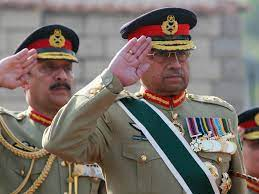
To understand Kargil, we first need to understand Pervez Musharaff. At the onset of 1999, General Pervez Musharraf’s name held little recognition beyond Pakistan. However, by the year’s end, he had skyrocketed to global notoriety. He became the central figure in igniting a conflict between two nuclear-armed nations and subsequently orchestrated a coup to seize power domestically, becoming Pakistan’s first military dictator since Gen. Zia-Ul-Haq.
In February of that pivotal year, Prime Minister Atal Bihari Vajpayee of India and his Pakistani counterpart, Nawaz Sharif, embarked on what seemed a groundbreaking journey toward peace. Vajpayee crossed the border to Lahore accompanied by a delegation of prominent Indians, and Sharif warmly received his guests with unexpected enthusiasm.
While Vajpayee and Sharif cautiously approached peace talks, General Musharraf was clandestinely laying the groundwork for a bold military incursion across the Kargil border. Unbeknownst to the Sharif government, preparations for an invasion were underway. Musharraf’s actions would soon shatter the optimism of the peace mission, transforming it from a historic to a footnote in history. He thrust Sharif into a conflict he could not disavow and pushed Vajpayee into a confrontation he could not avoid.
Kargil was made as a military exercise. According to former Indian army chief Ved Prakash Malik and various scholars, significant groundwork, including the establishment of logistical supply routes, was initiated well before. In the 1980s and 1990s, the Indian army had presented similar proposals to Pakistani leaders such as Zia Ul Haq and Benazir Bhutto regarding infiltration into the Kargil region, but these plans were abandoned due to concerns about escalating into full-scale war.
Some analysts suggest that the plan for the attack was revived shortly after Pervez Musharraf assumed the position of chief of army staff in October 1998. Following the conflict, Nawaz Sharif, who was the Prime Minister of Pakistan during the Kargil episode, claimed ignorance of the plans, asserting that he was first informed about the situation through an urgent phone call from his Indian counterpart, Atal Bihari Vajpayee. Sharif attributed the plan to Musharraf and “just two or three of his cronies”, a sentiment echoed by certain Pakistani writers who stated that only four generals, including Musharraf, were aware of the plan. However, Musharraf insisted that Sharif had been briefed on the Kargil operation 15 days before Vajpayee visited Lahore on 20 February.
It must be seen that the war was not something that the Pakistani Government wanted. Musharaff feared that he would be removed by Nawaz Sharif, and therefore decided to launch a war, which he knew he would lose but would tie up the government’s attention for such a long time, that his real plan, was to make himself the new leader of Pakistan would have been successful.
The Pieces of chess, all together
Three elements show this was planned. Firstly, the intrusion itself was launched around Kargil, a geographically difficult area, which was designed to garner international attention and tie up the Indians. However, the intrusion was not large enough to force the Indians to open a new front to be able to relieve some pressure from the Kargil front. The entire plan just had enough risks to keep the Indians and the Pakistani government tied up, while Pervez Musharaff set up his house in order, to dethrone Nawaz Sharif. This could be seen in rapid promotions and demotions as if he was preparing for the takeover while putting up a smoke screen of the Kargil Conflict.
Evidence for this can be seen in the protest made by Admiral Bhokari, who questioned the logic of the operation, and questioned whether this was really planned with the intention of internationalizing the dispute, or was it made with another, far more sinister purpose.
The second element that underscored the complexity of the situation was the perplexing passivity of the Pakistan Air Force (PAF). Despite the Indian Air Force (IAF) conducting airstrikes and actively interdicting Pakistani forces, the PAF remained conspicuously inert. This stance seemed to defy conventional military logic, almost suggesting a tacit complicity in allowing the conflict to flounder. It was as though they were content to let the Indian offensive proceed unhindered, potentially with the intent to amplify the failure and tarnish the image of Nawaz Sharif, the then Prime Minister of Pakistan.
This inaction appeared calculated, as if deliberately orchestrated to ensure that the conflict did not escalate beyond a certain threshold, adhering strictly to its intended objectives. Such a strategic manoeuvre implies a sophisticated understanding of geopolitical dynamics and a willingness to manipulate them for tactical advantage. The enigmatic behaviour of the PAF added a layer of intrigue to an already complex and volatile situation, raising questions about the underlying motives and machinations at play within the theatre of war.
The ultimate factor contributing to the situation was the deployment of the Northern Light Infantry (NLI). Initially intended for operations in the rugged and remote regions of Gilgit and Kargil, the NLI, a paramilitary unit, primarily consisted of light infantry forces. However, they found themselves inadequately supported, lacking the necessary artillery, anti-air capabilities, and logistical infrastructure crucial for such challenging terrains. Instead of receiving the requisite backing, they were deployed in a manner reminiscent of General Luigi Cadorna’s infamous strategies from World War I – a deployment without adequate support or provisions. This decision left the NLI exposed and vulnerable, significantly hindering their effectiveness in the field and exacerbating the difficulties faced in the conflict zone.
Conclusion
In conclusion, the Kargil conflict of 1999 presents a complex web of political intrigue, military strategy, and personal ambition. General Pervez Musharraf’s orchestration of the conflict, seemingly designed to consolidate his power within Pakistan, highlights the intricate maneuvering of key players in the region. The passive stance of the Pakistan Air Force and the ill-prepared deployment of the Northern Light Infantry further underscore the calculated nature of the conflict. The Kargil episode serves as a stark reminder of how geopolitical tensions and internal power struggles can intersect to shape the course of history. Ultimately, it stands as a cautionary tale against the manipulation of military action for personal gain, emphasizing the need for transparent and accountable leadership to navigate complex international relations.
Author’s Bio
Dheemant Anil is a student of law at the OP Jindal Global University and is an international Relations enthusiast. He is also a movie enthusiast and is interested in the history of the world and has been interested in learning about the world during the great wars and understanding why history happened the way it happened and would like to have a conversation with the history of the world and of the story of how the trade routes changed the world.
Image Source: https://www.aljazeera.com/news/2023/2/6/former-military-ruler-pervez-musharrafs-body-brought-to-pakistan
 NICKELED AND DIMED