
By Aryan Govindakrishnan
The upward revision in India’s economic growth projection for FY23-24 by the Reserve Bank of India is fueled by robust performances in the manufacturing and construction sectors. Positive trends in the Index of Industrial Production (IIP) over two quarters support this, with manufacturing displaying consistent growth and construction exhibiting a remarkable surge. The convergence of these trends signals resilience, stability, and a positive economic outlook for India’s recovery and expansion.
Introduction
The upward revision in the growth projection for the Indian economy by the Reserve Bank of India (RBI) for the fiscal year 2023-24 (FY24) is significantly influenced by the strong performance of the construction and manufacturing sectors. The confirmation of economic growth is underscored by the positive trends observed in these key sectors, as indicated by the Index of Industrial Production (IIP) data over the past two quarters.
The manufacturing sector, a pivotal driver of economic activity, has shown resilience and dynamism. Increased production levels, driven by both domestic demand and export-oriented activities, contribute to the sector’s robust performance. The momentum in manufacturing is often reflective of a growing economy, as it signifies higher industrial output, employment generation, and overall economic vibrancy.
Simultaneously, the construction sector’s noteworthy performance plays a crucial role in the economic growth narrative. Construction activities, including infrastructure development and real estate projects, stimulate demand for raw materials, machinery, and labor, creating a multiplier effect on various ancillary industries. A flourishing construction sector not only contributes to GDP growth but also enhances the overall investment climate by attracting both domestic and foreign investments.
The IIP data, which measures the industrial output of these sectors, serves as a vital tool for understanding the economic landscape. Positive trends in the IIP are indicative of increased production, manufacturing, and construction activities. This, in turn, aligns with the RBI’s decision to revise the growth projection upwards, signaling confidence in the sustainability of the economic recovery.
What is the Index of Industrial Production?
The Index of Industrial Production (IIP) is a comprehensive metric designed to gauge short-term variations in the production volume of a designated basket of industrial products within a specific time frame relative to a chosen base period. This index is a vital indicator reflecting the performance of diverse industrial sectors within the Indian economy.
The measured industry groups encompass broad sectors such as manufacturing, mining, and electricity. Additionally, it delves into use-based sectors, including capital goods, basic goods, intermediate goods, infrastructure goods, and consumer durables and non-durables. This detailed classification facilitates a granular analysis of the economy’s industrial dynamics.
In essence, the IIP acts as a crucial tool for policymakers, economists, and businesses alike, offering a comprehensive overview of industrial health and trends. It aids in identifying areas of growth or contraction, enabling informed decision-making and strategic planning based on the evolving landscape of industrial production in India.
In order to understand the recent increase in the growth forecast, we will primarily analyze industrial activities, specifically in the use-based sector, focusing on infrastructural products. We will also examine the broad sector classification, with a special emphasis on the manufacturing sector. This focused analysis seeks to offer insights into the factors that contribute to the improved economic outlook, specifically examining crucial elements such as the production of necessary items for infrastructure and the overall performance of the manufacturing industry.
IIP Index value
| Item Description | JAN2023 | FEB2023 | MAR2023 | APR2023 | MAY2023 | JUN2023 | JUL2023 | AUG2023 | SEP2023 | OCT2023 |
| Infrastructure/ Construction Goods | 176.9 | 165.7 | 181.7 | 169.8 | 173.2 | 170.9 | 170.3 | 173.5 | 170.9 | 173.9 |
| Manufacturing | 145.5 | 137.6 | 147.5 | 138.5 | 143.1 | 141.6 | 142.1 | 143.5 | 141.2 | 141.8 |
Manufacturing
In the second quarter of FY24, the Indian manufacturing sector experienced a significant turnaround, exhibiting robust growth of 13.9%, in stark contrast to the previous quarter’s muted expansion of 4.7%. This unexpected double-digit growth is attributed to a favorable base effect, low input costs, and increased capital expenditure by both state and central governments. Experts highlight the role of government spending, particularly in infrastructure projects, as a key driver of this industrial resurgence. The crowding in of state and central government capex, growing by 26.7% in Q2FY24, played a pivotal role. Additionally, the construction sector, the second-largest employer in the country, posted substantial growth, contributing to overall economic uplift.
The Index of Industrial Production (IIP) for the first quarter depicted a decline, notably in February, with the index value dropping to 137 units, signaling a temporary setback or specific challenges within the industrial sector. However, subsequent quarters showcased a resilient recovery, maintaining a consistent performance at 140 units in both quarter two and the initial part of quarter three. This sustained level suggests a stabilization or potential rebound in industrial output, indicating adaptability and resilience in the face of earlier challenges. Factors contributing to this recovery could include effective government policies, improved market conditions, heightened consumer demand, or successful implementation of corrective

measures. The steady IIP index value implies that the industrial sector has found a renewed equilibrium, demonstrating a more robust and stable performance. This consistent trend is a positive indicator, reflecting the sector’s ability to overcome previous obstacles and adapt to changing circumstances, fostering an environment of potential growth and stability in industrial production.
Construction
The Indian construction industry has experienced a remarkable upswing, posting a robust 13.3% growth in the July-September quarter, its most impressive performance in five quarters. This surge has played a pivotal role in India’s economic expansion, surpassing expectations at 7.6% and positioning the country among the world’s fastest-growing major economies. Factors fueling this construction boom include rising incomes, a severe housing shortage in major cities, and substantial population growth.
The buoyancy is evident in increased home sales, particularly in major cities, with a 36% rise in the July-September quarter despite an 8%-18% increase in property prices. Builders are optimistic, anticipating the boom to last for several years. Notably, smaller cities in southern states have also witnessed a surge in housing demand, driven by rising incomes and rural-to-urban migration.
The Index of Industrial Production (IIP) reveals a notable trend in the manufacturing sector. The first quarter as seen in the graph displayed a drop in performance in February, with the IIP index value declining to 166 units. This decline in February may be indicative of temporary challenges or specific factors affecting manufacturing output during that particular month.
However, a significant recovery is evident in subsequent periods. In both quarter two and the initial part of quarter three, there has been a consistent and improved performance, with the IIP index stabilizing at 180 units. This suggests a rebound and stabilization in the manufacturing sector after the dip observed in February.
Several factors could contribute to this positive trend. It might be attributed to effective policy measures, improved market conditions, increased consumer demand, or successful resolution of challenges faced in the earlier period. The sustained performance at 180 units indicates that the manufacturing sector has not only recovered from the setback but has also achieved a level of stability, maintaining a certain threshold of output.
IIP Growth Rate
| Item Description | JAN2023 | FEB2023 | MAR2023 | APR2023 | MAY2023 | JUN2023 | JUL2023 | AUG2023 | SEP2023 | OCT2023 |
| Infrastructure/ Construction Goods | 11.33 | 9.01 | 7.20 | 13.43 | 12.98 | 13.33 | 12.56 | 13.55 | 8.92 | 11.33 |
| Manufacturing | 4.53 | 5.93 | 1.51 | 5.24 | 6.32 | 3.51 | 5.26 | 9.29 | 4.90 | 10.35 |
The Index of Industrial Production (IIP) growth rate reflects a compelling performance in both the construction and manufacturing sectors. The construction sector has exhibited excellent growth, boasting a robust growth rate of 12 percent. This aligns with the IIP index values, suggesting a strong correlation between the growth rate and the actual performance of the construction industry. The stellar performance in construction is often indicative of increased infrastructure development, rising demand for real estate, and overall economic vibrancy.
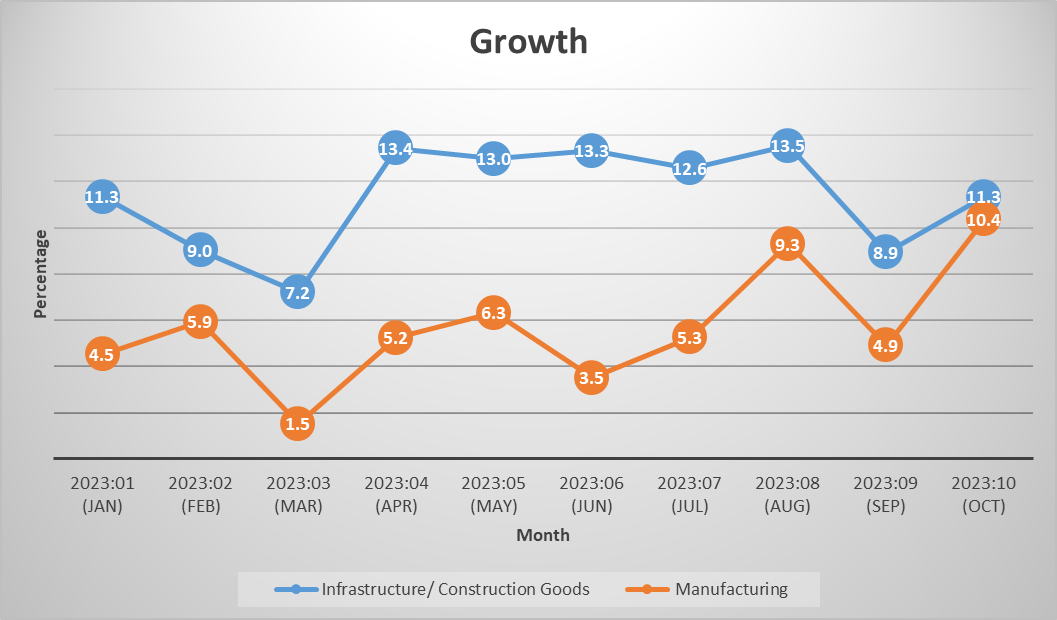
In the manufacturing sector, while the growth rate may be comparatively lower at 6 percent, the key highlight is the consistency in this growth. Despite the lower percentage, the fact that the sector has maintained a constant growth of 6 percent is noteworthy. This sustained growth is well-supported by the corresponding IIP index values, indicating a steady and reliable expansion in manufacturing activities. A constant growth rate in manufacturing signifies stability and resilience, contributing to economic development and employment generation.
Conclusion
The recent trends in the Index of Industrial Production (IIP) and growth rates underscore a robust and resilient performance in both the construction and manufacturing sectors, contributing significantly to the upward revision in India’s economic growth projection for FY23-24. The manufacturing sector, despite a lower growth rate of 6 percent, demonstrates noteworthy consistency, maintaining a steady expansion throughout the analyzed period. This reliability in growth, supported by the corresponding IIP index values, reflects stability and resilience, crucial for sustained economic development and job creation.
On the other hand, the construction sector has exhibited stellar growth, boasting a robust growth rate of 12 percent, aligning seamlessly with positive IIP index values. This exceptional performance is indicative of heightened infrastructure development and a surge in real estate activities, contributing substantially to overall economic vibrancy.
The convergence of these positive trends in manufacturing and construction has played a pivotal role in India’s economic narrative. The consistency in manufacturing, coupled with the outstanding growth in construction, positions the country as a resilient and dynamic player in the global economic landscape. As these sectors continue to drive economic momentum, they signal a positive outlook for India’s growth trajectory as projected by RBI recently, providing optimism for sustained recovery and expansion in the coming quarters.
Author’s Bio
Aryan Govindakrishnan is a second-year student at the Jindal School of Government School and Public Policy, pursuing Masters in Economics. His research interests include finance, policy and economics.
Image Source: https://housing.com/news/is-real-estate-helping-or-hurting-indian-manufacturing-and-make-in-india/
 NICKELED AND DIMED