
By Nitya Arora
Abstract
This article examines the 2014 production of Greek tragedian Euripides’ Medea at the National Theatre in London. It draws parallels between the two and observes how Medea’s narrative is still haunting our imagination after almost a millennium – what makes Medea a timeless reflection of human follies and fascinations?
Introduction
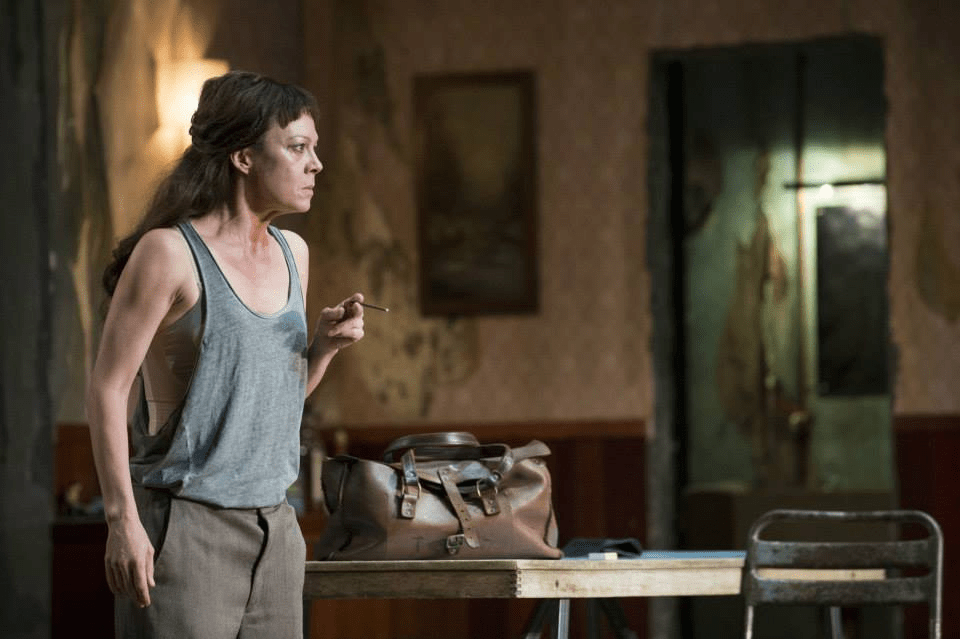
The tragic character of Medea from ancient Greek mythology has been subjected to several cultural and artistic treatments throughout history. Her story is painted with strong elements of shock and awe. She continues to be a universally enigmatic character, associated with witchcraft and her subsequent action of murdering her children after being left by her husband, Jason. However, various reconsiderations of her narrative have explored many complex facets of her psyche and the possible reasoning behind her actions. One of the most fascinating retellings of the myth is Carrie Cracknell’s Medea, a live play that debuted in 2014 at the National Theatre in London. Ben Power adapted the screenplay and it featured an arsenal of talented actors including Helen McCrory as the titular character.
The Production of Cracknell’s Medea
Cracknell makes an admirable directive decision by setting the production in a modern-day urban milieu where the dramatic action takes place on a minimalist set – conjuring an atmosphere of isolation and despair. Following the footsteps of the Greek tragedian Euripides, the core elements of the play continue to be betrayal, revenge, and the oppression of women based on gender as well as Medea’s status as a ‘foreigner’. However, for the modern audience, this contemporary retelling gives the myth of Medea a dimensional reboot which resonates starkly against the harrowing thematic backdrop of the classical play.
One of the most critically acclaimed features of the production is its sensational use of music, especially a haunting piece composed by Will Gregory, from the band Goldfrapp. The music elevates the play and makes intense moments as unsettling as they were originally intended to be depicted by Euripides, portraying the indisputable inner turmoil of the characters.
The dance of the Chorus was choreographed by Lucy Guerin, who is known for her work having physical depth. The incorporation of dance as an active element in the play holds significance for Cracknell as she says “Dance is so interesting because it makes you very active as an audience member. You’re being asked to make sense of it, to find meaning in it. It’s not literal, it’s not tied down to narrative.” On the subject of being honest about the text and narrative and the impact of dance on that, she says “We still make enormous divisions between dance and theatre, and actually all acting is movement. All acting is breath.”
Ever the directorial ventriloquist, Cracknell pulls on the strings of the psychological complexity of the characters, especially Medea’s. It is a commendable effort to delve into the depths of her rage and despair. McCrory’s performance has been commended for intense, raw emotions, as she conveys the emotional ambiguity of the character through a powerful and nuanced delivery. Medea is portrayed as a powerful woman who has sacrificed her career and her ambitions for the sake of her husband and family. Jason, played by Danny Sapany, is not portrayed as an obvious brute but a politician who justifies his abandonment of Medea through sophisticated explanations of ambition.
McCrory’s Interpretation of Medea
In an interview at the National Theatre, Helen McCrory goes deep into conversation with Genista McIntosh about her processes of seeking, understanding, and embodying Medea. She was asked by McIntosh about the debate regarding Medea being mad or bad, or neither of those things because McCrory had said quite firmly that Medea needed to be sane, which is not exactly a sentiment shared by critics and commentators and people who have played her. She asked Helen if that was a stance she was instinctively sure of when she read the script for the first time or whether it was one that she came to in the process of learning about Medea and presenting her. Helen’s reply after thoughtful consideration was “One of the questions that was brought up originally was that whether she (Medea) should be in a straitjacket at the end of the play, and I very much didn’t want that, I didn’t think that she was insane at all. I think she is driven to a desperate and wicked act. In the Greek translation, she literally says that I understand what I am about to do but anger (we have no English word for it, apparently) militarily defeats me and I will do it anyway. There is a ‘Medea law’ in which it is now still argued in court as premeditated murder without insanity. I felt it was important that if the British legal system was taken by it that I got it in the play. Also because, although grief, from what I understand, does cause a chemical imbalance, whether it is the death of a spouse or being left by Jason, having murdered having had a very traumatic upbringing.” She goes on to say, “All this might make her emotionally extreme but she is quite clear, cunning, manipulative all the way through in order to get what she wants. So it was very instinctive.”
Thematic Characterisations of Medea
The tragic core of the play emerges in full force during the climax, which in this production, is more tailored to modern tastes as opposed to the original one written by Euripides. We do not see Medea exiting in a grand chariot provided by the Sun God, instead, we see her exiting in a profoundly understated manner which is a perfectly juxtaposed contradiction to the extremity of her actions and circumstances.
The archetype of Medea’s character transcends time. It has now morphed into a multitude of modern-day narratives including her being a feminist icon who subverts gender roles and as the original figure who managed to survive and thrive despite marginalisation based on her femininity and her ‘otherness’. Medea is an amalgamation of stereotypically feminine features as well as evidently masculine ones. Her deceptive disposition is perceived as a decidedly feminine characteristic, however, her undaunted boldness, was at the time of her conception, an attribute reserved for Greek heroes. There is a perpetual dichotomy in terms of gender roles portrayed in the play and Medea consistently subverts the audience’s expectations. The juxtaposition of Medea and Jason’s narrative also repeatedly highlights the asymmetrical power relations in marriage. Even the fact that most of the criticism against Medea comes from Jason is quite intentional in both the adaptation and the original play by Euripides.
Another aspect highlighted most in Euripides’ Medea is her not being the regular ‘Greek woman,’ being a foreigner and not entirely belonging to the same society as Jason does. Denys Page says that Medea “embodies the qualities which the 5th centuries Athenian believed to be characteristic of Orientals.” In the original play, the Chorus often emphasise her foreign status, drawing upon contemporary stereotypes of foreigners being more likely to commit barbaric crimes like infanticide. Her actions now, with recent deliberations, are seen as a response to political repression and injustice where her decision to kill her children is not completely founded in anger but also in the urge to protect them from a world where they would have faced similar discrimination. Medea does not have the provision of a safety net consisting of a family, city, wealth, and so forth like other Greek women. She laments the death of her children in the way of a traditional mother. This facet of Medea’s identity has resonated with audiences through centuries based on displaced cultural identities, migration, and existence in the diaspora.
Medea remains a complex, multifaceted character whose psyche remains eternally fascinating in terms of the extremity of her emotions and her intellectual reasoning behind them. She creates a rupture in our fascination with rationalising the motives and severity of any character’s actions. The lack of resolution in Medea’s narrative and her transcending glory is what complicates the regular trope of a Greek tragedy and portrays the genius of Euripides. Cracknell’s Medea is an amalgamation of the Classical play based in a modern landscape where we witness the universality of humaneness and all its follies.
Author’s Bio
Nitya Arora is a second-year student at OP Jindal Global University pursuing English Honours. Her areas of interest include literary studies, book cultures, and mapping cultures through their literary representations.
Image Source: https://theotherbridgeproject.files.wordpress.com/2014/07/medea-helen-mccrory-richard-hubert-smith.jpg
 NICKELED AND DIMED
