
By Nitya Arora
Abstract
This article explores the spatiality along with the cultural and historical significance of the 13th-century hunting lodge of Bhuli Bhatiyari in Delhi. The monument is an embodiment of the rural and urban dichotomy in the landscapes of Delhi – how the city is laced with remnants of its past interacting perennially with the upcoming “modern” elements that it houses, including the changing population demographic and culture. It highlights the necessity of government intervention in the restoration of the many forgotten historical ruins scattered across the city and how the diverse population of the city interacts with the monument in differing capacities.
Introduction
In the unsuspecting realm of the Central Ridge Reserve Forest in New Delhi lies Bhuli Bhatiyari ka Mahal, an often-overlooked refuge amidst the chaos of the big city. Tied to these ruins are several diverse expositions of a myriad of people who have laid their claim on this desolate structure. This article will be focused on exploring the various narratives surrounding the origins and pasts of this monument, the location and how it is an example of the rural and urban dichotomy of Delhi, the need for state intervention in restoration, and the subsequent commercialization of the space as a result of government intervention.
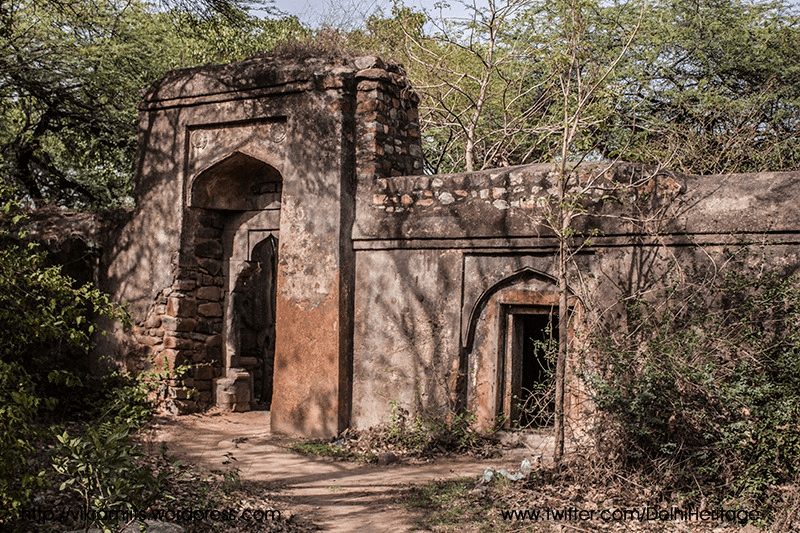
On the bustling Pusa Road, near Karol Bagh, with traffic zooming in all directions, avoiding catastrophe by being separated through delicate intervals of time, the aerial view of the gol chakkar or roundabout would reveal perfectly harmonious chaos in the existence of city life as a symphony orchestrated tirelessly by traffic police and signals. Here, an often-overlooked dusty road, next to the Hanuman Mandir, is hidden in plain sight from the view of the unceasing pace of city dwellers. This road leads to Bhuli Bhatiyari ka Mahal in the Central Ridge Reserve Forest. The monument now seems like an irretrievable part of the forest itself, with the ever-growing ivy on all its walls from about seven centuries of standing tall against the ravages of time, making it difficult to imagine its ties to a royal past as a hunting lodge. However, its location and disposition for camouflaging against the backdrop of the forest make it the perfect hideout for a hunting expedition for Delhi’s Sultan, as suggested by various stories of its origin.
One of the more popular narratives says that the abandoned palace belonged to a queen who died six centuries ago and now haunts it. It is also said that it was taken care of by a woman named Bu-Ali Bhatti and the name has been twisted over time to Bhuli Bhatiyari. However, the name is a testament to the monument’s lesser-known glory and limited appreciation from the people of the city – a forgotten place, like many other remnants of Delhi’s repeatedly erased history, only stumbled upon by lost wanderers seeking refuge. Others say that this was the irrefutable sanctuary of saint Bu-Ali Bakhtiyar, who opened an inn here. Some more romantic admirers of the palace recount the story of a woman named Bhuri belonging to the Rajasthani Bhatiyar tribe. They claim that she was lost on her journey and came across this hideaway and here, she encountered Sultan Firoz Shah Tughlaq, who at the time, found himself in need of drinking water – the girl offered him that and he named the place after her. Since she had forgotten her way, the place came to be known as Bhuli Bhatiyari.
These overlapping narratives all hold some truth and fiction, making this place a receptacle of folk history and an inspiration for bedtime stories. However, in all historically accurate likelihood, this was a hunting lodge built by Sultan Firoz Shah Tughlaq in the 14th century, along with a bund or an embankment. According to the Department of Archeology, the palace stands on the southern side of the embankment and it is a rectangular structure enclosed with double doorways in the northeast corner. The palace is built on two levels, the lower level has small rooms and a courtyard in the front and the upper level has a washroom separated by a wall which opens in the courtyard as well. The construction mainly consists of rubble masonry, consisting of Delhi quartzite stones bound by limestone mortar and covered in limestone plaster. There is a security guard on duty here, making sure that no one trespasses past the stipulated time which is 7 am to 5 pm every day.
However, the most fascinating aspect of this palace is that even with the ever-changing landscape of the city it has retained its ability to transport any visitor into the era of its conception. As emphasized by William Dalrymple in the introduction to his book City of Djinns, different spaces in the city still preserve different eras in all their grandeur and follies. Despite the rapid metropolitanism of New Delhi, including within the 500-meter radius of Bhuli Bhatiyari, the monument manages to unfailingly cause a fortunate rupture in the undefined wave of contemporary globalization of the city. The monument lies right opposite a chain of elementary, secondary, and senior secondary schools on Pusa Road, giving the students easy access to the space during and after school hours, making it possible for a million different narratives to stem from the foundation of these forgotten ruins. Right opposite the schools, is a recently opened Starbucks café resulting from the previously mentioned contemporary globalisation. Little further down, lie several coaching institutions for IAS, JEE and NEET examinations, with students who have travelled to realize their dream in the city of Delhi in a race of excellence with the insurmountably impassioned youth from all parts of the country. Within this hyper-changing landscape of the city lies a historical machination with the irrefutable ability to give refuge and a momentary escape to people with the weight of the world on their shoulders. This palace then becomes the perfect embodiment of the urban and rural dichotomy of the city – Delhi is as urban as it is rural, and these two landscapes exist in perpetual intricate ties with one another. The landscape of the city is laced with remnants of its past interacting perennially and positively with the upcoming inconceivably “modern” elements that it houses, including the changing population demographic and culture.
In 2016, Bhuli Bhatiyari was brought under the ambit of the Delhi Government’s Department of Archaeology in collaboration with the Indian National Trust for Art and Cultural Heritage (INTACH) for restoration, along with other lesser-known monuments of the city. Before its restoration, it was a place that became a longstanding victim of neglect rooted in a lack of awareness regarding its history and heavy encroachment by the countless homeless people of the city and drug addicts. INTACH project director Ajay Kumar said that the majority of these structures had never been restored before and after the efforts of the project, the building became stable and was chemically cleaned whenever required, improving the state of their overall environment. When Sohail Hashmi, a historian who regularly conducts heritage walks around the city, was asked about the significance of these structures said “The problematic categorisation of what is significant or insignificant was introduced by the British. For us, each bit of heritage, even a pebble, is significant. We have lost 33% of our monuments in Delhi in the last 100 years. It is good that the Archaeology Department is doing the restoration work.”
The importance of state intervention in the restoration of heritage sites like Bhuli Bhatiyari is unparalleled, especially because in the past, there have been several efforts made by corrupt and colonising government bodies and institutions to erase the history of the capital city, starting with the British erasing any remnant of a Mughal past in Delhi after the Revolt of 1857. Deborah Sutton mentions that the monuments offered structural and spatial canvases for lives within the city, providing shelter, solitude, and the possibility of privacy, as well as a devotional and commercial opportunity. In the past few years, there have been propositions from the government to arrange for heritage walks in various lesser-known monuments, starting with Malcha Mahal and introducing one for Bhuli Bhatiyari on a pilot basis. Bhuli Bhatiyari is one of the very few sites venerated with a shared religious past of Hindus and Muslims, it was the site of an annual mela, or fair held on the full moon of the month of Ashad or the month when the monsoon begins in Delhi. Here, Brahmins and Muslim astrologers would test the winds and predict the rains and the agricultural production of that year. It is speculated by Anand Vivek Taneja, in Rumba under Fire, that when Ghalib wrote the following famous couplet, he was speaking of this fair and its annual prediction:
Dekhiye pate hain ushaq buton se kya faiz
Ik birahman ne kaha hai key eh sal accha hai
Let’s see what grace lovers find from idols
A Brahman has said that this year is good
The location and spatiality of Bhuli Bhatiyari are perceived varyingly by different elements of the city along with their varying interactions with the space – including, the restorative measure by the government and their eventual commercialization of the space with heritage walks, the escape found by students seeking adventure in their mundane days, the haunted narratives and quests for ghosts by supernatural enthusiasts, a means of life and survival for homeless families, a receptacle of interest for historians and archaeologists and most importantly, a means of livelihood for people working on its restoration and the security guard on duty who spends the entirety of his days looking after a gem in Delhi’s heritage.
Author’s Bio
Nitya Arora is a second-year student at OP Jindal Global University pursuing English Honours. Her areas of interest include literary studies, book cultures, and mapping cultures through their literary representations.
Image source: https://delhipedia.com/wp-content/uploads/2022/03/2.jpeg
 NICKELED AND DIMED
