
By Sankalp Wadhwani
Abstract
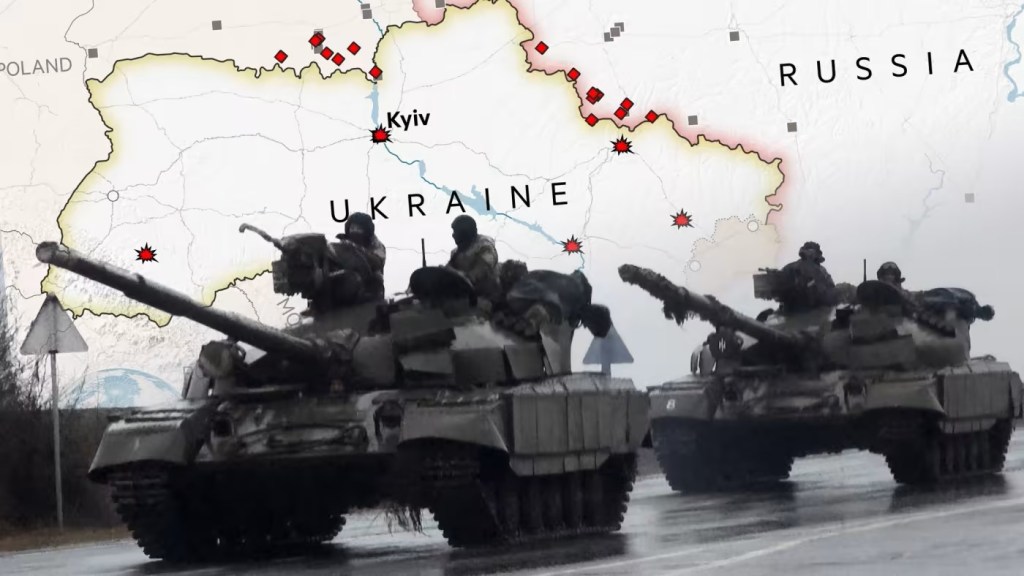
This essay examines key lessons from the Russia-Ukraine war that are relevant to India’s military strategy. This highlights the need for India to maintain its defence independence while also highlighting the ongoing significance of conventional warfare. A thorough, flexible plan is shaped for India’s changing security requirements by highlighting the critical role of sophisticated artillery, the effects of technology, the necessity of a united national morale, and the necessity of an integrated defence approach.
Introduction
The Russia-Ukraine war is an ongoing conflict where a symphony of warfare plays out, revealing modern battlefields’ intricate dynamics. The conflict has unexpectedly lasted for more than one and a half years challenging the common beliefs of modern warfare up until now, therefore, it is not merely a localised dispute; it is a revelation of the contemporary art of war, laden with profound lessons. War is a cruel but instructive teacher, and often the only thing we can gain from the suffering of others is more knowledge and wisdom for the future. Likewise, the Russia-Ukraine war has proven to be a lesson for India in terms of military and strategy. India’s strategic autonomy in the changing geopolitical landscape has allowed it to adapt and refine its defence doctrines, acquisition approaches, and technological advancements in alignment with the changing paradigm of warfare. An in-depth analysis of the key lessons learned from the Russia-Ukraine conflict is provided in this paper, along with suggestions for how they might be applied to create a more adaptable and reliable security environment for India.
The Lessons
The first lesson for India is realising that conventional warfare is not completely over, and it will play a crucial role in the future. “Military icons of the 20th century” were on their way out in 2020, according to General M.M. Naravane, then-chief of the Indian Army, in the same way that the “Sony Walkman” was rendered obsolete by modern music-listening devices. This war has showcased that despite the growing technology in warfare it has restrictions on it, therefore a mix of conventional warfare is necessary for future modern warfare. The world has come full circle, and Russia has modified its approach, switching from brigades to divisions and reverting to World War II tactics.
More importantly, this war proved that possession of nuclear weapons is no longer a huge deterrent. The “Joint Doctrine of the Armed Forces—2017” states that future wars are expected to be “ambiguous, uncertain, short, swift, and lethal.” On this plain assumption, some reflection is necessary, and hopefully, it is already under progress, according to Lt Gen DS Hooda. Consequently, the possibility of a long war is still in place. Since India has two active borders, it is always advisable to be ready for a conventional confrontation because both sides may change their capabilities and intent at any time, and the situation may worsen. Therefore, the Indian Armed Forces must be ready for everything.
The second lesson for India is that it has to be self-sufficient in the defence domain. As observed, there may be conventional warfare, thus war may last for a longer period as well for India considering its neighbouring nations like China and Pakistan (which can be backed by China). In this context, it is noted that whereas the Kargil fight was rather prolonged and confined to a specific sector, the 1971 Bangladesh Liberation War was brief. Therefore, the emphasis must be on accumulating sufficient war reserves to last for a longer period. Currently, India is not self-sufficient in the military domain and not ready to sustain a long war. As conflict loomed after the 2016 Uri terror assault, the Indian military was forced to embark on a global shopping binge to stock up on ammunition, including specialised shells for its T-90 tanks. In a 2017 assessment, the Comptroller and Auditor General (CAG) of India discovered that almost 40% of the ammunition used by the Indian Army would not even last ten days during a conflict. The CAG audit also observed that the Defense Ministry’s 2013 goal to close the artillery gap in the Army by 2019 had not yet been put into practice.
The same case is with the Indian airforce and navy which lack the numbers to engage in a long period of war being self-sustaining. More importantly, Russia, one of the biggest suppliers to India in defence has been not able to meet the defence requirements of the Indian army due to its engagement in war. While India’s reliance on the Russian Federation will likely last for some time, India will undoubtedly need to wean itself off on Russian military prowess given its growing stock of Russian-made conventional weapons. Hence, India needs to focus on the indigenization of arms and equipment. Positively, India has started the defence indigenization process to attain the ultimate goal of ‘‘Atmanirbhar Bharat’’. “Mediumization with indigenous guns is likely to be completed by the year 2042,” according to India’s plan. Additionally, the Army has ordered 300 Sharang guns that are 155 mm instead of 130 mm and 114 Dhanush weapons that are locally modified versions of the Bofors guns.
In addition to firearms, indigenization of munitions is a primary focus, according to officials, who noted that four different munitions types are presently undergoing trials.
The third lesson this war has taught India is that hard firepower still plays an integral part, and more advanced fast-paced artillery is required on the battlefield. The use of precision-guided munitions in well-thought-out strikes only makes artillery more deadly, even though it still plays a significant role in warfare. The inability of Russian artillery bombardments to breach Ukrainian defences is instructive. In contrast, Russian ammunition stockpiles, command centres, and important bridges were frequently destroyed by NATO’s High-Mobility Artillery Rocket System, or HIMARS, which can fire GPS-guided rockets up to 50 miles away. India has also learned from this lesson and started to improve its artillery with a focus on mobility and long-range firepower which makes it imperative for the Indian army. Indian army officials have recognized the importance of ‘‘shoot and scoot’’ capability in the war. Given that artillery fire was responsible for 80% of the estimated war losses in Russia-Ukraine, one official claimed that the conflict has confirmed the use of firepower as a decisive factor in winning battles.
Along with the Operations Branch, the Artillery Regiment conducted a thorough investigation. The Army is aiming for additional self-propelled and mounted gun weapons in the updated Artillery profile. The focus is on improving the range and accuracy of rocket and missile regiments, developing and modernising munitions with longer ranges, reorganising surveillance and target acquisition (SATA) units for effective surveillance, data management, coordination, and targeting tasks, and creating efficient sensor-shooter networks and procedures. Lastly, the DRDO is improving the missile capability for both ballistic and cruise missiles in terms of range and accuracy. The BrahMos missile’s range has been increased, and the DRDO is looking into developing a variety of other missiles with a range of different capabilities.
The fourth lesson the war has taught is the importance of technology and the role of non-state actors on the battlefield. The war has displayed the successful use of drones on the battlefield, and the role of social media as well as creating a hybrid warfare. Even smaller drones have been crucial in information, surveillance, and reconnaissance missions. Major drones, like the Turkish Bayraktar, have proved incredibly effective in striking major targets in Ukraine. The spaced-backed capability and open-source data have made it easy for the military to be more transparent. More importantly, the role of social media, to drive the narrative of the war globally towards the West is something to be looked upon by India. Social media cannot be permitted to set its standards for material outside of the legal frameworks of the nations in which they operate. India should control how social media platforms operate while engaged in a conflict. Lastly, the use of nonlinear warfare techniques and the presence of non-state actors on the front lines add another level of complexity, thickening the haze of conflict. India might also need to deal with non-state actors while it is engaged with Pakistan in a conflict. However, regarding the use of technology in the battlefield especially drones, there are certain limitations as well. According to reports, the drones can be used for border-area attacks as well as monitoring. Drones won’t be able to do deeper penetration, though, like a fighter, it is predicted. Therefore, India must maintain a strong air force to deeply penetrate beyond enemy lines, and not be heavily dependent on drones for offence, but on the other hand, start infusion of technology into warfighting systems.
The last lesson for India is that it must understand that the morale of the nation matters in a war and there should be an integrated approach to the conflict. The conflict will bring economic pressure, due to possible sanctions, but India should be able to unite its diverse citizens, as the morale of the nations will also affect the soldiers on the battlefield fighting for India. Experts claim that the early failure of the Russian assault was caused by a lack of coordination between the armoured columns, mounted infantry, self-propelled artillery, air defence, airpower, and logistics, which showed the absence of a combined arms formation. Without any actual coordination on the ground, it appeared as though each arm was engaged in a separate conflict. Therefore, defence experts consequently emphasize the need for a cohesive approach to war, which would require employing the assets of all three forces in a focused manner. India should make sure its army is well coordinated in an event of conflict as it did during the 1971 Bangladesh liberation war.
Conclusion
In conclusion, India can use the lessons learned from the Russia-Ukraine conflict as a compass to strengthen its military plans and develop a strong security paradigm. India’s defence mentality must be imbued with the necessity of a balanced strategy that includes conventional warfare, self-reliance, artillery firepower, technological integration, and national solidarity. India sets sail for a future where its military posture is resilient, responsive, and flexible in a constantly changing international environment by taking these lessons to heart.
Author’s Bio
Sankalp Wadhwani is third year B.A. (Hons.) Global Affairs student at Jindal School of International Affairs. His key interest areas are counter-terrorism, international relations, defence strategies, foreign policies, etc.
Image Source: https://www.ft.com/content/4351d5b0-0888-4b47-9368-6bc4dfbccbf5
 NICKELED AND DIMED