
By Dhruv Bonavate
Abstract
The Fukushima Daiichi nuclear disaster in 2011 was a stark reminder of the consequences of complacency, lax regulation, and technical negligence in the nuclear industry. The disaster, triggered by a major earthquake and tsunami, exposed fundamental flaws in safety procedures and sparked a heated debate about dumping treated radioactive water into the sea. The purpose of this article is to analyze the 2011 Fukushima Daiichi nuclear disaster, focus on the key factors causing the disaster, shed light on the post-disaster management of processed radioactive water, and the resulting domestic and geopolitical consequences.
The Fukushima Nuclear Disaster:
On March 11, 2011, Japan experienced its worst earthquake ever, weighing in a staggering 9.1 on the rector scale. The subsequent Tsunami ensured the total capitulation of Japan’s coastal infrastructure and sparked the worst nuclear tragedy since Chernobyl in 1986. The Fukushima Daiichi Nuclear is a terrible episode that provides an example of the consequences of the dangers of regulatory laxity. It was a complex of six nuclear reactors operated by the Tokyo Electric Power Company (TEPCO) in Fukushima Prefecture. The earthquake and tsunami caused off-site and on-site power supplies to collapse, crippling the plant’s cooling systems. Following the failure of cooling systems, the chain of events culminated in the overheating and partial meltdown of reactor cores in unit 1- and subsequently overheating led the fuel to melt, causing damage to the fuel rods and reactor pressure vessels. The depletion of coolant finally resulted in the release of hydrogen gas, which caused explosions within reactor buildings 1, 3, and 4
The general notion in Japan that nuclear power facilities were intrinsically safe and that a tragedy of this size was impossible was a significant element in the Fukushima Daiichi accident. As a result, Japan was not adequately prepared for a major nuclear disaster in March 2011. This complacency resulted from the notion that nuclear power plant architecture and safety mechanisms were robust enough to survive even low-probability, high-consequence external occurrences. This persistent faith in the nuclear industry’s invincibility resulted in a lack of preparation and preparedness for catastrophic mishaps.
The treatment of the water:
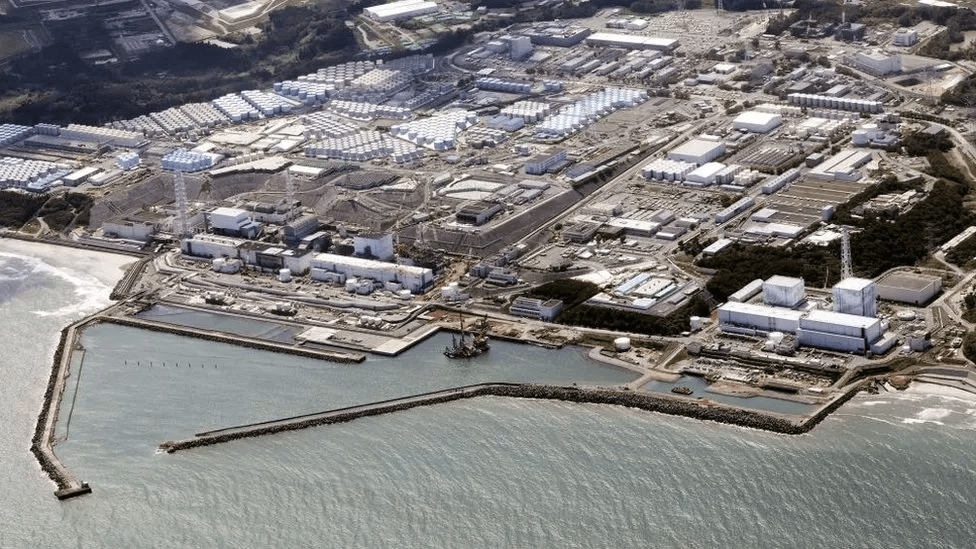
Since the catastrophe in March 2011 continuous cooling of the melted fuel and fuel debris at the Fukushima Daiichi NPP has been required. Groundwater seeps into the site from the surrounding environment, and rainwater falls into the damaged reactor and turbine buildings in addition to the water pumped in for this reason. Water becomes polluted when it comes into touch with melted fuel, fuel debris, or other radioactive chemicals. The polluted water is then cleaned using an Advanced Liquid Processing System (ALPS) filtering procedure to remove the majority of the radiation before being stored.
Since 2011, TEPCO has been in charge of decommissioning the Fukushima Daiichi power plant and managing the waste. During the tragedy, Tepco poured water into reactors to cool the fuel rods. It is estimated that over 1,000 tanks contain polluted water, enough to fill more than 500 Olympic swimming pools daily. There is a need to construct new tanks and decommission the existing ones. The sheer volume of radioactive water these are holding has sparked fear about their disaster viability in the situation of a natural calamity.
The treatment of water, as promised by both TEPCO and the Japanese government would filter the water of every other radioactive element except tritium, and both argue that the concentration of tritium does not exceed international standards. The International Atomic Energy Agency (IAEA), the United Nations’ nuclear watchdog, approved the proposal in July, stating it matched international standards and would have a “negligible” impact on people and the environment. According to TEPCO’s website, the radiation emitted by tritium is “extremely weak, and can be blocked with a single sheet of paper”. The concentration is also six times less than the limit for tritium in drinking water, set by the World Health Organization.
Geopolitical and domestic consequences:
The decision for the removal of wastewater removal has come with domestic and geopolitical implications. The proposal is highly divisive among Japanese citizens. In an August poll done by the daily Asahi Shimbun just 53% indicated they supported it, while 41% said they did not due to the population’s lack of unanimous support regarding the water release it risks deepening the mistrust between citizens and their government
The skepticism has stemmed from complacent approaches undertaken in implementing safety measures pre-tsunami due to which the government failed to forecast and respond appropriately to the crisis. One of the most dangerous prospects, if the implementation does as planned, is the literal radioactive destruction of aquaculture and other organisms in the ocean.
Japan has always had vibrant fisheries and aquaculture, being the leading exporter of fish in the global market albeit the exports have steadily declined over the years. Masanobu Sakamoto, head of Japan’s national fisheries cooperatives, was part of the protest against the planned dumping of treated radioactive water from the Fukushima nuclear facility into the sea. Sakamoto demands the government’s responsibility for any negative consequences on the fishing business and calls for greater openness and research into the long-term effects of low-dose radioactive exposure.
Several nations, notably China have declared prohibitions on particular regions of Japanese seafood imports. It quickly declared a ban on all Japanese fish imports, triggering a plunge of 76% year on year in August reflecting Beijing’s prohibition on such imports since Tokyo began releasing treated water from the wrecked Fukushima Daiichi nuclear power plant. China claims that the embargo is required to avoid radioactive contamination of food and accuses Japan of neglecting world interests. The restriction has serious ramifications for the Japanese food business, which is huge in China. There are roughly 789,000 Japanese restaurants in China valued at around $25 billion. Japan’s seafood exports to China and Hong Kong are projected to be $942.4 million and $432.3 million, respectively, in 2022.
The Japanese government has responded comprehensively to China’s worries over the release of ALPS-treated water from the Fukushima Daiichi Nuclear Power Plant into the sea. Japan used scientific proof and honesty to refute China’s assertions. It denied the presence of more than 60 radionuclides, stating that the ALPS system is meant to “eliminate 62 nuclides, with just 29 being important”. The IAEA validated the dependability of monitoring data and TEPCO data, and international involvement assures openness. Japan emphasized the peaceful use of nuclear energy while calling for respect for the IAEA’s authority and international safety standards.
Overall, the release of treated radioactive wastewater has led to a diplomatic dispute between Japan and China, with China’s seafood import ban impacting Japanese exports and businesses. This disagreement also reflects the two Asian powers’ long history of enmity, with past boycotts happening during territorial conflicts. There is a certain element of the wider geopolitical tensions omnipresent between the two states as China has adopted the stance of a unilateral hegemon with its military in the South China Sea.
North Korea’s foreign ministry has even requested that the water release be stopped immediately, calling it a “crime against humanity.” Protests against the discharge have erupted in several areas, including countries like South Korea with some protesters questioning the safety of dumping radioactive water into the ocean. While Japan insists that the water discharge is safe, it is nonetheless a sensitive topic that affects both Japan’s relations with neighboring nations and the lives of its fishing communities.
Despite numerous protests in South Korea against the release, both countries have taken a constructive approach to the situation. Given the approval ratings of the release in Japan, as well as South Korea, have been on the lower side, Japan’s Prime Minister Fumio Kishida and South Korean President Yoon Suk Yeol have worked towards increasing public faith in the safety of Fukushima’s water outflow.
The two leaders have maintained clarity about dangers and mitigation measures, which have improved Japan’s domestic and global standing. South Korea declared its support for Japan’s proposal to discharge treated radioactive water from the Fukushima nuclear plant, claiming that it satisfies worldwide safety standards and adheres to the United Nations nuclear watchdog’s permission
South Korea performed its review and decided that the proposal meets international criteria, including those specified by the IAEA. The IAEA stated that the water’s radioactive impact on humans and the environment would be low. Despite its support for the proposal, South Korea will continue to prohibit food and seafood from the Fukushima zone, agreeing to continue monitoring and maintaining a ban on Fukushima-related seafood.
Current progress:
Tokyo Electric Power Company Holdings (Tepco) has begun releasing water with tritium levels below the prescribed limits, despite concerns from local fishers and strong opposition from China.
During the Inter-Ministerial Council held on August 23 the Japanese Government announced that it had decided on the start date of the discharge of “ALPS treated water” into the sea and requested that TEPCO begin preparations for the start date.
The International Atomic Energy Agency (IAEA) and Japan have inked an agreement for continuing safety control of the treated water discharge from the Fukushima Daiichi Nuclear Power Station. With five main review areas, it assures conformity to international safety requirements throughout discharge. The IAEA’s study began in 2021 and found that there would be no radiation damage.
Following the discharge of treated water into the ocean, Japan has begun radiation testing in seawater and fish near the Fukushima No. 1 nuclear power facility. The Fisheries Agency discovered that fish captured around the facility were tritium-free. To stress the safety of the water, the government intends to collect and exchange statistics. The Environment Ministry is investigating tritium levels in 35 ocean areas while the Nuclear Regulation Authority and the Fukushima Prefectural Government are also conducting independent investigations.
Around 7,800 tons of cleaned radioactive water from Japan’s Fukushima Daiichi Nuclear Power Plant were safely released into the sea, with tritium levels below established limits. This release began in August, with the Japanese government and the International Atomic Energy Agency (IAEA) overseeing it. Tokyo Electric Power Company Holdings Inc. (TEPCO) planned to release around 31,200 tons in four phases by March 2024 due to increased water volume from nuclear fuel cooling. There have been no anomalies were discovered in the surrounding seas, and IAEA Director-General Rafael Grossi affirmed that tritium levels were within Japan’s guidelines.
The Japanese government has introduced support measures for the fishery industry and urged China to lift the ban and engage in scientific discussions with experts from both countries
Conclusion
However controversial it may be, the decision to decommission the wastewater falls at an important conjecture in history. Today as the world looks for viable replacements for conventional energy resources, nuclear energy despite its advantages has a negative connotation attached to it; precisely due to accidents like Chernobyl (1986) and Fukushima. The Japanese government has the opportunity to improve the public sentiment regarding nuclear energy and start a new era of sustainable development free from the shackles of the past
Author’s Bio
Dhruv Bonavate is a third-year student pursuing a BA (Hons) in Global Affairs at the Jindal School of International Affairs. His research interests include Sustainable energy transition and security dynamics in the Indo-Pacific.
Image Source: https://www.bbc.com/news/world-asia-66609889
 NICKELED AND DIMED