
By Harshita Hari
Abstract
This article delves into the recently passed Women’s Reservation Bill, 2023 and how emerging conversations of the Bill have been about its implementation after the next set out delimitation process. This article examines both arguments which are for it as well against it. In this article, the issue of delimitation freeze is explored and how this freeze occurred with reference to political history. There is a reference to the current South-North divide on the delimitation freeze and critical views on how each stakeholder perceives this freeze and the dated removal of the freeze in 2026.
Recently both houses of parliament passed the Women’s Reservation Bill, which reserves 1/3rd of seats in both upper houses of legislature and the Delhi legislature. The aim of the bill is to have a more gender-empowered space. The Bill garnered lots of support from all political parties while voting. The 128th Amendment of the Constitution empowered the idea of women’s reservation. It is observed in the new bill that the bill will come into power after the exercise of delimitation which is set out to be in 2026. The excitement and jitters about the new bill come to a halt, at least for a few, asking why there is an imposition of a start date for these reservations. Why can’t it be implemented now? The narrative is much more complex than this. It isn’t about political ploy for winning elections or which party really introduced this bill for debate, it’s about a deeper issue which oddly isn’t being discussed which is the use of outdated census for the current parliamentary structure.
What is delimitation and why is it so important? Delimitation is redrawing a certain constituency in a set period of time as demographics change in the particular area. Delimitation redraws constituencies so they don’t outweigh one another, as it helps make each voter’s vote count equally everywhere. It is the epitome of an electoral democracy like India to sustain in a fair manner. Delimitation, Democracy, and End of Constitutional Freeze by Alistair McMillan which was published in 1991 highlighted the issue of how using outdated census from 1971 has affected the deserved allocation of seats by states. McMillan makes a comparative chart of seats allocated in 1971 and what the redistributed seats should have looked like in 1991. Few states like Uttar Pradesh, Madhya Pradesh and Rajasthan were underrepresented, which means they had fewer seats than what they required. States like Goa, Delhi and Arunachal Pradesh were overrepresented. Similarly, Milan Vaishnav and Jamie Hinston’s India’s Emerging Crisis of Representation, which was published in 2019 highlighted the similar issues of outdated census and allocation of seats in the parliament. This paper also highlighted the same states with the same issue of whether they were underrepresented or overrepresented but with high margins this time around as demographics have further increased. It’s interesting to see a study which was done in the late 90’s-2000’s is still very similar in crux while looking at the issue as of recently. Both these papers talk about how there is a disastrous misallocation of seats among states as the population rises. With prolongment of the freeze, the removal of the freeze which must occur one day can have an amplified impact on state reactions. But what caused this delimitation freeze?
History of ‘Delimitation Freeze’
Article 82 of the Indian Constitution governs the readjustment of seats upon census. In 1976, former Prime Minister Indra Gandhi directed the suspension of the revision of seats till the 2001 census. Gandhi’s office asserted that it was done to reduce the increasing fertility rate in India. Contextually looking at this period, Gandhi’s led Congress had become immensely unpopular due to her radical social and political reforms and policy making. She suspends delimitation during the peak emergency imposed by her. Due to this, the winnable image of Congress went down. In the late 1960’s the large majority Indian National Congress also suffered splits within the party causing multiple smaller Congress parties to form in regional levels. Congress still had a fair shot in the Southern parts of India. Southern states of India have managed to have lower population rates than states in the North. Therefore, delimitation would further cause states in the South to lose seats. Many speculate that remitting the census for seat allocation was to make sure Congress didn’t lose the general elections which followed the next year. Losing seats in Southern states would lower the winnability of Congress as a party and the re-election of Indira Gandhi. She therefore stated that suspension of delimitation can help states focus on family planning and decreasing their fertility rates and also stated that states in the South would feel jeopardized of their national position due to loss of seats. This suspension was continued by Atal Bihari Vajpayee’s government in 2002. During Vajpayee’s government, a 91st amendment was passed which pushed the process of delimitation to 2026. We await for delimitation to occur in 2026, but the larger issue we must focus on is how something so crucial like delimitation and census accounts which is safeguarded by the Constitution is visibly being exploited by political minds of the country for their trivial win.
Many say that these individuals are being elected by the masses, implying a very ‘you reap what you sow’ reasoning. This ideology reflects a deeply flawed perspective on electoral democracy and the distribution of power within our nation. A democracy that can be manipulated with ease by politicians shows the repressive foundation it has. The Constitution having measures to safeguard the sanctity of the electoral process of the country and having no article or legislative provision that criminalizes the act of undermining this electoral process leaves the public with no alternative but to witness this destruction.
Implementation of Women’s Reservation Bill, 2023
Now going back to the Women’s Reservation Bill and when it will be implemented. As said earlier, the implementation of the Bill will take place after the next delimitation and census. Is it wrong? It’s not as simple as a yes or no answer, it’s imperative to understand the major stances in this conversation. Recently, Tamil Nadu Chief Minister, MK Stalin stated he is in support of the Women’s Reservation Bill but he fears as it will be implemented after delimitation, the voice of southern states like Tamil Nadu will be wiped out as seat allocations will change. Stalin made a point very similar to former Prime Minister Indra Gandhi, which is why should Southern states that have followed adequately the Union Government’s policies to control population growth in India suffer by losing their seats? Southern states jointly believe that since they do contribute a larger sum than Northern states to the current economic structure, it is only fair they have enough representation in the houses of parliament. With the rise of population in the North, there is a fear that the country will align and support the Northern region’s agenda more than the South. It also might result in national parties wishing to fulfill agendas and concerns closely related to the North to gain more support from Northern states. The debate only gets more divided on the subject. Siding that delimitation shouldn’t happen suggests that states which might not be progressively doing the best in social policies shouldn’t get equal representation. Therefore it is important to ask whether a state should be penalized for lack of representation because they might be suffering to fulfill their social reforms. It is likely that the lesser performance of states like Uttar Pradesh or Rajasthan on social fronts could be because of underrepresentation.
Therefore, Women’s reservation is a great initiative itself and it definitely is a need of the hour. It’s introduced to better the present reality we are in now, not the 1971 reality our parliament is stuck in. As many Congress leaders like P. Chidambaram, have said this is a political ploy and if it is with true intentions, implement the Bill now! This is a classic syndrome of expecting an all-you-can-eat buffet which has a clear limit. With such reservations, we forget that the parliament is running on a limit. A limit on seats, a limit on equal representation and no limit on expectations!
To conclude, the implementation of the Women’s Reservation Bill is a deep-rooted issue which is beyond the Bill. It is rooted in decades of misallocation of seats because there hasn’t been an active delimitation exercise in place. It is time we acknowledge the importance of delimitation and understand allocation of seats can never be even to all states, that defeats the fundamental idea of fair representation. The representation has to be fair, not even. As a country, delimitation and implementing census has to become an active routine for the sanity of our electoral system. As seen with the historical account, the current issue of delimitation freeze is because it is fairly easy to exploit electoral processes in our country. Our current electoral system doesn’t have a mechanism to safeguard the misuse of power of our country’s politicians. Something like delimitation which is the grassroots of our current electoral system has been a form of misuse by leaders for their own vote counts. It is high time we acknowledge our parliament isn’t the all-you-can-eat buffet we expect, not everyone can be served in this system, but it can be changed as well. Will we? Is the question left.
Author’s Bio
Harshita is a third-year law student at OP Jindal Global University. Her major interests lie in feminist and queer thought, constitutional law and the criminal justice system.
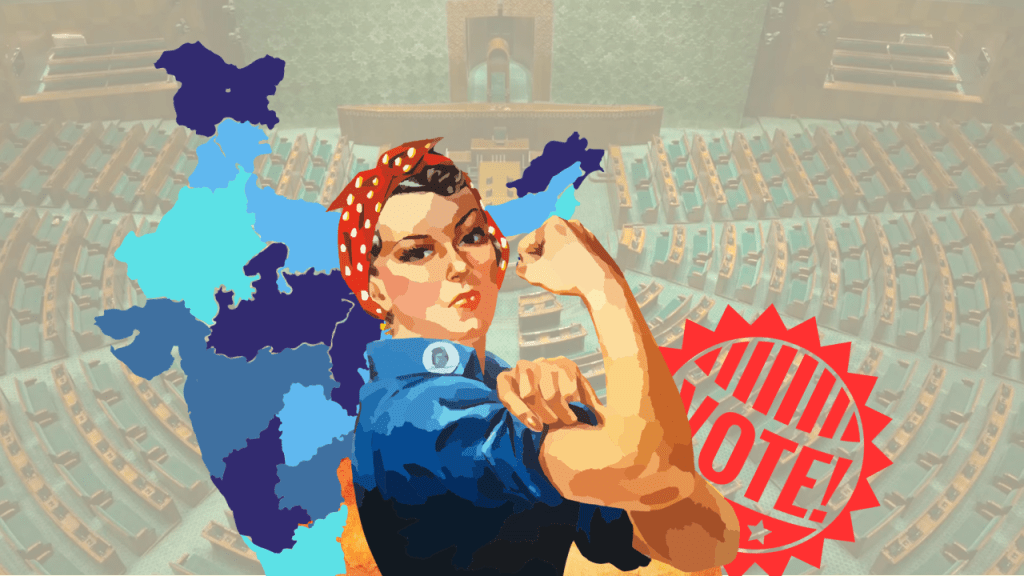
Image Source: Made by author
 NICKELED AND DIMED