By Rieshav Chakraborty
Abstract
Despite being one of the cleanest sources of energy, there is a decline in Nuclear Energy around the planet due to 3 reasons: Accidents, Nuclear Waste, and Costs. The article dives deep into clear misconceptions regarding safety concerns and goes on to discuss economic difficulties in maintaining nuclear energy. The article concludes by providing policy recommendations going forward to provide a boost to nuclear energy.
Introduction
Throughout the vast span of human history, we have grappled with the task of finding energy sources. During the Industrial Revolution, human innovation grew faster than it ever did in the past. We learnt to produce electricity a long time ago but we needed way more of it during this time and we learnt how to harness it as we were heavily reliant on fossil fuels. A few centuries later, we require more energy than ever and the priorities and constraints on producing more of it are widely different with a massive focus on what’s best for the environment.
70 years ago during World War 2, we made a scientific breakthrough and discovered how a massive amount of energy could be released by bombarding a special atom with a tiny neutron and splitting it open. Soon after the war, scientists learnt to control the chain reaction in order to produce electricity and we got a lot of it from a very tiny amount of fuel. Today, it is one of the cleanest sources of energy along with Solar, Wind, and Hydropower and in a time when fossil fuels are scarce and there is a very heavy emphasis on producing clean sources of energy for the sake of the environment, Nuclear Power is in decline. We shall discuss the reasons behind this decline and steps that could be taken to mitigate changes.
Reasons behind the Decline of Nuclear Power
There are primarily 3 reasons behind the decline of Nuclear Power over the past few years despite the promises created by it for a limitless source of energy without any carbon footprint.
- Accidents
Accidents are one of the biggest reasons behind the internalized notion that nuclear energy is scary. If you were to think of nuclear power plants, some of the first things that come to mind are probably the Chornobyl disaster (1986), the Fukushima Disaster (2011), or maybe the Mile Island Accident (1979). It is because nuclear power plants are such a massive spectacle with such apocalyptic energy to them. It is very interesting to know that during the Mile Island Accident, about 116,000 people had to evacuate, and there were 0 deaths.
When looking at how dangerous a source of energy can be in terms of human casualties, it’s important to compare them in terms of deaths per unit of electricity production.
It is clearly noticeable how fossil fuels are clearly worse off with orders of magnitude more deaths than any sort of renewable source of energy. On the other hand, nuclear energy conveniently sits between Wind and Solar and is among one of the safest forms of producing energy.
Another scary aspect of Nuclear accidents is Radiation since you can’t really see it but it breaks down your living cells itself and kills you. However, what’s interesting is how overestimated it is the amount of radiation that someone would be exposed to living near a nuclear power plant.

However, according to the diagram above, the radiation dose over a whole year is less than the radiation dose received from a typical chest X-ray or dose received during a flight from New York to Tokyo.
- Waste
There are essentially 3 types of nuclear waste, namely Low-level waste (90%), Intermediate-level waste (7%), and High-level waste (3%) as mentioned in the diagram below.

Among these, the part that concerns us is the 3% of High-Level Waste, which is the fuel spent in producing energy. Every year, we produce enough high-level waste to fill up about half of an Olympic-sized swimming pool which is miniscule compared to the amount of energy we produce out of it. However, the scary part is that the High-Level Waste doesn’t go away (doesn’t decay) and takes thousands or even millions of years to decompose.
In addition to that, the concerning part is that this nuclear waste is not centralized in one location. So there are a lot of points of failure as time goes on, you can see how this could just build up and become a massive management task.
However, some countries are implementing this thing called Deep Geological Storage or Repository. What they essentially do is assemble the fuel pellets (the high-level waste) into fuel rods, and then bury them very deep in the ground.

Another concept that’s really interesting is Nuclear Recycling. Since the high-level waste is radioactive, we can use it as an energy source. At the same time, it reduces the radioactive lifespan to only a few hundred years. In fact, Japan has been implementing the strategy for a few years now.
- Costs
Cost plays one of the biggest factors in the decline in nuclear power plants today since the ultimate end goal while generating electricity is to make it as affordable as possible while keeping environmental damages in check.

With reference to the diagram above, we can clearly see that the investment in renewable sources of energy has been increasing. However, it’s interesting to see that while investment in Nuclear Energy has increased over the years, it’s still negligible compared to other renewable sources of energy, and in fact has decreased post 2013 (possibly due to the Fukushima Accident). The better question to ask here would be how much energy we get from each of these sources.

Source: US Energy Energy Administration
We can see that while nuclear power makes up for 8% of the total US energy consumption, there are too many old nuclear power plants which are no longer very competitive with all these new sources of renewable energy. This point carries the discussion to the next point, which is the extremely high construction cost compared to other renewable sources and how that is a massive disadvantage.
High Construction Cost
The cost of constructing a nuclear power plant represents almost 75% of the cost of electricity generated from it. This is lower than the capital percentages for some other non-fossil fuel sources (80% for wind, 88% for solar), but higher than the capital percentages for fossil fuel power plants (63% for coal, 22% for natural gas).
Since the initial capital cost is so high and the construction period for nuclear power plants is relatively long before revenue starts coming in, investment can contribute up to 80% of the cost of electricity. While the World Nuclear Association (WNA) estimates the average construction time to be between 5 to 8.5 years, the average construction time since 2009 has been 10 years. Climate goals are significantly impacted by the additional time it takes to develop nuclear power stations because current fossil fuel plants continue to produce CO2 while waiting for replacement. Moreover, Delays in construction can dramatically raise a plant’s cost. Longer construction periods directly translate into higher finance charges because a power plant doesn’t generate income while it is being built and interest must be paid on debt from the moment it is incurred.
The economics of nuclear power generation have recently become less attractive in many nations, and no new nuclear power facilities have been developed in a liberalized energy market. In the past, a monopoly provider could ensure output requirements for decades to come. Private generating companies want a faster return on investment since they must now accept shorter output contracts and the dangers of upcoming lower-cost competition. There is also the additional challenge that private finance is unlikely to be readily available on favourable terms due to the high sunk costs and uncertain future revenue from the liberalized power market. This is especially important for nuclear as it is capital-intensive.
Lifetime Extensions
It is significantly less expensive to extend a nuclear reactor’s operational life than to build a new facility. Such extensions are affordable compared to other renewable energy sources, such as the creation of new solar PV and wind plants. It’s important to remember that these additions still require a sizable capital outlay. Depending on the state of the site, the anticipated cost to extend the operating life of 1 GW of nuclear power for at least 10 years ranges from $500 million to just over $1 billion.
Nevertheless, investments in extending operational lifespans face obstacles due to the difficult market conditions. In the majority of rich economies, extended periods of low wholesale energy prices have significantly reduced or even erased profit margins for numerous technologies, putting nuclear power at risk of early shutdown if new expenditures are required. As a result, the viability of these extensions significantly depends on domestic market circumstances.
Comparison With Other Sources of Electricity
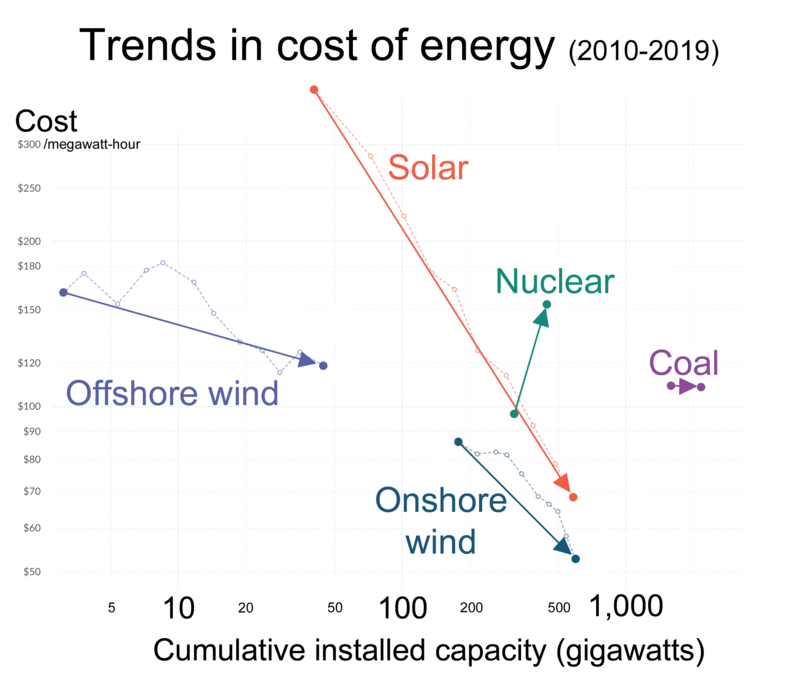
Although there has been a consistent decrease in the cost of electricity produced from Solar and Wind energy sources, attributed to significant investments and ongoing innovations, the cost of electricity derived from Nuclear Energy has risen, as detailed earlier in the article. This escalation in cost renders nuclear energy less economically viable. At the same time, natural gas is very cheap which is very disadvantageous to nuclear energy for profit making. Moreover, a natural gas combined-cycle plant uses substantially less personnel and has three guys operating the controls. These combined-cycle natural gas plants can function with the barest minimum of people, so as labour costs rise, it is bad for nuclear power which has to often employ over 500 people and thus it becomes comparatively more expensive.
What Happens when a Nuclear Power Plant Shuts Down
In USA, Nuclear energy does not qualify for federal tax credits like solar and wind energy do, nor does it benefit from state laws requiring a specific percentage of a state’s electricity to come from renewable sources. These elements have changed the economic climate for nuclear power development and jeopardize the viability of many nuclear plants.
There are hundreds of people employed at the plant who lose their jobs when a nuclear facility is shut down. The Nuclear Energy Institute estimates that each reactor in the US creates a payroll of around $40 million, employs a workforce of 400 to 700 highly qualified individuals, and contributes $470 million to the regional economy.
It would be myopic to abandon nuclear-generated electricity. Nuclear power is unmatched among sources of emissions-free electricity generation. Renewable energy sources like solar and wind power depend on good weather because they can only generate electricity when it is sunny and the wind is blowing. Both solar and wind energy depend on backup power from natural gas facilities during bad weather. While natural gas offers a number of advantages over coal as a fuel, it nevertheless contributes to smog production by releasing nitrogen oxides and large amounts of carbon into the environment.
Policy Recommendations
- Keep the door open: Authorize extensions of the operational lifespans of existing nuclear plants for as long as they can safely operate.
- Prioritize dispatchability: Structure the electricity market to adequately recognize the value of essential system services necessary for ensuring electricity security, including capacity availability and frequency control services. Ensure that providers of these services, including nuclear power plants, receive competitive and impartial compensation.
- Recognize non-market benefits: Establish a fair and equitable playing field for nuclear power alongside other low-carbon energy sources, acknowledging its environmental and energy security advantages, and compensate it accordingly.
- Revise safety regulations: If required, update safety regulations to guarantee the ongoing safe operation of nuclear facilities. Whenever technically feasible, this should involve permitting flexible operation of nuclear power plants to provide ancillary services.
- Foster a favorable financing framework: Develop risk management and financing frameworks that facilitate the mobilization of capital for both new and existing plants, taking into account the risk profile and lengthy project timelines associated with nuclear projects.
- Support new construction: Ensure that licensing processes do not result in project delays and cost escalations that cannot be justified by safety requirements.
- Foster innovative reactor designs: Accelerate the advancement of novel reactor designs characterized by lower capital costs, shorter lead times, and technologies that enhance the operational adaptability of nuclear power plants to facilitate the integration of expanding wind and solar capacity into the electricity grid.
- Sustain human resources: Safeguard and enhance the expertise and project management capabilities in nuclear engineering.
Author’s Bio
Rieshav Chakraborty is a 2nd -year student at the Jindal School of Government and Public Policy, pursuing a BA (Hons) in Economics. His research interests include Behavioral Economics, Environmental Economics, and Development Economics.
Image Source: Mining
 NICKELED AND DIMED