
By Aena Rawal
Abstract
In an era marked by unparalleled challenges and opportunities, the essence of sustainable development stands as a linchpin for shaping a just and equitable global future. This article delves into the imperative role of sustainability and tries to make a compelling case for it through Environmental, Economic and Social policy making perspectives.
Introduction
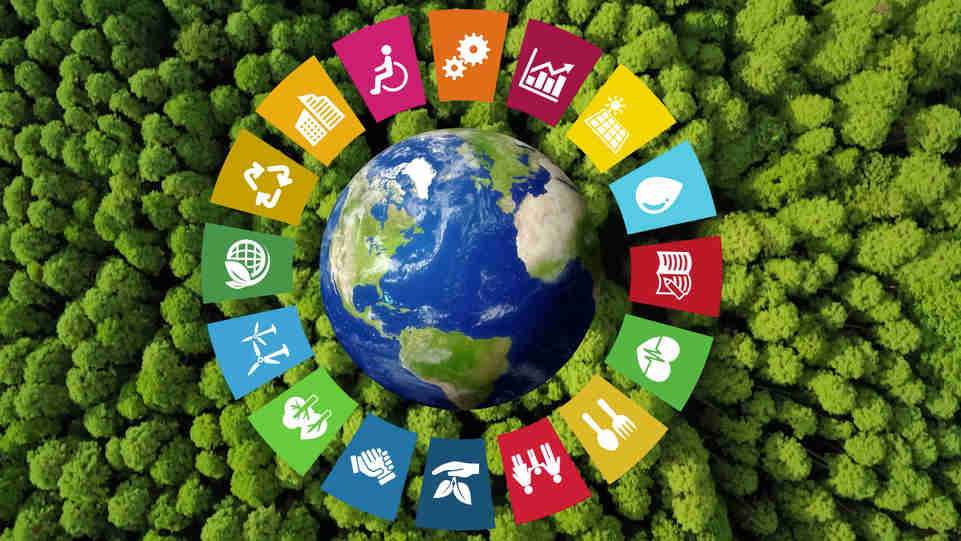
Despite a few translation issues that have led to some controversy, the term “sustainable” has been one of the most often used in the globe since 1987. The 17 Sustainable Development Goals (SDGs) established by the UN for 2030 have added to our understanding of what sustainable development is and how ambitious it is. For a more realistic meaning to sustainability, different dimensions, such as health and well-being, social equality, funding, and the energy transition have been enumerated. Here “sustainability”—the capacity to act or exist and turn an idea into a fact on the ground—comes into play. The idea of sustainability has evolved as a beacon of hope for a brighter future in a society characterized by expanding industrialization, rising consumerism, and environmental deterioration. However, sustainability also involves guaranteeing justice for every individual accompanying preservation of our only planet. The complex relationship between sustainability and justice emphasizes the urgent need to address social, economic, and environmental inequities in our quest for a society that is peaceful and long-lasting.
The vast majority of human-caused GHG emissions in the atmosphere come from businesses operating in or for wealthy nations, but poorer countries dealing with environmental shocks brought on by climate change bear an increased burden of its effects. As one illustration, the Global North has significantly increased carbon emissions per person compared to the bulk of other countries globally. Prominent examples include countries such as the United States, Canada, the European Union (EU), and Australia. Additionally, Russia and nations with hydrocarbon-based economies including Kuwait, Qatar, Saudi Arabia, and the United Arab Emirates as well as other Gulf Cooperation Council members must be mentioned here. The region even surpasses the Global North in terms of GHGs emissions through human activities.
At its core, justice is the fair distribution of resources, opportunities, and burdens within a society. When we examine the principles of sustainability, we find an undeniable overlap with justice. Sustainability seeks to maintain ecological balance, promote economic development, and uplift societies while ensuring that these benefits are accessible to everyone, regardless of their background. This interconnection is vital because environmental degradation and resource depletion disproportionately affect marginalized communities, intensifying existing social inequalities. However it is not that areas in developed nations would be spared if unsustainable models of development are continued.
Understanding through Environmental, Economic, and Urban Sustainable Perspectives
One poignant aspect of the relationship between sustainability and justice is environmental sustainability. The disproportionate exposure of vulnerable communities to environmental hazards and pollution,is not a mere coincidence but rather a reflection of systemic injustices. The UN report titled “NEGLECTED: Environmental Justice Ramifications of Marine Debris and Plastic Contamination” delves into the significant issue of plastic pollution within the framework of inequitable actions.The report includes that, “The impact of plastics on vulnerable populations goes well beyond ineffective and occasionally non-existent waste management systems. It begins with oil extraction-related problems, moves on to toxic environments and greenhouse gas emissions, and even affects water distribution policies.” It demonstrates the detrimental impact of plastic waste on the realization of Sustainable Development Goals (SDGs), particularly SDG1 addressing poverty eradication, SDG2 concerning the elimination of hunger, SDG14 dedicated to the preservation of marine ecosystems, and SDG16 aimed at ensuring universal access to justice, fostering accountable institutions, and promoting inclusivity across all levels. In another illustration, escalating sea levels is expected to endanger 410 million people by the year 2100 spanning from small island developing nations to industrially advanced countries of the world.
Economic progress plays a pivotal role in advancing human development, especially in the context of eliminating the pervasive issue of poverty. Nevertheless, the conventional approach that has been adhered to for numerous years necessitates a reconsideration. The approach of sustainable economic development commands coordination and harmony for use of natural resources, the pattern of investments, the orientation of technological development, and institutional change or reforms, therefore improving potential for meeting human needs now and in the future. In the long term, economic progress without sustainability is inefficient and ineffective. Economic sustainability needs novel methods of thinking about production and consumption patterns. To be able to create more with fewer resources and less waste, it challenges us to continually seek out new levels of efficiency. New manufacturing techniques, increased recycling, and the creation of regenerative or recyclable output components are all recommended in the approach. In order to determine how the production process might be improved, we must examine the ways things are produced, traded in, delivered, and disposed while considering the impact of economic development on natural and biological processes.
Sustainable economic growth for a just society can be achieved only through the combined endeavor of pluralist institutions, technical advancements, and the market economic system.
By emphasizing sustainability discourse, the countries will challenge conventional notions of growth and pave the way for a more just and sustainable global economy.
Another vivid illustration of the symbiosis between justice and sustainability lies in social sustainability .Social sustainability is about how spaces are organized and utilized. Presently, approximately 56% of the global populace, totaling 4.4 billion individuals, resides in urban spaces. The cities are hotbeds of economic activity and environmental impact. Sustainable urban planning that prioritizes equitable access to resources, green spaces,affordable housing and climate resilient development depicts that justice can be integrated into the urban fabric. Here, urban heat island effect, offers a great example. On a worldwide level, folks in developing nations, especially in places like South Asia, Africa, and East Asia, who haven’t really played a big role in causing climate change and lack the means to adjust, will probably feel the worst effects of health problems due to super hot conditions brought about by climate change. Looking at individual cities, areas with lower-income residents or communities that are often overlooked, plus places with less developed facilities and services like fewer parks and a history of housing neglect, are noticeably hotter.
Conclusion
It is important to note that the concept of sustainable development, often referred to as sustainability, is considered a wicked problem. It is a complex issue intertwined with both intergenerational and intragenerational concerns, demanding continuous engagement with stakeholders. A wicked problem is challenging to define and solve due to its subjective nature and far-reaching impact. This subjectivity ensures that there is no one-size-fits-all solution to any given problem. To achieve the goals of sustainable development, the Systems of Systems (SoS) approach is deliberated as the solution. This holistic approach ensures the integration of various systems—economic, environmental, and social—along with the interrelationships between stakeholders and their respective concerns. To forge equitable societies through sustainable development is an urgent imperative. The Sustainable Development Goals (SDGs) serve as a roadmap for this journey, highlighting the interconnectedness of sustainability and justice.
Author’s Bio
Aena Rawal is a Public Policy Masters student at Jindal School of Governance and Public Policy with a passion for Urbanism and Sustainable Development.
Image source: https://www.telegraphindia.com/opinion/slip-up-editorial-on-india-lagging-behind-on-sustainable-development-goals/cid/1919856
 NICKELED AND DIMED