
By Rohit Muthiah
Abstract
USA is known for having large amounts of debt, which has been steadily increasing. However, with the US dollar being used as a global currency, the nature of US government debt is vastly different to that of other countries. In this article, I shall seek to show how the US uses the ‘debt-ceiling’ to borrow money and the implications this holds domestically and internationally.
“Our system of debt-fueled economic growth is eating itself alive,” said economist Paul Gilding. This issue has never been as pertinent as it has been in the recent past.
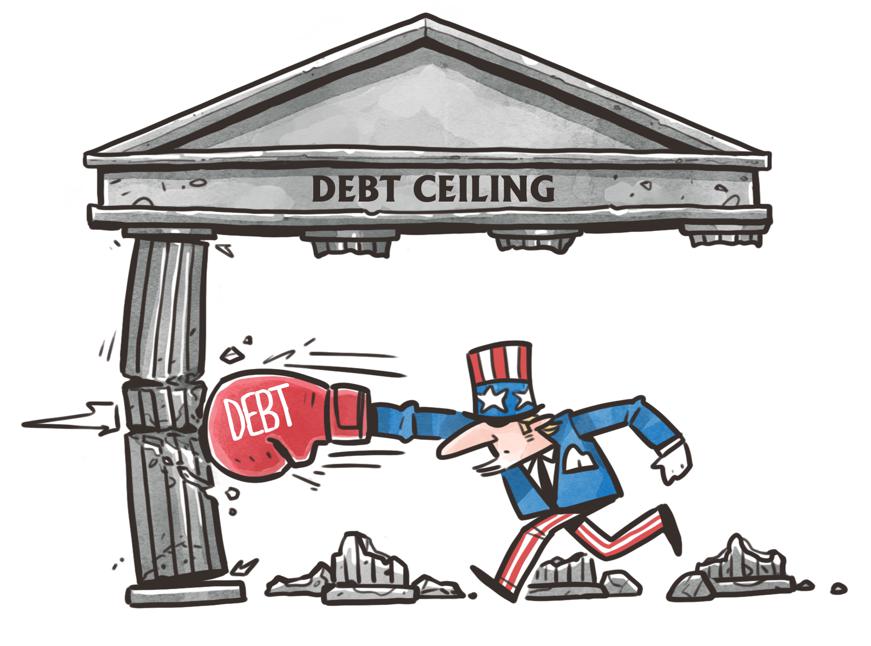
On Jan 19 this year, the United States officially reached its so-called “debt ceiling” limit. After nearly 4 months of grueling negotiations, on May 31st the US House of Representatives passed a bill to suspend the country’s debt ceiling till 2025. It is said that this is the 90th time the debt ceiling has increased in the 20th century alone.
A potential default by the US government on its debt would have triggered an economic catastrophe. Such a scenario was starting to look highly likely and kept global markers in a state of limbo and uncertainty for almost 4 months. Naturally, this agreement between US policymakers has been met with a collective sigh of relief from the international community.
What is the debt ceiling?
Central governments often spend more than they earn, and as a result, incur a budget deficit. They then have to borrow money to match the deficit. Instead of borrowing money from other countries, the US Federal government, as it is called, raises its own money by issuing government bonds. Simply put, the debt ceiling is the maximum amount of money that the United States can borrow cumulatively by issuing bonds.
The debt ceiling was created under the Second Liberty Bond Act of 1917, to limit borrowing more money just to meet some of its existing obligations , such as government salaries and pensions. The primary purpose of this ceiling is to prevent the country from going into a vicious debt cycle.
The problem for the US, however, is that they have reached their debt ceiling multiple times, the latest being January 2023. This means that they cannot borrow more money. The only way out is either for the debt ceiling to be raised, or for their tax revenues to be good enough to match their spending needs.
When it was first introduced in 1917, the ceiling limit was a mere $1 billion. It now stands at a staggering $31.4 trillion. To avoid the risk of default, the debt ceiling has been tweaked 61 times since 1978, which works out to once every 9 months! There have been several showdowns over this, some of which have even led to government shutdowns.
Impact of the agreement
Amidst the uncertainty surrounding the debt ceiling from January to May, interest rates on US Treasury bills rose significantly, by around 7%. This increase also affected derivatives used to protect US treasuries, leading to higher prices. Developments like these had a ripple effect on the global foreign exchange market, especially impacting emerging market currencies. Concerns also abound about the reduced confidence in US assets and the potential implications for the US dollar’s status as a global reserve currency.
In 2011, when the US faced a similar debt ceiling crisis, its credit rating was lowered and massive panic in global markets ensued. While the downgrade was only due to the high levels of domestic debt, its ultimate impact on a global level should not be underestimated.
This current debt ceiling resolution has had a significant impact on not only the global markets but the Indian market as well. Following the announcement of the agreement, the BSE Sensex experienced a massive surge, nearing an all-time high. The Nifty50 also made significant gains. This accurately highlights the profound interconnectedness of the global economy and the substantial influence that U.S. fiscal policy holds over emerging markets.
Understanding the ramifications
However, it is important to be wary of the fact that this is only a short-term relief. The debt ceiling deal has broader implications for the Indian economy and other emerging markets.
It is crucial to understand and be ready for long-term ramifications, given the massive interdependence of the global economic landscape.
President Joe Biden said that “the nation has never defaulted on its debt, and it never will.” But suppose this agreement had failed and the US did default on its obligations, the consequences would have been dire. This would have reverberated across the global financial ecosystem and resulted in a catastrophe similar to that of the 2008 financial crisis.
India is a country that is heavily reliant on foreign investments. In an instance of a US default, there would be a significant outflow of capital from the country. This would create significant volatility and downward pressure on the Indian Rupee, which would in turn result in higher inflation, hurt corporate profitability, and undermine economic growth
Further, a US default would increase global risk aversion, and borrowing would become more costly. Large economies like India would be particularly affected. Higher cost of borrowing would put more pressure on India’s fiscal situation and also constrain India’s ability to finance infrastructure and other growth-enhancing investments.
The Road Ahead
Even with the current deal in place, the US still grapples with the future implications of its soaring national debt, which continues to remain an unsolved problem. But on the flip side, global economic growth remains positive for the foreseeable future owing to high US spending. That is until it again hits the ceiling.
The good thing to come out of this whole ‘debt-ceiling’ saga is that it has shown countries the importance of building resilience against such external shocks. It has reiterated the need for a robust fiscal strategy that can effectively navigate the uncertainties of the global economic landscape.
To this end, India has to try and increase growth in the domestic sector and implement growth-oriented policies. It should strengthen its foreign exchange reserves and maintain a clear fiscal approach. Enhancing the competitiveness of the Indian economy and encouraging investments in crucial sectors that drive growth should be prioritized.
By adopting a comprehensive and multi-faceted approach like this, India and other countries can better equip themselves to navigate the challenges posed by global events like the US debt ceiling crisis.
Author’s Bio
Rohit Muthiah is a first-year student at Ashoka University, pursuing a degree in Economics and Finance.
Image Source: https://global.chinadaily.com.cn/a/202305/12/WS645d7383a310b6054fad280f.html
 NICKELED AND DIMED