
By Diksha Mittal
Abstract
This article aims to undertake a comprehensive analysis of the legal implications depicted in a widely acclaimed film, elucidating its contribution to the comprehension of criminal law intricacies. By delving into the film’s narrative, this study seeks to unveil the complexities of criminal law involvement, thereby offering profound insights into its multifaceted dimensions. The film, a global sensation captivating millions, serves as a unique lens through which the legal intricacies can be scrutinized. Through a meticulous examination, this article endeavours to provide a nuanced understanding of the intersections between cinematic artistry and the legal realm, shedding light on the broader implications for both Indian nationals and global audiences.
- Introduction and Issues Raised:
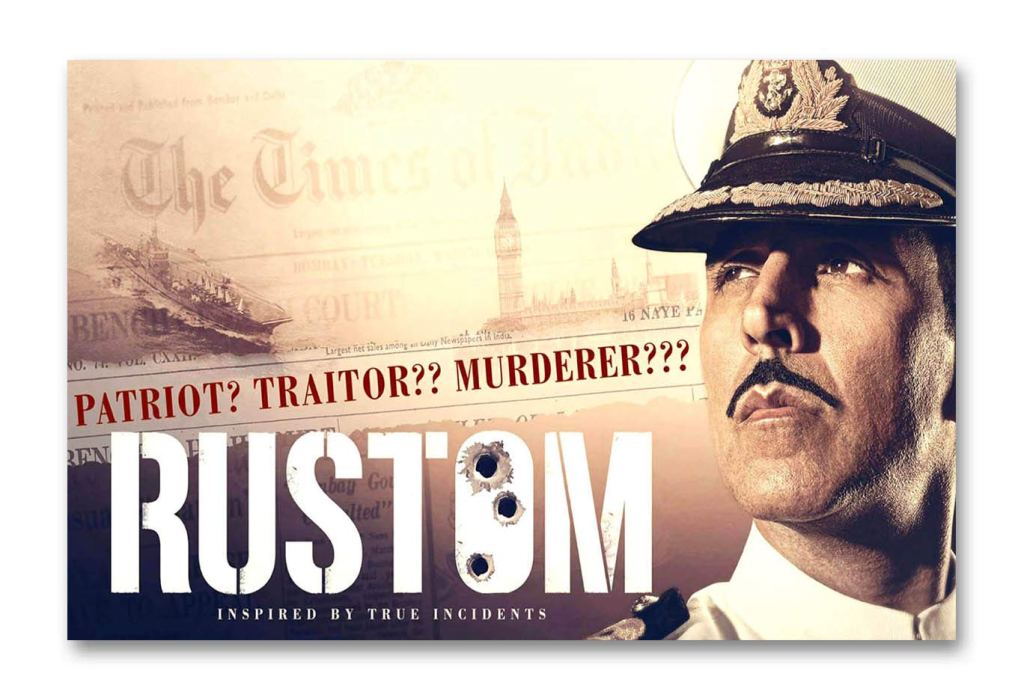
The film Rustom, featuring Akshay Kumar and Ileana D’Cruz, resurrected one of the most contentious and infamous cases in Indian legal history: the 1959 Nanavati case. After all, it was this case that contributed to India’s final abolition of the jury system. This film is based on the true story of a navy officer, his gorgeous but lonesome wife, and her lover, as well as a controversial murder. In the movie, after finding that his wife, Cynthia, had an infidelity with the affluent businessman, Rustom Pavri, an esteemed officer of the Indian Navy, shoots his mate Vikram to death. The Commander promptly surrenders to the police and admits to killing Vikram, but pleads ‘not guilty’ in court on the grounds of self-defense. He was found not guilty by the jury. The objective of this article is to critically examine the legal perspective of this film to have a better understanding of criminal law involvement and intricacies in something as simple as a film watched by millions of Indian nationals and people all around the world.
- Relevant Sections Applicable:
As already remarked, Rustom is based on a true story, yet still so distant from reality. Some aspects of the movie like Adultery (§497), battery (§352), criminal trespass (§441), and criminal intimidation (§503) are all relevant sections of the Indian Penal Code (IPC) that apply to the crime committed in the film. However, after critically investigating the movie, one may acquire several substantial legal issues, including:
Culpable Homicide: Culpable homicide is defined in Section 299 of the IPC as “Whosoever causes death by doing an act with the intention of causing death or with the intention of causing such bodily injury as it is likely to cause death or with the knowledge that he is likely by such act to cause death.”
Rustom obtained a pistol under false pretences and went to the victim’s residence with a loaded gun, shooting him twice in the chest, causing the victim’s death. Thus, he was tried in the court of law under Culpable Homicide.
Self-defense: According to Section 96 of the IPC, “nothing is an offence, which is done in the exercise of the right of private defense”, while Section 97 states that “every person has a right to defend his own body, and the body of any other person, against any offence affecting the human body.”
Rustom claimed he went to the victim’s residence to resolve their feud, but when they met, one thing led to another in the heat of the moment, ending in a scuffle between the two. Hence, in court, Rustom claimed to have exercised his right to self-defense to defend himself.
Provocation: Section 300 of the IPC makes an exemption for deaths that occur as a result of acts committed under the influence of grave and sudden provocation. If the death was prompted by a well-planned plot and the major goal of the provocation was to commit murder, the accused cannot plead to sudden or grave provocation.
Rustom claimed he went to the victim’s residence to resolve their feud, but when they met, one thing led to another, and Rustom, in a grave and sudden provocation, pulled out his revolver and shot him thrice in the chest. In court, he argued that his actions were justifiable due to grave and sudden provocation.
Attempt to murder: According to Section 307 of IPC, “Whoever does any act with such intention or knowledge, and under such circumstances that, if he by that act caused death, he would be guilty of murder, shall be punished with imprisonment of either description for a term which may extend to ten years, and shall also be liable to fine; and if hurt is caused to any person by such act, the offender shall be liable either to [imprisonment for life], or such punishment as is hereinbefore mentioned.”
Rustom’s actions in this movie, such as obtaining a loaded pistol from a ship under false pretences, carrying it to the victim’s residence, and shooting him thrice in the chest, were tried in court as an attempt to murder.
- Understanding the Conundrum Involved Critically:
This case came down to one crucial question: Can the acts of Rustom be equated as a crime of passion (an act undertaken “under grave and sudden provocation”) or be equated as premeditated? However, the appointed jury determined that he was merely protecting his and his wife’s honor and that he had not committed any criminal offense as a consequence. The jury’s judgment was based on the idea of masculine honor and a man protecting his woman and making sure she is committed to him as a justification for murder rather than the standards of fairness.
Many of the scenes in the film were entirely hypothetical, there were fewer specifics provided in terms of criminal law. According to me, the outcome would be entirely different if the offense were prosecuted under contemporary Indian criminal law. The jury in the film neglected to consider the “Stages of the crimes” which is a standard followed in criminal law, resulting in gaps. The first stage of the crime, the intentions of Rustom, could be deduced from the incident of a revolver being obtained under false pretences. He had the demeanour of someone who had planned and calculatedly executed vengeance on his wife’s lover. His conduct of acquiring the handgun on a false pretext deduces the second stage of crime, which is preparation. Despite having several occasions to do so, he did not notify anyone that he shot the deceased by mistake until his trial. His actions, such as going into Ahuja’s bedroom with a loaded weapon, plainly demonstrated the attempts stage, since he is acting towards the commission of a crime. Furthermore, as noted in R v. Robinson [1915] 2 K.B. 342, the accused’s conduct of striding into the victim’s bedroom with a loaded pistol is directly associated with the commission of a crime. Later, he shot him, completing all of the stages of the crime and resulting in the commission of the crime.
As a result, in my opinion, the courts, under existing Indian criminal law, would examine the stages of the crime and reject the defense of grave and sudden provocation (exception 1 to section 300 of IPC).
The word ‘sudden,’ as held in Mahmood vs State on November 17, 1960, involves two components. The provocation must, first and foremost, be unanticipated. The provocation cannot be considered to be unexpected if the accused anticipates receiving a provocation to validate the following killing. Second, the time between the provocation and the homicide should be as short as possible. Therefore, we may deduce that the provocation claimed by the accused was not sudden and grave, as he testified in court that he had anticipated the provocation because he was afraid of the victim’s propensity of becoming agitated and pulling out the pistol. He claimed self-defense for bringing the pistol to the victim’s home but based on these shards of evidence it should be disqualified. Moreover, the period between the provocation and the homicide was not brief since he travelled to the ship to pick up the gun and the victim’s office at that time. Furthermore, was the verbal split between Ahuja and Nanavati when he arrived at the former’s residence adequate to provoke such a provocation? A mere remark cannot be called provocation; an objective evaluation is required.
Furthermore, there was no deprivation of self-control power and it was not continuing from the perspective of a reasonable individual. His asking Ahuja about him marrying his wife shows that he was in self-control and was making plans for the future. Furthermore, no reasonable person would shoot a man three times in the chest to defend himself in a scuffle. He undertook things exceptional that no reasonable person would do in a similar situation.
We may also deduce that his actions were planned and premeditated because he was also thinking about the future of his family and he had ample time to cool down after his wife disclosed her infidelity to him.
As a result of his vengeance and premeditated plan, he shot the victim, leading to his death. Hence, it’s apparent that his actions were pre-planned rather than the outcome of a spontaneous provocation.
The accused should also be liable under Culpable homicide because his actions satisfy all the ingredients of Section 299.
The notion that he killed the victim by shooting him three times in the chest demonstrates his actus reus. So, we can deduce that his actus reus was the proximate cause of the victim’s death. The fact that he shot himself in the chest three times proves his intent to kill. He could have shot someplace else and only once if it was in self-defense, but instead, he shot him three times and constantly, which was unnecessary. His conduct of taking a loaded pistol to the victim’s house and using it instead of a lathi or asking for help demonstrates his intent to cause bodily injury that is likely to result in death. Any other reasonable individual in the same situation would not have responded in the same way since it is foreseeable that firing with a gun will result in serious injury and death. There was no room for doubt that death could certainly be caused. He had knowledge of his actions since he had meticulously planned and executed vengeance on his wife’s lover. He calculatedly obtained the pistol under false pretences and took it to the victim’s residence, where he shot him in revenge.
Therefore, as it is proven above, it was a pre-planned strategy with intention. So, the accused should be found guilty under (section 304 (1) IPC) and sentenced to life imprisonment with liability to pay a fine.
- Conclusion:
This film is lacking in the unsettling tension that such a film should have. Director Tinu Suresh Desai, on the other hand, adds a lot of drama and suspense to the film. This courtroom play is based on the true story of naval commander KM Nanavati, although the ending has been cleverly dramatized. Given that this was the country’s final jury trial, the narrative should have been much better. As a result, in my opinion, this film did not address criminal law or the aforementioned key components of criminal law but rather focused on the lives of the individuals involved.
Author’s Bio
Diksha Mittal is a bachelor of Law student at Jindal Global Law School, Sonipat, India. Her enthusiasm flows towards legal research and drafting and she would also like to write about various public policies and key areas of the law that she feels are significant for society. She has worked at a variety of different places to gain expertise in the legal field. Additionally, whether it is in corporate or commercial law, she is keen on working, learning, and expanding her horizons across numerous legal disciplines.
Image Source: Official Movie Poster
 NICKELED AND DIMED