
By Amisha Mittal
Abstract
This second installment of a two-part series examines the film ‘Court,’ directed by Chaitanya Tamhane, through the lens of caste-based prejudice within the Indian legal system. Building upon the previous analysis of the film’s characters, this section delves deeper into the issue, unraveling the pervasive nature of institutionalized casteism that obstructs justice. Drawing insights from scholars like Prof. Upendra Baxi, the paper underscores the paradoxical relationship between law and caste-based violence, revealing how the absence of law’s enforcement perpetuates discrimination, as exemplified by the cases of Narayan Kamble and the manhole worker in the film. The study also references Teltumbe’s insights on the State’s role in perpetuating casteism and highlights instances where law enforcement agencies exhibit deep-seated biases. Moreover, the paper explores the connection between manual scavenging and caste, shedding light on the structural underpinnings of caste-based occupational hierarchy. The article critically evaluates the persistence of caste-based violence despite legislation, such as the SC/ST Prevention of Atrocities Act, and scrutinizes the failures of the executive in protecting marginalized communities. By exposing how state machineries perpetrate caste-based violence and suppress legitimate expressions of dissent, the analysis underscores the significance of cultural institutions like the Kabir Kala Manch in challenging the status quo. The film ‘Court’ serves as a poignant portrayal of the intricate interplay between casteism, systemic prejudice, and the struggle for justice in contemporary India.
Theoretical Underpinnings
To understand the happenings in the film ‘Court’, the author refers to none other than India’s own jewel Prof. (Dr.) Upendra Baxi. Baxi in his work emphasizes on the paradox of Primitive accumulation that takes place when there is an absence in the presence of law. While the law prohibits caste and class-based violence and discrimination, the same goes unchecked and unimplemented in real scenarios like the film where both Narayan Kamble and the manhole worker face discrimination. The same can be attributed to the cases of child and bonded labor even where there is a legislation prohibiting it, but the implementation stands absent. The case of Narayan Kamble is a subtle example of how caste discrimination works, in practice. There are cases such as the Khairlanji Massacre where the situation is much larger than being detained, where a family is killed and molested by tens of people owing to their caste and the same goes unrecognized and unreported by the police arising out of mere ignorance. The Khairlanji atrocity is a prime example of how the state apparatus which is responsible for protecting Dalits from societal prejudice itself becomes a major perpetrator of caste crime. The same happened in the case of Narayan Kamble where the state, which must uphold one’s right to free speech, protect the minorities and prevent prejudice itself perpetrates it. The judiciary, the prosecutor as well as the investigating officers are all examples of the failing role of the Indian legal system to use their authority and power for justice.
Further, Teltumbe in The Persistence of Caste exposes how the State is responsible for protecting Dalits from societal violence and prejudice that perpetuates casteism in the first place and also goes on to exhibit the State’s aversion to naxalism that further oppresses Dalits and Adivasis. He argues that the caste-based character of the State persists irrespective of who dominates the administration, be it, the marginalized castes, or the dominant castes. An illustration of this statement is visible in the film where the police are questioned by the defense lawyer, Vinay Vohra, regarding the unlawful arrest of the protagonist, Narayan Kamble. He asks the police officer to show the arrest warrant and the reason for arrest given he was just singing songs. This is a deeply critical moment in the film where the caste biases and prejudice of the police against a Dalit man are subtly perceptible to the audience. This goes to show that though the structure of the police as an institution of the government is supposed to be non-prejudicial since it is run by individuals and because “institutions are trans-individual and maintain its character despite the individuals that are a part of it”, the institutional structures i.e., the police here breeds casteism. Teltumbe brilliantly exposes the relationship between “Dalits, privileged castes and the state, with the privileged castes everywhere denying Dalits their rights and receiving partisan preference from the police.” The fact here is that, because the defense lawyer, Mr. Vohra, belongs to an upper-caste Hindu family who is educated and financially stable, therefore, he was in a position to sit at the police station and question the officials. The police entertained him knowing his background and reach. Had it been another Dalit coming and asking the same questions, there is a high possibility that the police would have reprimanded and shooed that person away or worse, harassed them. This instance illuminates the structural necessities of the neoliberal state and the state acting as perpetrators of caste violence instead of protecting the Dalits.
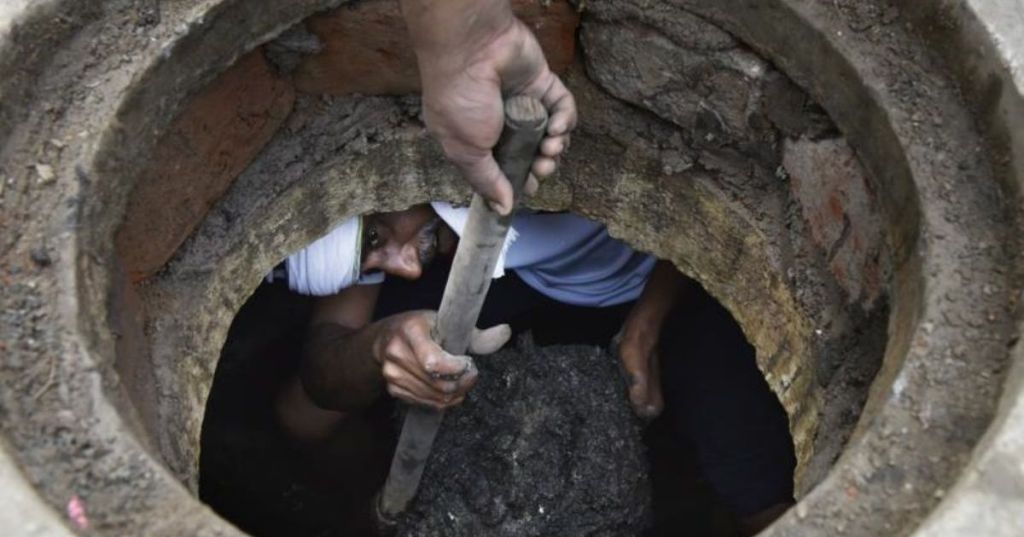
It is to be noted that caste is at the heart of the film ‘Court’ and Manual Scavenging as a profession is deeply rooted in caste. Clifton Rozario, a Bengaluru-based advocate, petitioned against manual scavenging in the Karnataka High Court stating “Any death related to manual scavenging is called an accident, but the truth is that it is culpable homicide if not murder. When you send someone inside a pit with poisonous gases, you are aware of the danger to that person’s life”. He went on to state that manual scavenging is a caste issue. Any kind of sanitation worker be it, a sweeper or manhole worker or toilet cleaner at airports etc., all of them predominantly belong to the Dalit community. This is institutionalized casteism where work is reserved only for the members of the Dalit community as they are born into this by birth and there is a lack of choice here given the institutional structures around.
The initial inheritors of the Indian British colonial state were landlords and capitalists that created an egalitarian constitution. While a new constitution was drafted by Dr. Ambedkar, a lot of colonial legislations in modern India were passed unchanged and used by the government as and when necessary. For instance, the Land Acquisition Act is often used to usurp land from Dalits and Adivasis and create tax heaves for multinational corporations in the name of Special Economic Zones. While such instances still represent a subtle way of how caste prejudice works, cases of detention and state-sponsored atrocities are much bigger yet common forms of caste-based violence. A method of perpetrating state-sponsored violence is through the use of the police force for inflicting brutality against Dalits. The same can be traced back to the case of Khairlanji where the police repeatedly bashed the Dalits who sought their protection and ended up covering up the caste atrocity when they were raped and killed eventually. The film ‘Court’ also represents the role of police while showcasing their poor investigation, and state-sponsored prejudice where the entire judicial system treated Kamble as a nuisance and refused to provide him with justice disregarding the fact that a song abetting suicide never existed in the first place and that his poetry was nothing but a form of expression to register dissent and spread awareness about social inequalities.
SC/ST Prevention of Atrocities Act
Another example of the state turning a blind eye toward caste prejudice can be seen in Rao’s Death of a Kotwal. While the Scheduled Caste/Scheduled Tribes Prevention of Atrocities Act is seen as a key achievement and result of Dalit mobilization, the implementation of this law takes a different form and is highly unregulated. This piece talks about a Dalit’s killing on August 17, 1991, in Maharashtra. The killing was associated with various absurd narratives with the killing with his family registering it as caste violence, the police shunning it as a spontaneous incident unrelated to caste and being related to things like alcohol consumption and illicit relations, and the state regarding it as a result of political activism while the entire case was, in fact, a caste atrocity arising out a Dalit entering a temple and trying to install an ‘Ambedkar’ statue in the locality. No stringent punishment was given to the accused in this case and thus, the implementation of the SC/ST Prevention of Atrocities Act which was passed 2 years before the incident took place went unregulated.
Manual Scavenging remains unchecked, but this is not the limit of Caste prejudice.
The film, Court, is a prime example of caste-based violence perpetuated through the governmental structures i.e., the police, judiciary, and executive. Despite having a manual scavenging act known as, The Prohibition of Employment as Manual Scavengers and their Rehabilitation Act, 2013, the atrocious practice of manual scavenging persists in India, that too, without supplying the manhole workers with requisite tools and masks for cleaning. This is where the executive fails. Implementation of government orders and laws is deplorable for the protection of Dalits. The case is entirely different when it comes to privileged castes who are surrounded by the bureaucratic sycophants available at their beck and call. The judge’s apathetic response towards Kambale in the film alongside the police action to intentionally prosecute a Dalit man illustrates the caste-based violence perpetuated by State machineries. Manipulation of such acts of expression to stifle legitimate criticism in a democracy like India, which claims to be democratic in the true sense, is a violation of the fundamental right to freedom of speech and expression, which has been guaranteed to the Indian citizens without discrimination on a variety of grounds, including caste and lineage. Folklore singers like that of Narayan Kamble and The Kabir Kala Manch are institutions that have survived extended periods of state atrocities and are still on a mission to change the world with music and calmness of poetry rather than violence.
Author’s Bio
The piece is authored by Amisha Mittal. Amisha is a final-year student at Jindal Global Law School. Her interest areas lie in Intellectual property and Competition law.
 NICKELED AND DIMED