By Nishtha Aggarwal
Abstract
On 26 July 2023, the Lok Sabha witnessed a significant political upheaval as the opposition parties united to raise a momentous no-confidence motion against the ruling Bhartiya Janata Party (BJP)-led National Democratic Alliance (NDA) government. This event exemplified the enduring importance of no-confidence motions in parliamentary systems and their potential repercussions on the nation’s governance. This article provides a comprehensive overview of the historical origins of no-confidence motions and traces their evolution to modern parliamentary practices. It highlights the power that no-confidence motions hold in reinstating the democratic principles of a country by enabling and forcing discussion of issues of importance.
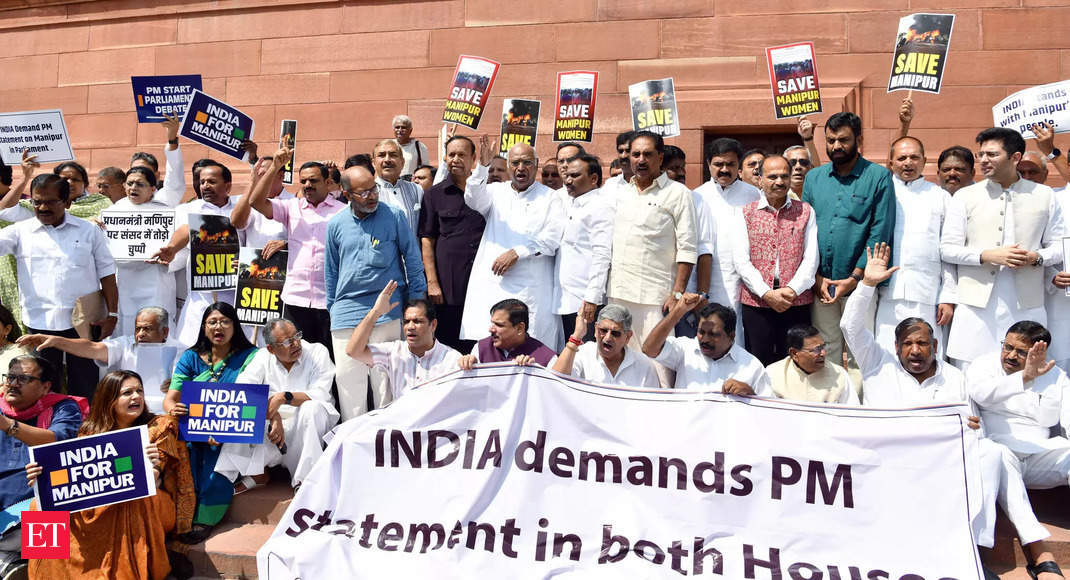
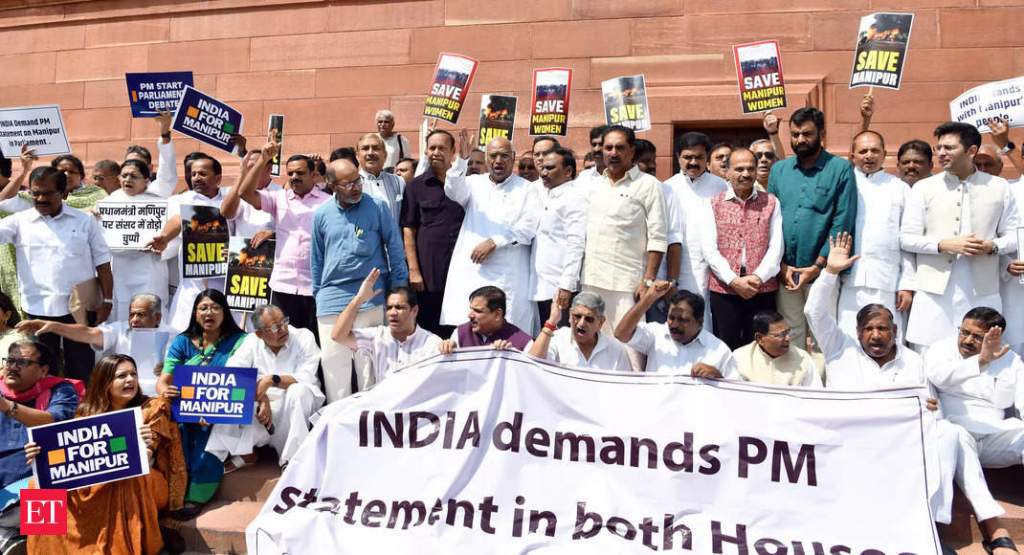
A political upheaval occurred in the Lok Sabha on July 26, 2023, when the opposition parties banded together to introduce a motion of no confidence in the National Democratic Alliance (NDA) government, which was led by the Bharatiya Janata Party (BJP) to reprimand the silence and absence from discussion of the Prime Minister on the Manipal ethnic conflict. The conflict between the predominantly Christian Kuki and Naga tribes and the majority Hindu Meitei group in the BJP-led state of Manipur started in early May, but the Indian government has largely kept quiet about it. However, videos of two Kuki women in Manipur being stripped naked and attacked by a mob and then being paraded through a village recently went viral, igniting a national outcry and drawing criticism from around the world. This incident serves as a prime example of the continuing significance of no-confidence motions in legislative systems and their potential impact on the direction of the country’s government. This article will explore what a vote of no confidence is, trace its historical origins and discuss some of the most impactful votes of no confidence seen throughout history. It will in turn discuss the significance of such a tool in upholding the fundamental notions of a democracy.
What is a Vote of No-Confidence?
A vote of no confidence, also known as a motion of no confidence, is a declaration or vote on whether a person in a position of responsibility, such as in management or government, is still deemed qualified to hold that position. This could be due to factors like their shortcomings in one area, their failure to fulfill their duties or the decisions they make being perceived negatively by other members. The legislative motion shows the head of state that the elected legislature either still has confidence in one or more members of the appointed administration or no longer does. In certain nations, a minister must resign if a motion of no confidence is carried against him or her. If the minister in question is the premier, the majority of the time, all other ministers must resign as well.
A vote of no-confidence serves as an essential tool for democratic governments all around the world, as it allows the opposition to exercise its rights and demand accountability from the ruling government. It is an excellent tool to urge discussion and debate on matters of pressing importance.
Historical Origins of No-Confidence Motions
The historical origins of no-confidence motions can be traced back to the emergence of parliamentary systems and the need for mechanisms to hold governments accountable. The concept took shape in the 17th and 18th centuries, during the early development of modern democracies.
The British Parliament voted in March 1782 that it could no longer repose confidence in the present ministers in the wake of the British defeat at Yorktown during the American Revolutionary War the previous October. This was the first motion of no confidence against an entire government. In response, Lord North, the British prime minister, requested that King George III accept his resignation. An immediate constitutional convention was not triggered by that. Sir Robert Walpole’s resignation in 1742 following a Commons vote defeat is regarded as the first de facto motion of no confidence, even though it is the first statutory motion of no confidence.
When it comes to India, a no-confidence resolution could be introduced in the Lok Sabha in 1952 if 30 MPs supported it. Even so, not a single motion for a vote of no confidence was introduced during the first two Lok Sabhas’ terms. The first one was introduced by Acharya J B Kripalani in 1963 during the third Lok Sabha against the Jawaharlal Nehru-led government. In response to the motion, Jawaharlal Nehru said, “A no-confidence motion aims at or should aim at removing the party from government and taking its place. It is clear in the present instance that there was no such expectation or hope. And so the debate, although it was interesting in many ways and, I think profitable too, was a little unreal. Personally, I have welcomed this motion and this debate. I have felt that it would be a good thing if we were to have periodical tests of this kind.”
Overall, the historical evolution of no-confidence motions reflects the development of modern democracies and the ongoing efforts to strike a balance between government stability and accountability. From their informal beginnings to their formalization in modern political systems, no-confidence motions have remained a crucial feature of parliamentary governance worldwide.
Landmark Moments: Historical No-Confidence Motions in India and Their Impact
The forthcoming no-confidence motion against Prime Minister Narendra Modi will mark the 28th such motion to be raised in the history of independent India. However, there were some votes of confidence that significantly impacted the landscape of the Indian government in their time.
As mentioned earlier, Acharya J.B. Kripalani introduced the first vote of no-confidence in the Jawaharlal Nehru administration in 1963 over the prime minister’s China policy, immediately following the war of 1962. The debate lasted 21 hours and 33 minutes over the course of four days (August 19–22, 1963), according to G.C. Malhotra’s book Cabinet Responsibility to Legislature: Motions of Confidence and No-Confidence in Lok Sabha and State Legislatures, which is available in the Parliament digital library. When the motion was put to a vote, 44 members supported it, 62 supported it and 347 members opposed it.
In 1979, Y B Chavan of the Congress party introduced a no-confidence resolution that ultimately resulted in the overthrow of Prime Minister Morarji Desai’s administration. Desai resigned before the motion could be put to a vote following a nine-hour debate over two days. In the previous year, 1978, CM Stephen of the Congress group led by Indira submitted a motion of no-confidence in Desai. This successful removal of the ruling government from power played a role in displaying the pragmatic power of no-confidence motions in addressing the grievances and lack of trust felt by the opposition.
Prior to Modi, Vajpayee’s administration faced a no-confidence vote in 2003, which was brought by Sonia Gandhi. Vajpayee, however, opposed the proposal with a 125-vote majority. Vajpayee served as prime minister twice, once from 1998 to 1999 and once in 1996. In an effort to demonstrate his majority in the house, he had moved three motions of confidence.
The 12th Lok Sabha was prematurely dissolved as a result of his narrow defeat in the third election in April 1999, which was followed by the opposition failing to assemble enough support to form a government.
The Congress’s no-confidence motion will be the second one Modi has faced in his nine years in office. Modi lost his first motion for no confidence in 2018. Kesineni Srinivas of the Telugu Desam Party would move the motion since his name was drawn in the lottery, according to Speaker Sumitra Mahajan, who listed all opposition members who had introduced comparable resolutions to remove the speaker from office. The Modi administration overcame the no-confidence motion in the Lok Sabha by 199 votes following a contentious 12-hour discussion.
Congressman Rahul Gandhi’s embrace of Prime Minister Modi following his speech in which he questioned the government’s and Modi’s silence regarding the rise in crimes against minorities and women, as well as the government’s contentious role in the Rafale deal and the effects of demonetisation, will live on in the annals of the debate.
Role of No-Confidence Motions and Why They Matter
Irrespective of the outcome of no-confidence motions in taking a government down and preserving its stature, they have significant effects on the functioning of the ruling as well as opposition parties. Often, no-confidence motions serve as strategic tools used by the Opposition to get their pressing questions answered by the ruling government, draw attention to their shortcomings and host a well-rounded parliamentary debate around them. This becomes important when the ruling government fails to give essentiality to some nationwide concerns on its own accord. The raising of such a notion in turn forces the ruling government to take accountability and answer the questions of the opposition. It forces those in power into action.
While the outcome of the ongoing no-confidence motion is yet to be observed, the motion will surely force the ruling government into a response, putting an end to the silence maintained by PM Narendra Modi on the pressing issue of the civil war raging in Manipur.
Author’s Bio
Nishtha Aggarwal is a third-year Economics major and Psychology minor at Ashoka University.
Image Source: https://img.etimg.com/thumb/msid-102098354,width-1070,height-580,imgsize-331908,overlay-economictimes/photo.jpg
 NICKELED AND DIMED