
By Shreya Agarwal
Abstract
The article assesses the various microfinance schemes introduced in South Asian and African countries for women to gauge the current outlook on women empowerment in that region. The article establishes that the provision of credit alone is not sufficient to enable women to make independent decisions regarding their financial and social trajectory.
Introduction
Over the course of centuries, women across the world have suffered all forms of discrimination, whether in the political, economic, or legal field. In the recent past, women have raised their voices demanding the establishment of an egalitarian society based on the equality of all genders. Presently, in India, and other South Asian and African countries, many laws and policies are being introduced to empower women. Some of these empowerment policies also have an ulterior motive of bringing about the overall economic development of the country along with empowering women. It has led to a new trend in policymaking across countries, of viewing women’s empowerment not as an end in itself but as a means to a bigger goal. This article addresses this pattern by assessing some of the microfinance schemes that were introduced in the abovementioned regions.
What is Microfinance
Microfinance allows poor people to start or grow a small business, save for future needs, cope during emergencies and ensure smooth income flows needed to manage daily household expenditures and protect against shock. The primary reason why microfinance is being advocated by many prominent policymakers and economists like Abhijeet Banerjee is due to its simple but effective model- Providing poor people, who are ordinarily left out of the formal financial sector, with access to a range of financial services which gives them the power of choice and the ability to change one’s life for the better.
Microfinance and Women Empowerment
With time, governments across the countries also started to introduce microfinance schemes for women, to enable their empowerment. These schemes were solely focused on empowering women. Along with providing credit, these schemes also provided training and workshops to women to empower them to use the credit efficiently for themselves and demand more equality and financial say within their households. These were the schemes that were introduced viewing women empowerment as an end goal.
However, eventually, governments also started introducing microfinance schemes for women simply as a means for the overall development of the country. This was due to the many reports and analysis that came out during that period which highlighted how gender inequality served as an impediment for economic development and growth. For example, a 2001 report by the World Bank highlighted how gender inequality in developing countries inhibits development and growth leading to greater poverty, weak governance and slower economic growth. To combat these issues, countries introduced women-targeted microfinance schemes. However, these schemes were different from the above context because here, women empowerment was viewed not as a goal in itself, but just as a means or necessity to the bigger goal of the State to foster development.
The debate over the impact of these schemes
Seema Singh, a prominent feminist emphasised upon a three-dimensional model of women empowerment by combining some of the theories of previous feminists. She considers women empowerment as a process that takes place over time, making women agents who formulate choices, control resources and make strategic life choices.
It leads to an important question. Can such schemes that view women merely as a means also hold the power to do some good for them? The following examples provide an insight into the intricate dynamics of agency and choice in some of the prominent microfinance schemes introduced by governments.
Renowned Empowerment Models and Schemes
In India, a scheme of providing women with some credit through Self Help Groups (SHG’s) was introduced in Kishanganj, Bihar. Much has been debated upon the efficacy of this scheme through the period from 2013 to 2015 when NRLM (National Rural Livelihood Mission) intensified its operations in the village. Purely assessing the scheme from an economic front, this scheme was hailed successful by the Indian government in giving credit to women and bringing about overall economic development of the region. However, it was observed that men of the community were only interested in sending the women of their house to avail this credit so that the women could become channels of bringing money in the household. The scheme was ultimately not able to bring about much change in the prominent patriarchal social setting of the village. In cases like these, more could have been done to provide independence and agency to women to make sure that they are empowered enough to make their own decisions regarding the usage of credit that was provided to them. It was a prime example of a situation where the government agencies were only interested in what women can do for the overall empowerment of the village and not what the scheme can do for women.
In Bangladesh, a landless women’s organisation called Saptagram was set up to provide poor women with basic economic security through joint savings. What it did differently from NRLM In India was that along with financial security, it also gave training to women through group discussions and projects to build up their critical consciousness. The program, along with economic empowerment, also tried to build awareness on the concept of agency while also engaging with men of the community so that they too, change some of their traditional and patriarchal ways of thinking, thus bringing about a social change.
Thus, what can be observed from the above case studies is that the microfinance schemes introduced in the region were primarily based on the two different models of women empowerment. While one viewed women empowerment as a means to a bigger end, like in the NRLM scheme, another scheme – Saptagram in Bangladesh was implemented keeping in mind women empowerment as the end goal- seeing what the scheme can do for women and not what women can contribute to the region. There are many different schools of thought on gender and microfinance, and because of the complexity behind gender imbalances, many questions remain unanswered over the extent to which microfinance really empowers women.
Women as mere conduits to development?
A study on Wisdom, an MFI in Ethiopia, examined the impact of microfinance on women borrowers in two regions most heavily affected by drought. The results revealed a statistically significant increase among the women borrowers (as opposed to male borrowers and non-borrowers) in nutritional status of both women and children, higher diversification of income, greater land and home ownership, and reduced receipt of food aid. In addition to this example, other studies also highlighted that women are most often the ones left behind to hold a family together after a conflict or natural disaster, and thus involuntarily assume the huge responsibility of rebuilding whole communities. However, it leads to an important observation- that women are often used as channels to make judicious use of the credit provided by the government. Whether such schemes end up actually providing women with agency and social and political empowerment is highly debatable.
Social and Political change-
Another aspect that needs to be addressed is that of social and political change. There are examples where although women found employment through these schemes, however upon returning home, they still had to adhere to the patriarchal set up of being the primary caregivers and homemakers. Scholars argue that microfinance institutions cannot create more than a limited impact on women empowerment unless there are changes in the wider gender inequalities in the broader social context in which such schemes operate. In some cases, while the credit lended to women is used for the benefit of the whole family, however, the responsibility to repay the loans ended up falling on the women.
Conclusion
While there may be potential for microfinance to empower women, the blaring truth remains: credit alone does not empower. Along with providing credit, the MFIs need to establish local self-help groups and small communities within the region of their work to make sure that the same patriarchal gender roles are not repeated. It is not empowerment unless it is all encompassing- economical along with social and political. The schemes that view women empowerment as only a means, are flawed because they do not ultimately end up empowering women. So, even on paper, if they provide credit to improve the overall statistics, the ulterior goal of development will still not be fulfilled because the on-ground reality has not changed. And if the on ground reality does not change, it will always remain a roadblock for the actual development.
Author’s Bio
Shreya Agarwal is a first-year undergraduate student at Ashoka University pursuing a major in Economics. Her interests lie in economics, finance and public policy- and the intersection among these domains.
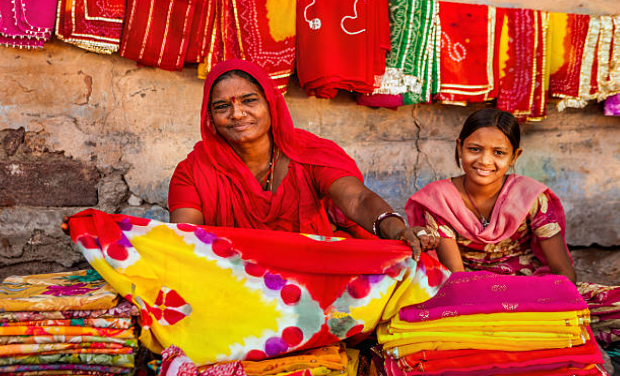
Image Source- https://www.istockphoto.com/photo/indian-women-selling-colorful-fabrics-gm622212298-108911423
 NICKELED AND DIMED