
By Dheemant Anil
Abstract-
Turkey is a nation that is currently split between two opposing sides and two opposing visions for Turkey one of which wishes for Turkey to be a republic with its eyes set on integration with the West, while the other wishes for a more Islamic nation. The struggle between the two will determine where Turkey Heads in the Future.
Turkey – Varying visions and unique location
Turkey is a nation that is currently split between two opposing sides and two opposing visions. One of these visions’ wishes for Turkey to be a republic with its eyes set on integration with the West, while the other wishes for a more Islamic nation connected to its roots in the Middle East. The struggle between the two is set to dertermine the future of Turkey. Turkey has a unique position in maps. If one were to look at the Map of Europe, Turkey is at the Bottom of the map, an almost forgotten and often debated part of Europe, but if one were to look at the map of the Middle East, Turkey is at the top of it, aloof, as if it were on a separate continent. Now combine those two maps, and we will find that Turkey is at the centre of these two; it acts almost as a crossroads between the two, and that’s why Anatolia has been the heartland for many of the empires of the Yore, the Hittites, the Lydians, the Seleucids, the Byzantines, and more recently, the Ottoman Empire.
The Modern Turkish state finds its origins in the 1920s, after the dissolution of the defeated Ottoman empire in the Treaty of Sevres. After a short but bloody war of Independence against the occupation powers, the New state now had to do some soul-searching and decided to remove all vestiges of the previous regime under its first president, Mustafa Kemal Ataturk.
However, a significant caveat existed within this context. Mustafa Kemal Ataturk was a military Man and thus, most of the cabinet, which surrounded the First President, who had now been termed the founding father of the Republic, had either been in the military or had seen Military service in the war. This meant that the Founding Fathers of the Turkish Republic saw the military not as an instrument of State policy but rather as an institution of state building. The Military and its officers were therefore not only the defenders of its physical borders but also of its ideological ones.
The Military kept its position in society and went to great lengths to protect it. In 1960, the Turkish Military overthrew Adnan Menderes, who had come close to challenging the status quo, and had him executed. It did a coup again in 1980, obstinately to save the constitution but also to crack down upon a rising wave of resentment against the established political order. Consequently, it was to no one’s surprise that the Turkish Military took to the streets again in 2016 to overthrow the government and re-establish itself as the guardian of Turkey.
However, the coup was stopped as people rose and tried to stop the takeover of power. Some did it by calling out to the soldiers, who it is to be remembered are conscripts serving a two-year term. Some did it by barricading the routes; others, like the Istanbul police, went ahead and sought a mini-civil war within the streets of Istanbul.
The Evolution of Turkish Vision: Erdogan and Turkish Islamism
So what changed? In order to ascertain this, we would have to study Erdogan himself and, in a broader context, Turkish Islamism, especially the philosophy of Syed Nursi, who is said to be the father of Turkish Islamism.
In Turkey, Islamism faced a unique challenge, comparable in significance to Germany’s Denazification campaigns. The objective was to disconnect the new nation from its historical identity as a defender of Islam and instead embrace a modern Western nationhood, aligning with European states. This endeavor involved significant changes, such as transitioning from Arabic script to Roman script, banning the hijab, and prohibiting the Azaan, all aimed at breaking away from the Islamic heritage and establishing a modern state.
Syed Nursi was one of the few scholars who sought to balance the visions of Modernity alongside those of Islam. He argued that Modernity was not the enemy of Islam but rather an ally that could be used to modernize the Islamic world to compete with the West. This vision was in direct contrast to the new elite, which sought to remove all vestiges of the old world, and this became the cornerstone of a new Political force that sought to present a new Vision for society.
They were also helped by a rising trend of inequality in the nation. While the West was rapidly industrializing and looking at the open sea of opportunities, the East was impoverished and was still stuck in an agricultural economy. Society was still stuck in the old ways and was not modernized. It still looked at the Arab Nations on its frontiers and wished to interact with them openly. However, this situation was curtailed, and many of the easterners, which also included Erdogan, migrated to the west and settled in slums in the major cities of this New Turkey. It was this voter base of people that played a significant role in Erdogan’s rise to power in the 2003 elections and later helped him secure his position when faced with attempts by the military to remove him by force.
However, the essential inquiry that necessitates examination pertains to the transformative impact these developments had on Turkey’s socio-political landscape.
The answer to this question becomes evident when observing Turkey’s increasingly assertive role in its neighboring regions. In the past, Turkey’s involvement had been limited to mere threats of war during the 1990s. However, in recent times, the nation has undergone a significant transformation, engaging in full-scale support and interventions.
Turkey has provided military assistance to the Haftar Militia in Libya and directly intervened in the Syrian Civil War. Moreover, it actively aided Azerbaijan during its war with Armenia, a conflict that also saw support from Russia. Furthermore, Turkey directly intervened in Syria, establishing a cordon sanitaire with the primary objective of preventing potential Kurdish attacks, thus framing it as a counter-terrorism operation. This heightened interventionism marks a substantial departure from Turkey’s previous restrained approach.
However, the Turkish planners harbored another strategic objective. Syria had long been a source of concern for Turkey due to its pursuit of establishing a Greater Syria, a notion deemed unacceptable by Turkish authorities. In response, Turkey sent a resolute message that it would no longer remain passive but actively seek its rightful place on the global stage, asserting its presence and interests beyond regional boundaries.
Erdogan’s Position and Potential Threats
Despite Erdogan’s seemingly entrenched position as President, several factors pose potential risks to his continued tenure. The Turkish economy has experienced significant turmoil, resulting in considerable losses for the populace and sparking widespread protests. Additionally, the Eastern regions have grappled with mounting challenges, including corruption, placing a burdensome strain on ordinary citizens.
These circumstances have not gone unnoticed by Turkish officers. While a mass purge followed the failed coup attempt, elements within the military still harbor aspirations to reclaim their former influence within the Turkish State. This sense of resentment is now shared among various ranks, leading the military to rebuild some of the image lost after the coup. Notably, the military has undertaken successful campaigns against the Kurdish forces and the remnants of ISIS in border regions. Furthermore, by supporting Azerbaijan, a fellow Turkish nation, against Christian Armenia, the military further asserted its role in Turkey’s affairs.
Despite these factors, the prospect of another coup remains improbable. Erdogan retains substantial support from the working-class population, while sections within the military also align with his vision of restoring Turkey’s influence in the Middle East. Thus, despite the underlying tensions, the likelihood of an immediate coup against Erdogan is minimal.
Currently, the military faces numerous factors beyond its control. Despite Erdogan’s responsibility for the decline of the Turkish economy, he continues to enjoy unwavering loyalty from the working-class population. Moreover, within the military ranks, there exist elements that empathize with Erdogan’s aspiration to revive Turkey’s historical influence in the Middle East.
As a result, the military has begun to align with this vision of restoring the empire’s prominence. Participating in this endeavor would enable the military to maintain its esteemed status within society, a position it held before Erdogan assumed power.
Nevertheless, if we were to contemplate a hypothetical scenario regarding the military’s potential takeover from Erdogan, it might materialize under specific circumstances. Such circumstances could include a sharp decline in Erdogan’s popularity or if his actions pose a severe threat to the nation’s stability and survival. In such dire situations, the possibility of a coup against the commanding president, who has amassed considerable power akin to Ataturk, might be considered. Erdogan’s unprecedented success in overcoming the once-dominant generals further solidifies his status as a formidable leader. However, any potential coup remains speculative and contingent on exceptional conditions.
Conclusion
In conclusion, Turkey appears destined for an enduring era of governance under the leadership of an uncrowned Sultan. As this unfolds, the evolving power dynamics between the president and the military generals will have far-reaching implications for the global community. The outcome of this ongoing struggle will inevitably shape Turkey’s future trajectory. The epicenter of this battle for Turkey’s future lies at the crossroads between the Barracks, symbolizing the military’s historical influence, and the Mosque, representing its Islamic heritage. How this intricate power struggle plays out will determine the nation’s course in the years to come.
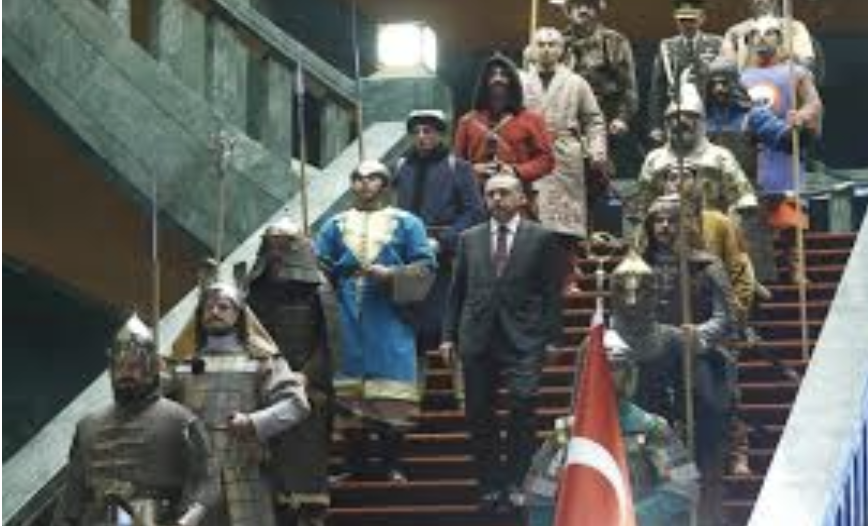
Image Source: https://foreignpolicy.com/2018/06/20/dont-turn-the-turkish-army-into-a-political-tool/
About The Author
Dheemant Anil is a student of B.A., LL.B. (Hons.) 2021 and a student of history and international relations. He is a columnist for Nickeled and Dimed, CNES.

 NICKELED AND DIMED