
By Tejas Vir Singh
Abstract
This Article will discuss the background of the conflict in Northern Ireland, also termed as ‘The Troubles’, which came up due to communal tensions between the Catholic and Protestant populations of Ireland over the question of joining an independent Ireland or staying with the United Kingdom. The resulting violence has been a source of inspiration for many prominent elements of popular culture, such as television, film and music.
Background
Northern Ireland is one of the four main components of the United Kingdom, alongside England, Scotland and Wales. Between the decades of the 1960s and 1990s, political and communal divisions amongst the population of Northern Ireland had spiralled out of control into widespread violence that also took the form of terrorist activities by paramilitaries.
The conflict can be seen as having two components, religious and political, that tended to overlap here. Firstly, one can say it was religious as it pitted the Catholic minority in Northern Ireland against the Protestant majority. Secondly, the political angle was closely intertwined with these religious identities. The Catholic minority was supportive of leaving the United Kingdom and joining the Catholic-majority Republic of Ireland to the south, while the Protestant population preferred staying in the Protestant-majority United Kingdom. This gave the two sides the terms ‘Nationalists’ and ‘Loyalists’ respectively.
In order to better understand the reason for this divide between the populations, one needs to look at Irish history. Ireland had been under British rule since the Middle Ages, when, during the 1500s English emigrants settled down in the northern areas of the island. This colonisation was termed as the ‘The Plantation of Ireland’. This was a reactionary process which happened because the English monarchs felt threatened by Ireland; this led to a political takeover of the island amidst religious change where England turned to Protestantism while Ireland largely remained Catholic. This colonisation entailed confiscation of land from Catholic Irish natives which was then given to the English settlers, who were Protestant.
The following centuries saw the continuation of Ireland being used as a colony, until the early 1920s, when the Irish independence movement had reached its height and gave birth to the Republic of Ireland which comprised much of the island, except for the northern region of Ulster.
The Violence of the Troubles
A Protestant majority in Northern Ireland had led to an unequal division of power between the Protestants and the Catholics, where the former naturally had more power over the latter. By the 1960s, this was challenged through civil rights movements by the Catholics over unequal access to housing and jobs that had made them frustrated. This was brutally suppressed by the British, who deployed the military. This led to the situation in Northern Ireland to spiral out of control into violent acts, especially by the paramilitaries who were the main perpetrators of unrest. Explosions, terrorist activities and shootings became common throughout Northern Ireland. Die-hard nationalists organized themselves into the Irish Republican Army with the aim of making Britain leave Northern Ireland, by any means necessary, including violence.
The situation reached its worst on January 30, 1972, when fifteen thousand protestors took to the streets against the ban that was imposed on marches, in Derry. British Army soldiers fired upon the crowd after a tussle, killing 13 people and injuring many others. This event came to be known as ‘Bloody Sunday’, and this heightened the differences between the pro-British and pro-Republican populations.
In response to this, a power-sharing agreement between Northern Ireland factions, Britain and the Republic of Ireland was signed, called the Sunningdale Agreement. However, it collapsed due to a lack of support from the loyalists as it gave the Republic of Ireland a say in this agreement. Violence and terrorist activities continued, even affecting the British royal family when Lord Mountbatten, Queen Elizabeth’s second cousin was assassinated by the IRA.
The violence gradually came to an end with peace talks with the IRA; however, they were hesitant to the demand by the British to completely disarm themselves. By 1994, a ceasefire was declared by the IRA, and by 1998 the Good Friday Agreement was signed. This Agreement allowed Northern Ireland to have its own government with jurisdiction over issues such as health and education, and also mandated power sharing between the Loyalists and Nationalists.
The Legacy of the Troubles
Although the violence had ended, it was not forgotten. Around 4,000 were killed in the violence, and more than 47,000 were injured during the three decades of the ‘Troubles’. The division between the Catholics and Protestants remained even after the Agreement. Many Northern Irish communities, including Belfast, are still segregated into Catholic and Protestant quarters, separated by ‘peace walls’.
This segregation means that the situation is still fragile when it comes to political issues. Political parties in Northern Ireland are divided into pro-British, supported by the Protestants, and pro-Irish supported by the Catholics. The parties playing to community sentiments have led the government to become polarised, and thus, has hindered its abilities to solve problems such as the health care system. Moreover, the events of the violence still haunt the population; Northern Ireland has the highest rate of people suffering from post-traumatic stress disorder (PTSD), and half the people know of someone who was killed or injured in the violence.
The Role of Popular Culture
Irish culture has been influenced by its relationship with Britain and colonialism. Nationalists like W.B. Yeats wrote plays that envisioned his belief of purging the island of English influences and instead reviving the Celtic culture, as early as 1902. One of these is “Cathleen ni Houlihan”, which revolves around an old woman driven away from her farm by strangers. She seeks to fight off the strangers and get back her “four beautiful green fields”. The old woman is an allegory for Ireland, the strangers are the British and the fields are the four provinces of Ireland.
During the Troubles, this allegory of the four fields was drawn in folk musician Tommy Makem’s song ‘Four Green Fields’ which used the old woman’s allegory for Ireland singing for her “fourth green field” to bloom once again. This song became a nationalist battle call, for the fourth green field here stood for the province of Ulster in the north, that remained in Northern Ireland.
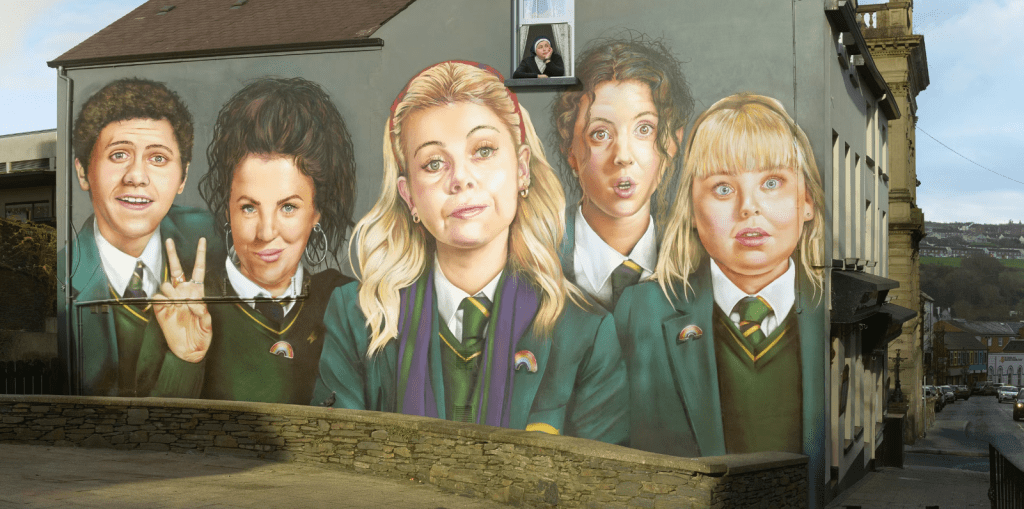
A more well-known piece of popular culture that portrays the Troubles is the TV show Derry Girls, created by Lisa McGee. The show is set in the 90s, in Northern Ireland, and follows the life of a teenage friend group living in the town of Derry during the Troubles. What is interesting about the show is that although the main characters are all Catholics, it does not differentiate its statement on the basis of identity; it portrays that ‘The Troubles’ existed, and they had to live through them. One of the episodes (Across the Barricades) portrays Catholic and Protestant teens gaining common ground, against their parents. In the final episode of the first season, while the protagonists are busy with their high school talent show, their parents are seen watching a news report on the TV about a bomb attack that has killed 12 people. It does not reveal who the perpetrator is, it simply shows that tragedy has struck the citizens of Derry, who will have to deal with it.
The show has found many fans in Northern Ireland, with its comedic and relatable tone that portrays the life of the people living amongst bombings and barricades. The residents of Derry have even painted a mural of the Derry Girls on the side of a bar to commemorate the show. It managed to not only strike a positive chord with the citizens of Northern Ireland, but it also portrays the Troubles in a unique way; it may be there in the background, but it does dictate the protagonists’ life. In comparison to music or plays, which tended to be more reactionary and rebellious, the show takes a different approach when it comes to portraying ‘The Troubles’.
Music too, played an important role in Ireland. Given the small size of Northern Ireland, there weren’t many festivals or gigs the youth could attend without crossing the border into Ireland. Crossing the border for music festivals thus reflected the spirit of the youth, transcending political and social identities; youth living even in the most northern areas would go down south across the border for music shows. Music in this sense united the youth of the island.
However, music could be reactionary too, especially with reference to the violence that the civilians had to endure. An example is the 90’s hit “Zombies” by the Cranberries. The lead singer, Dolores O’Riordan is quoted to have said that the “song’s our cry against man’s inhumanity to man; and man’s inhumanity to child”. The song was written as a reaction to the bomb attack in Warrington, England in 1993 when the Irish Republican Army set off two bombs that killed two children and injured dozens. The deaths are also mentioned in the first verse of the song, as “child is slowly taken.” The title of the song can thus refer to the inhuman acts, something that is done by a person turned into a zombie because of the violence and fighting. This is evident in the pre-chorus, “In your head, they are fightin’ with their tanks and their bombs … and their guns …”
Conclusion
Irish history and culture have been shaped by its interaction with the British and has taken a largely reactionary tone. The interplay of religious identities with political affiliations has led to a complex political situation in Northern Ireland even today, where segregation still causes problems for the region. The communal violence of ‘The Troubles’ in Northern Ireland has produced pieces of popular culture that have been widely consumed and shows how it can popularize the message it holds. These include the Warrington attacks in the hit song “Zombie” or through plays and songs with political references, and also give people an insight into the life of the Northern Irish people during the Troubles, through shows such as Derry Girls.
About the Author
Tejas Vir Singh is a second-year student at O.P. Jindal University currently pursuing a bachelor’s degree in law.
Image Source: https://www.eoinm.com/work/derry-girls
 NICKELED AND DIMED