
By Dheemant Anil
Abstract
Iran has decided to go forward with its nuclear programme. With the help of this article, we will understand the Iranian geopolitical situation and comprehend how having nuclear weapons would strengthen its leverage in dealing with its immediate neighbours as well as the rest of the world. . We shall also attempt to analyze the wider impact of a successful Iranian nuclear bomb and would try to understand the impact it might have on
Iran and its nuclear programme have been under a lot of international scrutinies, and a lot of ink has been deciphered to understand the potential impact that it might have on one of the most volatile regions of the world along with most vital Straits of Hormuz, which is one of the veins of the world’s economy, via the help of the flow of oil from the ports in Saudi Arabia, which is one of the largest producers of oil.
This puts the Iranian Nuclear Programme in a situation similar to that of someone keeping a gun on the driver’s head.
This has caught the attention of the world, and diplomats from all over the world are focusing on the prevention of the programme reaching its fruition with a carrot-and-stick approach designed to incentivize Iran to limit their nuclear programme and prevent the weaponization of the programme.
All of this has led to a back and forth between the Western Powers and the Iranians over the status of the programme. Added to this is the campaign of sabotage and assassination led by the Israelis, which considers the Iranian nuclear programme an existential threat. This is followed by the rise of hardliners within the Iranian elite and the Iranian Armed Forces after the rather ill-advised assassination of Qaseem Soleimani, a rather legendary or controversial commander, of the Iranian Revolutionary Guards Corps (IRGC)which made the prospect of reconciliation between the Iranians and the Americans, already a nearly impossible task, similar to boiling the Straits of Hormuz.
It has seen the hardening of the stances of both sides. Even after Trump was ejected from office, the newly arrived administration of Joe Biden is also hostile towards any form of negotiation and has put the condition on the Iranian regime to stop supporting Moscow in its war againstUkraine. This has been used by the Iranian hardliners to weaken the already embattled Iranian moderates within the theocracy.
But all of this boils down to the question: where did it all begin, and where will this end for India and our interest in the Middle East?
The Iranian nuclear programme began with American help during the 1950s under the Atom for Peace Programme. During that time, Iran was an autocratic monarchy under the rule of Reza Shah Pahlavi. The Tehran Nuclear Research Centre was built and opened in 1967, which ran with the help of the Atomic Energy Organisation of Iran, with a 5-Megawatt Energy Reactor supplied to it by American Machine and Foundry. The Shah of Iran wanted to use these nuclear reactors to modernise the Iranian economy and to serve the ideological purpose of showing Iran as a modern, westernised country.
But all of this soon came to an end, as the entire system, soon collapsed under the weight of running a Westernised state, which was enriching a particular
section of the Iranian state by keeping the larger section of the society, which lived outside the crème de la crème of the society, poor, while the intellectuals were abhorred by the feudalistic system that operated in Iran.
A symbol of this era was the mega party, which was held by the Shah of Iran, ostensibly on the 2500th anniversary of the Persian empire. All of this was combined with such luxury that it horrified the conservative Persian society, which was suffering through a large period of famine and drought.
This led to the Iranian Revolution, which saw the Iranian Shah and the dynasty overthrown and an Islamic republic formed. What happened in the revolution is a complex topic in and of itself, but what is important for us is the fact that this regime was against any form of modernization. And as such, the nuclear programme, a favourite of the Shah of Iran and, by extension, a symbol of his regime, was shut down, and many of the nuclear physicists left the country or were put into prison camps for being collaborators.
However, all of this soon changed as Iran was invaded by the Iraqis, who used gas and chemical weaponry to have devastating effects on the Iranian populace. This was combined with the Scuds attack launched on the Iranian cities, which saw hundreds die. All of this gave the newly formed Islamic regime in Iran a question: how will they prevent any further attacks by any foreign powers? Combined with this was also Operation Praying Mantis, which saw the Iranian Navy crippled by an American task force. All of this forced a question in the mind of the Iranian leadership.
They had mobilised their entire nation to barely hold Iraq back, and they were still outclassed by what could be just an American Task Force, which was operating in waters that could be home ground for the Iranians. All of this got the ball rolling on the need for a nuclear bomb, which would allow Iran to balance out the world and allow the “Democracy of God”, to constantly exist in Iran.
But they soon found a hitch: nearly all the scientists who could have been used for the creation of the nuclear bomb were either exiled or were either dead, lost in the long chain of stations hidden by the Iranian secret police, or had been executed on the site by the Pasdaran, the IRGC, or had been whisked away by the multitudes of vigilantes who were given the tacit approval of the Iranian regime. This combined with the fact that Iran had isolated itself from the world by considering both the USSR and the Americans as evil regimes and, as such, excluded itself from the supply chain of nuclear technology. Therefore, Iran needed someone who would be able to manufacture it without it appearing on the radar of the world.
They sought the help of AQ Khan, a nuclear physicist from Pakistan. He had been the father of the Pakistani nuclear programme and is also known as Doctor Atom. He has been responsible role in the proliferation of nuclear technology to rogue states and has been considered to be the originator of the centrifuge system of enrichment, which is a faster and cheaper method of enrichment, that reduces the costs as well as the efforts made to hide the nuclear plants in a manner that would not draw any attention from the world.
All this combined led to a rapid build-up of facilities in the form of reactors in the Nantaz and in Homs, which has been made in a manner so clandestine that its revelation, which was made by the MEK, an Iranian dissident group, was revealed to the world about the existence of the reactors in a press conference.
Conclusion
So, what can be done to stop it? As aforementioned, Israel has already been fighting a secret clandestine war with Iran to stop the nuclear programme, and America has imposed more sanctions on Iran, with some in the Pentagon dreaming of a top gun-esque mission. However, Iran had agreed to come to the negotiation table, and in return for freedom from the sanctions, it would disarm and reduce its nuclear arsenal and come clean in front of the world stage. As such, the Iranian Nuclear Deal was presented in front of the world community, but mutual suspicion soon won over all the partners, and the treaty soon went outside the window.It is no longer a secret that Iran can acquire a nuclear weapon, and if hypothetically it does, the entire region would be like a loaded musket. Further, Saudi Arabia will try to acquire an arsenal for itself, and this would lead to a cascading chain of events. For India, this could represent a dangerous situation. This would mean that a large segment of Indians who work in the economies of these nations, and their remittances, are needed for the economies of a variety of villages in India. Nuclear war would not simply mean that there would be no Indian deaths.
Many of the Arab states have Indian populations, which are far greater than their population. A nuclear strike on Doha or Dubai would be like a nuclear strike on an Indian city, as these cities have far more Indians than they have citizens. Therefore, it would be and is a major security threat to India.
There is also the threat that India will import its oil from the Middle East, which will meet the energy needs of its mass population, which would result in the Indian economy grinding to a halt and have the impact of reducing the employment potential of the economy, resulting in social instability and being problematic for India.
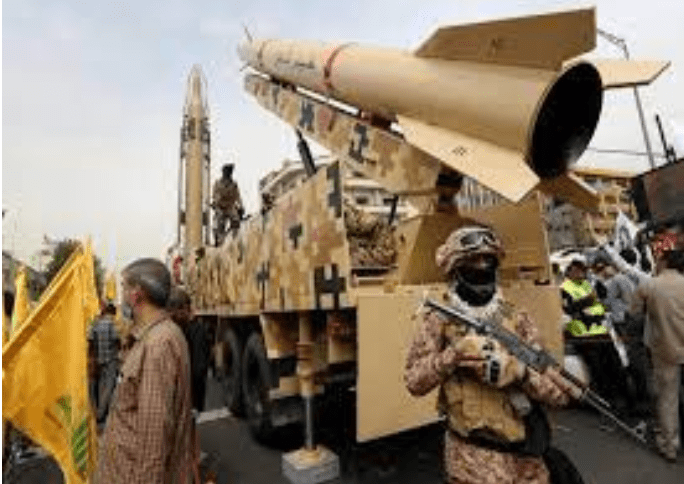
Image Source: https://foreignpolicy.com/2022/10/26/iran-ukraine-russia-war-drones-missiles-military-advisors-middle-east-nuclear/
About The Author
Dheemant Anil is a student of BA LLB (Hons) 2021 and is a student of history and international relations. He is a columnist for writes Nickeled and Dimed, CNES.
 NICKELED AND DIMED