
Co-Authors: Sanya Seth and Saumya Seth
Abstract
With their whimsical descriptions and seemingly perfect endings, fairy tales made for the choicest time of the day during my childhood; only to later be discouraged from such readings, dismissed as mere escapism. My persistent pleas to my grandmother for more books from the community library met with the same fate, every time, she averred, “They offer no moral compass, dear, far from reality.” Yet, can we disprove this widely accepted notion? Determined to explore this query, my co-author and I shall unravel the secrets hidden within the cherished pages of Alice in Wonderland, scrutinizing its fantasy world through the discerning lens of economics students.
Deconstructing the interactions
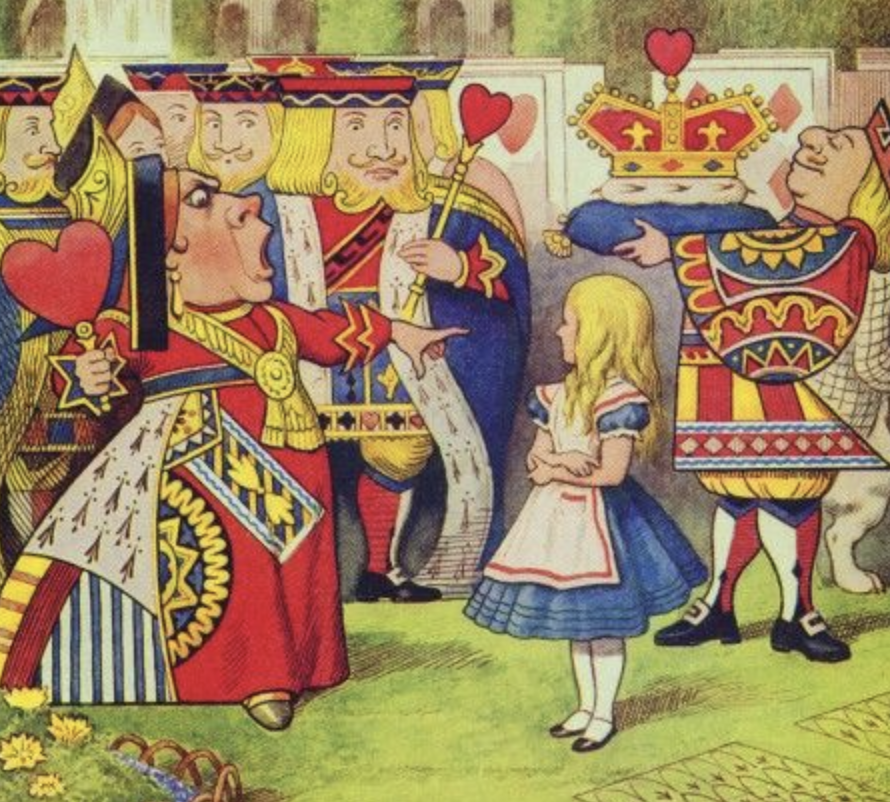
Alice’s first encounter with the Queen served as the cornerstone for determining the direction and purpose of this article, while also testifying the tale’s current relevance.
The queen’s idea of reaching “somewhere” connotes the idea of improvement. In the current capitalist society, the term ‘improvement’ might end up being regarded as a foreign coined word because institutionalized operations ingrained in its citizens tend to hinder the likelihood of maintaining or enhancing economic conditions. Frequent recessions across the globe coupled with the scarcity of resources make it difficult to maintain one’s wealth and status, and even more difficult to improve one’s economic standing, but does there exist any factor that can act as the accelerator to ensure improvement (here economic development) that nations have been looking for? The purpose of incorporating an economic storyline into a well-known fictional narrative is to validate if a nation’s geopolitical standing can act as an accelerator and hasten economic progress. But to completely understand the article’s emphasis and establish the importance of geopolitical standing, it is important to define the term first.
Geopolitical Standing, usually considered a synonym for power politics, means the real influence or power exerted by countries in the international arena like its diplomatic influence in international organizations, and its ability to shape regional and global security arrangements.
Revolutionizing the leaderboards
The significance of geopolitical standing in driving a country towards economic development is propounded by Alice’s statement- “Who in the world am I? Ah, that’s the great puzzle.” It implies that, given the dynamic character of world politics and the increasing importance of soft power, non-traditional security concerns, and economic interconnectedness, nations must be aware of their distinctive strengths, resources, and capabilities in order to preserve crucial national interests at home and exert economic and political influence abroad. This is possible if nations use their endowments (the ones acquired naturally due to favorable geographical locations and the ones that result from sustainable investments in their own country). Therefore, by strategically planning and deploying one’s own country’s abundant resources towards devising a solution for the tropical world problems, a country can redraw the geopolitical map of the 21st century.
For instance, Norway, which has significant natural gas and oil reserves, is positioning itself in the commercial race as a global leader in renewable energy by making significant investments in wind and hydroelectric power and other renewable energy sources. By making such investments, Norway has become one of the world’s top producers of clean energy and helped reduce the globe’s reliance on fossil fuels. Norway now has better diplomatic ties with other countries and is regarded as a responsible and innovative player in the fight against climate change.
Norway’s transition to renewable energy may speed up the development of new and advanced renewable energy technologies. This will help reduce the cost of renewables in the future, making them even more economically viable. Hence, corroborating the positive correlation between geopolitical standing and economic development. While this does signal the potential of geopolitics to act as an accelerator in economic development, what ought to be the prepotent domain of geopolitics (i.e. Geostrategy vs Geoculture vs Geoeconomy– Economic, Political, Military, Cultural, Demographic, Natural Resources) still requires a thought.
Might makes right
Alice’s experience in the Queen’s Kingdom echoed the proverbial “law of the jungle,” where the superiority of force and power was prominently showcased as the apparent solution to all problems. Quoting the protagonist, “ The Queen had only one way of settling all difficulties, great or small. ‘Off with his head!’ she said, without even looking around.”
The queen prioritizes drawing upon the military powers of the state without making room for appeal or negotiation. More than delivering justice or conveying to its citizens the repercussions of flouting rules, such martial laws only boast the country’s ability to control both- human and physical resources through its accumulated wealth. As we look around the world, a nation’s military power is one measure of the geopolitical standing of the nation if we adopt the approach of defining “Power as control over resources.” This might prompt us to end our search and state that building the military capability of a nation will improve its geopolitical standing and consequently lead to economic development, validating once again its role as an accelerator. But here’s the catch:
Military capability is the function of the size of the country. The underlying logic is that countries that have long borders spend more on military equipment and on the maintenance of armed forces to protect their borders. Thus, larger countries accumulate greater military capability, implying an edge in their geopolitical standing. Furthermore, a nation’s size can affect its economic growth because bigger nations typically have better access to resources, bigger consumer markets, and more opportunities for economies of scale. In contrast, smaller nations may struggle to have significant economic growth because of their constrained resources and market size. A vicious cycle might result from this constrained economic growth, which would then reduce the capacity to make investments for enhancing one’s military capability. A less developed economy finds it difficult to devote enough resources to build up its military, which has an impact on its geopolitical position and further impedes economic growth.
Back to square one!
Feels like the article has come full circle. The discussion outlined above, which theorizes the development of a vicious cycle, once again brings to the forefront the unsettling notion that economically poor countries can’t afford to maintain their geopolitical standing (let alone compete with the relatively better-off nations) and that improvement in their economic conditions shall always remain a distant dream. Thus, countering our assumption that geopolitical standing could act as the accelerating factor for economic development.
Although the explanation appears to be conclusive in light of the specific interpretation of dialogue from the fictional work that is used to support the assertion, the exclamatory phrase and repetition (“Curiouser and curiouser!”) prevent us from conclusively supporting or disputing the supposition that a country’s economic development accelerates because of its geopolitical position. Inarguably, there are various sides to this debate, and the above dialogue (from the story) goads us to dig deeper.
Telltale signals: paying the cost of aggression
A spin-off to the argument might arise if we consider that the phrase-“The Queen had only one way of settling all difficulties, great or small. ‘Off with his head!’ she said, without even looking around”– this is actually propounding the significance of developing soft power over military power. This phrase seems to be a satirical comment, that in reality tries to warn the reader about the potential drawbacks of adopting a combative and aggressive strategy in geopolitical matters.A country’s geopolitical stance can discourage international investment, sabotage commercial relations, and obstruct economic growth if it is hostile and aggressive. For instance, given North Korea’s proliferation of weapons and weapons technology that threaten to fuel instabilities in other parts of the world, it has faced severe economic sanctions and a dearth of foreign investment. This is a consequence of its antagonistic and confrontational stance, wherein they prioritize military power over soft power, which has resulted in a lack of cultural exchange and diplomatic relationships, with the international community, particularly the United States and South Korea, which could have potentially benefited North Korea’s international standing and economic growth. Foreign companies have been deterred from setting up operations in the nation due to the protracted hostilities, security policy interests, and the leery credibility of their nuclear non-proliferation regime. Due to these limitations, North Korea’s trading partners are constrained, and its economic potential is reduced, which hinders its continued growth and development.
Not an “Open-and-shut case” yet?
From the bird’s eye view- both the interpretations and their implications in realistic nations discussed above, present a contrasting case. While the former propounds that geopolitical standing is the accelerator for economic development when military power is the dominant dimension of geopolitics, the latter indicates how building geopolitical standing by solely focusing on the development of military power (leaving behind diplomacy, culture, and education) makes one nation’s progress toxic and hostile for other countries, ultimately backfiring and leading to abatement of economic development.
However, further research suggests that settling this debate is not a pressing need. We come across an array of arguments that claim the importance of developing soft power over military power to create the best path for economic development. As discussed before, fostering an authoritarian climate that prefers the use of military authority without the possibility of discussion or appeal deters firms and investors, and impedes economic development. Furthermore, using military force costs money and frequently takes it away from vital services like healthcare and education. On the other hand, by building pleasant ties and fostering talent and ideas from around the world, the emergence of soft power can assist economic progress and encourage international cooperation.
As a result, despite the fact that the opening passage’s Alice in Wonderland theme would have suggested the escape offered by fairy tales, it has taken us on a journey to dissect the role played by geopolitical position in economic progress. The Queen’s interaction with Alice has acted as a cautionary tale, showing the possible downsides of a belligerent and aggressive approach in foreign affairs and the emphasis on military might as the answer to all issues. We have discovered that maintaining a balance between hard and soft power is necessary to hasten economic development through our analysis of many countries and their tactics. It serves as a reminder that as we work to advance economic expansion, measures must be put into place that take into account the delicate balance between soft power and hard power (as components of geopolitical standing). As we move forward, policymakers must recognize the importance of this approach and work towards building a better future for all.
About The Authors
Saumya Seth and Sanya Seth are incoming graduates at Simon Business School, University of Rochester, New York, where they will be pursuing a Masters in Business Analytics. They are International level inline hockey players and hold a degree in the South Indian classical dance- Bharatnatyam. Their articles and blogs have been published in various magazines and journals, and they are currently working on crafting their lives such that they make for an inspiring read.
Image Source: Google Images
 NICKELED AND DIMED