
By Suteekshna Dubey
ABSTRACT
Hydrogen plays a key role for a necessary shift in today’s global market towards a sustainable future, decarbonizing the energy, industrial and transportation sectors and is expected to have a greater impact on the global energy mix. The goal of the 2050 energy outlook scenario is to achieve the 1.5degree Celsius limit, set forth in the Paris Agreement for global temperature rise. In view of this, multiple policies and guidelines have been established by India to promote green hydrogen, including the Green Hydrogen Policy, Harnessing Green Hydrogen by NITI Aayog and the National Green Hydrogen Mission (NGHM). This article emphasizes on the initiative of green energy production and the challenges that the industry might face while installing manufacturing units and implementing the Mission.
According to the Climate Change Performance Index 2023, India ranks in the top five countries and is the best amongst G-20 countries. To sustain this ranking and meet a higher objective, India has pledged to achieve a net-zero emissions goal by 2070 and become self-sufficient by 2070. To attain this, the National Green Hydrogen Mission aims to achieve a green hydrogen production to ensure that the demand for energy can be met by hydrogen, which is sustainable, with minimal impact on the environment and, with minimal or no carbon emissions. For this purpose, Green Hydrogen (GH2) is used, which can be produced from renewables, nuclear or fossil fuels with carbon capture, utilization and storage (CCUS). The NGHM aims to produce at least 5 MMT of green hydrogen annually, attract over Rs. 8 lakh crores in investments, and produce over 6 lakh employment.
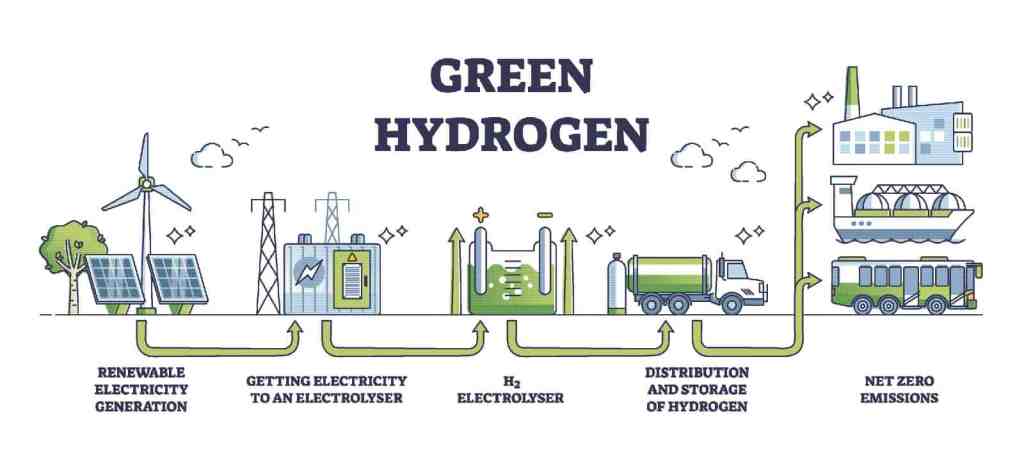
In addition to powering cars and ships, green hydrogen can be used to create steel, chemicals, and in refineries. This would enable a more seamless transition to the use of green hydrogen without having an impact on the consuming sectors.
With an allocation of Rs. 19,744 Crore for promoting the production of electrolysers, the Government of India passed a National Hydrogen Energy Mission, setting up pilot projects and R&D. Ministry of New & Renewable Energy will be responsible for overall coordination and implementation of the mission and it will formulate the scheme guidelines for implementation of the respective components. Green hydrogen has been considered as the “fuel of the future” that has the potential to achieve net-zero emissions which will be a necessary step to reduce global warming effects. The initial outlay of this Mission will be Rs. 19, 744 Crores of which Rs. 17, 490 Crores will go towards the Strategic Interventions for Green Hydrogen Transition Programme (SIGHT), Rs. 1,499 Crores to pilot projects, Rs.400 Crores to research and development and Rs. 388 Crores to other Mission components.
In order to meet demand for fertilizer plants and refineries, the Solar Energy Corporation of India (SECI) intends to launch a giant tender. The first green hydrogen and green ammonia refuelling hubs in India have been designated as the ports of Tuticorin on the east coast and Kandla on the west coast. By the end of 2023, eight trains will be propelled by hydrogen fuel cell technology on narrow-gauge heritage routes.
CHALLENGES DURING IMPLEMENTATION: –
While the Mission clearly states the objectives and methods to achieve consumption of Green Hydrogen, there are certain challenges that the Ministry might encounter when it comes to storage and manufacture, as India is not equipped with GH2-friendly resources.
STORAGE:
Hydrogen is stored by three methods: compression, cooling, or hybrid and can pose challenges like high energy requirements in compressed hydrogen storage, temperature, and pressure requirements etc. Despite good gravimetric energy or the amount of energy carried per unit of weight, it has limitations when it comes to volumetric energy density, that is to say, a much larger volume is needed compared to other fuels. It is compressed at a high rate (more than CNG – Compressed Natural Gas) and is kept in unique containers that can handle the pressure, but they are more expensive to build. To achieve optimum storage and prolonged use, government incentives for environmentally friendly hydrogen storage and transportation are necessary for the programme to be successful. Rough calculations show that with advanced technologies, the cost of producing a kilogramme of green hydrogen would not be less than $3, which would increase at the point of use. The price of green power (Rs. 0.54/kWh in India) must decrease if green hydrogen is to become more affordable. Since co-locating renewable power and hydrogen production facilities is not always feasible, strategies like cutting back on open access fees and other legislative changes would be necessary to lower the cost of green energy.
The Mission lays down a year-wise roadmap from 2022-23 to 2029-30 during which work will progress in two phases.
| Phase I – 2022-23 to 2025-26Plans to create the set-out standards, create initial demand, undertake pilot projects, and issue a set of incentives to boost local production. | Phase II – 2026-27 to 2029-30Plans to scale up commercialization of green hydrogen and take it to other sectors like shipping, transport and more.This plan is based on the assumption that by 2025-26, the prices of production of green hydrogen would become cost effective. |
MANUFACTURING
There are only a handful of manufacturers within this sector in India, and only a handful of those have few decades of expertise making electrolysers, the key component that separates hydrogen from water. Through the gasification of coal or gas, which produces significant amounts of carbon dioxide emissions (primary greenhouse gas driving global warming), hydrogen is produced at the lowest cost and is known as Grey Hydrogen. Because of limited release of carbon during its extraction and combustion, the creation of green hydrogen has become a promising future.
Currently, India uses 5 MMT of hydrogen annually, according to the mission document in which, most of this hydrogen comes from fossil fuels, and is principally used in the manufacturing of ammonia for fertilisers and petroleum refineries.
GREEN HYDROGEN ACROSS THE WORLD:
China is leading the development of electrolysers (around 200 megawatts), while Europe has the biggest proportion of proposed investments in the industry (about 30%).
Hemant Malaya, Fellow at the Council on Energy, Environment and Water (CEEW), elaborated on how nations like Oman, Australia, and a few others have made considerable strides in securing the market for green hydrogen and its derivatives like green ammonia and green methanol. India has a significant chance to dominate the green hydrogen market due to its huge landmass and inexpensive renewable energy sources.
A NITI Aayog report from 2022 states that 43 nations worldwide have strategies and roadmaps for developing hydrogen technologies. The United States, EU, Japan, and China receive the majority of the funding for research and development on green hydrogen.
Recently, Gujarat Government issued a “Policy of leasing of government waste land for green hydrogen production” (using non-conventional energy resources) intending to create employment and boost small industries, and promoting new technologies and methods for production of green hydrogen.
All these reports and statistics indicate that India has been actively inculcating and adopting new technologies and methods to establish itself as a low carbon emitting country. The objective of the mission can only be met if storage and manufacturing are kept in check and are set up accordingly. With the rise in storage and manufacturing units, GH2 production will create new jobs in the market and the use of advanced technologies would attract more workforce to contribute in this initiative. According to experts, there is still uncertainty around the sector-specific allocations to produce green hydrogen, the requirement for local production, and other relevant matters. By reducing or eliminating carbon dioxide emissions from the atmosphere, green hydrogen has the ability to “decarbonize” the nation. It has the potential to replace coal in steel mills and fossil fuels in long-distance transportation like shipping and trucking.
Conclusion:
Overall, the article provides valuable insights into the importance of green hydrogen in achieving a sustainable future and highlights the initiatives taken by India to promote its production and adoption. The article also effectively addresses the challenges faced during the implementation of green hydrogen projects, particularly in terms of storage and manufacturing. The inclusion of relevant statistics and global perspectives further strengthens the content. The hype around green hydrogen should surely be embraced and encouraged, but as the industry is still in its nascent stage, there needs to be more realism in expectations for what green hydrogen can accomplish and how far it can replace non-renewables.
Green hydrogen will likely continue to be viewed by many as the “golden key” to a net-zero future, but this does not mean that it is the only way to limit our fossil-fuel dependence. Realistically, there are severe capital restrictions, a small variety of demand sources, and a significant energy requirement for production.
About the Author
Suteekshna Dubey is a second-year law student (three-year LL.B. programme) at Jindal Global Law School. She is interested in changes in the industrial, aviation, and technology sectors, affecting public policy.
Image Source: https://technetics.com/hydrogen-production-the-challenges-and-practical-applications/
 NICKELED AND DIMED