
By Tanish Srivastava
Abstract:
According to the UN, Yemen is the world’s largest humanitarian crisis. It is divided into states inside states, thanks to its disunity. Groups such as the Houthis have foreign backing and have attracted states such as Saudi Arabia to use their military force in Yemen, often targeting common civilians. It is important to understand the history of these groups, and to trace the underlying issues that keep Yemen from unifying into one republic. This study will analyse the history of the unification of Yemen, the Houthis, the Southern Transitional Council, and the internationally recognised government based in Riyadh.
- Introduction
Yemen is the poorest country in the Arab world, and has vast amounts of violence, malnutrition and is generally unstable. As the country is divided into different power-sharing agreements in the North, the South and even an internationally recognised presidency based in Riyadh, a government not even based in Yemen, it is important to understand the roots of the disunity in Yemen and how the different factions with their own respective foreign backers have led Yemen down a path of violence and poverty. The different factions include the Houthis in the North, with complete control over the capital city of Sana’a and the internationally recognised government based in Riyadh. The internationally recognised government of President Hadi has power-sharing agreements with a separatist movement called the Southern Transitional Council in the city of Aden in the south, and the different agreements of power-sharing continuously fall apart. Apart from these factions, organisations such as Al-Qaeda and ISIS have also been active in the country, however, they have not been an active part of Yemen’s internal power struggle. This paper will explore the roots of all the different factions, their goals and history and their foreign backers.
- Unification of Yemen in 1990
The foundation of Yemen’s divided and disunited groups goes back to the unification of North Yemen and South Yemen in 1990, the failure of which led to its own months-long civil war in the 1990s. Before unification the country was divided into North and South Yemen as separate republics with the Yemen Arab Republic as “North Yemen” and the People’s Democratic Republic of Yemen as “South Yemen”.
The Yemen Arab Republic had been ruled under the Ottoman Empire till the end of the first world war, after which it was ruled by Zaydi Imams until an army-led coup in 1962. The People’s Democratic Republic of Yemen, on the other hand, had been under British rule till 1967, after which it was a communist state aligned with the Soviet Union. On the 22nd of May of 1990, with the looming disintegration of the Soviet Union, The two republics in Yemen unified under the rule of the northern President Ali Abdullah Saleh, which marked the end of decades of being separated for the Yemeni People.
However, there were many points of contention between the two republics after unification, ones that helped spark escalating tensions until 1993, when Vice President Ali Salim Al-Beidh, who was also the leader of the Yemeni Socialist Party, resigned and was replaced by Abdrabbuh Mansur Hadi. Beidh had then settled in Aden and challenged the government based in the city of Sana’a in the North and the challenges were based on issues related to political and economic marginalisation towards the southern people. Attempts to reconcile included the signing of an accord between Saleh and Beidh in the February of 1994 with Jordan’s King Hussein as a mediator. This, however, was ineffective at curbing the escalating tensions, which led to a civil war, which started in the March of 1994.
The armies of both the North and the South were not integrated very well, and were fairly disunited, which led to the army loyal to the North launching an offensive against the South, which they succeeded and the civil war lasted for about 70 days after which the Republic of Yemen was to stay as a united one. Even if the civil war had resulted in a victory for the North in neutralising the southern separatist threat at the time, the Republic of Yemen was bound to face other problems in the future in regard to the disunity in the country, including a stronger resurgence of the southern separatists in the future.
- The Houthi Rebellion
North Yemen, before the shift to being a republic, had a theocracy which was directly opposed to Saudi Arabia. The area in the northern part of Yemen bordering Saudi Arabia is inhabited by a Zaydi majority. Zaydi Shia Islam was a very influential force in the area that is today North Yemen. Before the 1962 shift of North Yemen to a republic, the Zaydi Imamate that had preceded it had various points of conflict with Saudi Arabia, Including a full-out war in 1934 between Saudi Arabia and the Zaydi Imamate of Imam Yahya. In the same year, there was an agreement in Taif, which demarcated a proper border between Saudi Arabia and the Imamate, and gave Saudi Arabia complete sovereignty over the provinces of Jizan, Asir and Najran in the North. After the war between the Saudi-backed Yemeni Republicans and the forces loyal to the Imamate in the North, the Republican win was rather a loss for the Zaydi Shia population in the North. Later, with the Unification of the two republics in 1990, along with a rise in Saudi economic and cultural influence (Cultural influence referring to the increase in the influence of the Wahhabi school of Sunni Islam in the North), there was a movement born in North Yemen called the Houthi movement. This movement was started by Hussein-Al-Houthi as an attempt to stop the increase in Wahhabi influence, to end the corrupt rule of President Saleh and to remove the government which in Al-Houthi’s view was too much in American and Saudi Influence.
The Houthi movement started in the 1990s and opposed President Saleh, who in turn had attempted various times to crush the rebel movement. In June of 2004, Hussein Al-Houthi led a rebellion against the Saleh government, which led to a crackdown by the government on Houthi rebels. Hundreds of Houthi rebels had been arrested, and in September of the same year, Hussein Al-Houthi was killed, after which, his brother Abdul-Malik Al-Houthi started leading the movement.
For the next few years, the Houthi rebellion was in full swing against the Saleh government with countless ceasefires and agreements being signed and consequently, violated. There was a whole timeline of events stuck in a cycle of ceasefires and violence. In the year 2005, there was an agreement that was signed between the two resulting in the surrender of the top military commander of the Houthis. Not long after, in 2006, the Saleh government granted amnesty to 600 Houthi fighters, and in the same year, the Saleh government won an election and came to power. After that, in 2007, there were clashes between the rebels and the Saleh government. This time, Qatar helped mediate a ceasefire agreement between the two parties, which was broken a few months later in 2008. In August 2009, the Yemeni military launched an operation against the Houthi rebels called Operation “Scorched Earth”. During this operation, Houthi rebels were fighting the Yemeni Military as well as Saudi Arabian forces towards the North, but the fighting was over in yet another ceasefire brokered in February of 2010. This simultaneous switch between ceasefire agreements and violent clashes had been taking place until the Houthi rebels found the ultimate opportunity to finally gain ground over the Saleh government, which was the Arab Spring.
- The Arab Spring
In the year 2011, the entire Arab world underwent a wave of pro-democracy protests, where leaders and governments fell and there were mass protests with thousands on the streets. The wave started in Tunisia and made its way to countries such as Egypt before it finally hit the streets of Sana’a in Yemen in 2011. Thousands of protestors were calling for the resignation of Saleh from office. There were violent and fatal clashes between the protestors and the security forces along with the supporters of Saleh, which led to even stronger anti-Saleh sentiment in the country. The president offered to redraft the constitutions, promised to not stand in the next elections (or have his son be his successor) and even monetary reparations such as tax cuts and reductions in oil prices. However, protestors had already seen Saleh’s tendency to give out fake promises such as the one where he promised to not run in the 2006 election, which he did. The demands of the people were to get Saleh out of office, and after violent fighting, President Saleh finally resigned by a deal brokered by the Gulf Cooperation Council, which made his Vice President Abdrabbuh Mansur Hadi the new President of the Republic.
By 2011 the Republic had very high amounts of Houthi Influence in the North, a new President who was Vice President under the Saleh government, and problems relating to poverty and sickness that had still not been solved. Along with the rebellion of the Houthis from the North, the common citizen of Yemen was unhappy. President Had, much like his predecessor, enjoyed support from the Saudis, something that would lead Yemen to be a victim of foreign military intervention in the future.
- Hadi and the Unity Government
After the Saleh government had resigned and been replaced by a government under Hadi, it was supposed to be a two-year long term from 2012-2014 overlooking the transition. However, in Yemen, the disunited different groups had their own problems with this government. For the Houthis, this government was essentially blamed for the same problems that the previous government under Hadi had been blamed for. These issues included corruption and marginalisation of people in the north, which was where the Houthi stronghold was situated. This led to the Houthis being opposed to the Hadi government.
There was also the fact that the Yemeni military still had forces that were loyal to Saleh, who already wanted power back from the Hadi government. This interestingly led to an alliance between the Houthis and Saleh, along with the military forces who were still loyal to Saleh. Along with the Hadi government slowly losing control over the country, there was also the issue of groups such as Al Qaeda orchestrating attacks In Yemen. In desperation, the Hadi government also offered a newly drafted constitution proposing more Houthi involvement in the government but was later rejected by the Houthis. Finally, in September 2014, the Houthi rebels, along with forces still loyal to Saleh invaded and took control of the capital city of Sana’a, and tried to arrest Hadi, who fled to his southern stronghold port city of Aden. By January of the next year, Hadi had been placed on house arrest where he had officially resigned. However, after the Houthis took control of the Yemeni government, Hadi took back his resignation and declared himself to be the legitimate President of the Yemeni Republic.
By March 2005, the Houthis had started an offensive towards the south of the country. This led to President Hadi fleeing to Riyadh. The takeover of the Houthis was not recognised by the UN and was widely disregarded, with the government of Hadi being internationally recognised as the legitimate government of Yemen. As a reaction to the Houthi takeover, the Saudi government officially got its military involvement in the conflict.
- Proxy Warfare
In March 2015, Saudi Arabia raised a coalition of states which included The UAE, Egypt, Pakistan, Morocco, Jordan, Sudan, Kuwait and Bahrain, and launched Operation Decisive Storm. While one of the primary reasons for this intervention was the advance of the Houthi and the forces loyal to Saleh had taken over the government control in Sana’a it is important to understand the geopolitical implications of the internal instability of Yemen.
The Houthis in Yemen are primarily a Zaydi Shia Muslim group, which has allegedly received economic and military support from Iran. Iran denies any intervention in Yemeni internal affairs, while other states such as Saudi Arabia accuse Iran of aiding the Houthis. Iran and Saudi Arabia have participated in various proxy wars in the region, and have used sectarianism as a method to gain allies. For example, In Lebanon, the Hezbollah group is primarily a Shi’ite group that has allegedly also received aid from Iran. Hezbollah exercises high amounts of power inside Lebanon and has been the primary method of seeping Iranian influence in the state, something that acts as a loss for the Saudis. On the other hand, the Houthis have allowed Iran to also have high amounts of influence inside Yemen, especially as the Houthis controlled a high share of the land and population. As the prominent power in the region Saudi Arabia cannot allow increasing Iranian influence to enter the region, which is why it chooses to intervene against the Houthis.
The Yemeni President Hadi had asked for support from the Saudi government. The Saudi state recognised Hadi as the legitimate President of Yemen which is why they supported him by weakening the Houthi movement in the South and forcing them to move back. As for the United States, it refused to get involved with direct military action (in light of the talks going on regarding Iran’s nuclear weapons programme) but diplomatically supported the Saudi intervention and provided intelligence. Oman is a Gulf state that refused to join the Saudi coalition and remained neutral in the conflict. This is due to Oman’s long-standing policy of neutrality in the Saudi-Iranian proxy war, and also acting as a mediator at times.
Essentially, the different actors involved in Yemen are Saudi Arabia and its Gulf coalition as supporters of President Hadi’s regime, Iran as the primary backer of the Houthi rebels (allegedly), and states like The UAE which seems to have taken a stance supporting The Saudi intervention, but also pursuing its own interests in the region, interests relating to yet another rebellion that started after the Saudi intervention, which was the Southern Transitional Council (STC).
- The Southern Transitional Council
After Hadi had fled to Saudi Arabia, he did eventually make a return to the city of Aden. By July of 2015, the Houthis had been driven out and forces loyal to Hadi had taken control over Aden. At the time it was functioning as the interim capital of the country, as the old capital Sana’a was completely under the control of the Houthis. At the time, the forces of southern Yemen had joined hands with forces loyal to Hadi in fighting the Houthis.
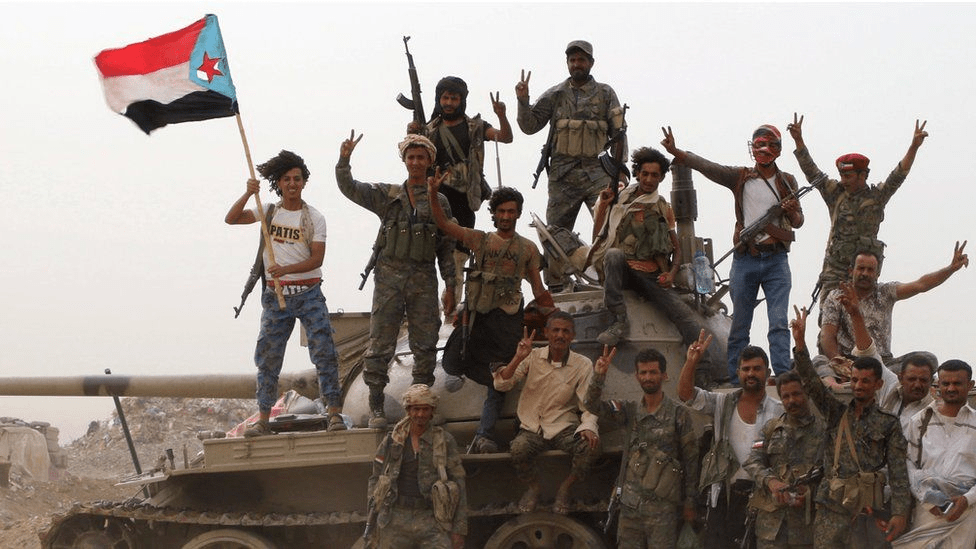
However, by April 2017, tensions had escalated when Hadi dismissed the governor of Aden, Aidorous Al-Zubaidi, and accused him of disloyalty. This led to a wave of mass protests against Hadi in the south. On the 11th of May in 2017, the Southern Transitional Council was formed as a 26-member council with Al-Zubaidi presiding over the council. It immediately decided to reinstate the southern state and was declared illegitimate by the Hadi government.
The movement has also been backed by the UAE, which conflicts with the fact that the UAE is also a part of the Saudi coalition that has decided to back Hadi against the Houthis. UAE’s support for the Southern Transitional Council can be seen as a part of its effort to protect its maritime trade by securing ports in the South of Yemen by aiding and helping the Southern Transitional Council.
By January 2018, The STC had started fighting forces that were loyal to Hadi in the city of Aden, and by August, had taken control over the entirety of Aden. Both the STC and Hadi’s forces clashed for control over the South, and the fighting ended when Saudi Arabia helped mediate a power-sharing agreement in November 2019. While the STC reneged on the deal, they accepted it a few months later in 2020. This had installed a government in which the separatists and Hadi would share their power equally. Even though this was a sign of progress, countless ceasefire agreements had failed to end the war in Yemen. In April of 2022, Hadi ceded all his power to a governing council and fired a deputy that the Houthis had opposed. At the same time, President Joe Biden of the United States had reversed a designation put forward by former President Donald Trump, which had labelled the Houthis as a terrorist organisation.
- Conclusion
As the warring sides continuously violate ceasefire agreements and attempts for peace, the population of the country is in deep poverty as Yemen is the poorest country in the Arab world. There is a problem of malnutrition, continuous violence, unclean drinking water and the subsequent pandemic of Cholera in the country. Even as the UN and other states attempt to give humanitarian aid, the aid is usually destroyed or taken by the different warring sides in the country. The real issue in the country is not only the humanitarian crisis, but also the fact that all the different warring sides have foreign backers who are not exactly willing to back out and try for peace, and on the off chance a peace agreement is actually signed, it is violated in the next few months. With the pandemic too, the government (or whoever is in power in the respective governorates) has not been competent enough to help the people. If there is any hope for Yemen, the responsibility lies not only on states such as Saudi Arabia, but also upon the people of Yemen itself, and their ability to unite as one single republic under one government.
About the Author
Tanish Srivastava is a student at the Jindal School of International Affairs and is very interested in issues related to security and economics.
 NICKELED AND DIMED