
By Nakul Rai Khurana
Abstract
This article examines the significance of shared democratic principles in fortifying the relationship between the United States and India. Despite potential skepticism, these common democratic ideals serve as the foundation for a strategic and mutually beneficial alliance as the world will witness during Prime Minister Narendra Modi’s visit to the United States.
It has been a customary tradition for American policymakers visiting India to praise the beauty of Indian politics, the diversity, and the shared values between the “world’s oldest democracy” and “the world’s largest democracy”. While a preconceived notion of the Indian diaspora sounds far-fetched in nature, it carries weight in Washington. U.S. policymakers have often opined that their strong bond with India is built on common democratic principles. The argument persists that as the two biggest democracies, they naturally share similar perspectives and interests when it comes to shared democratic values.
Mahatma Gandhi, the de facto head of the Indian independence movement at the time, received a letter from U.S. President Franklin Roosevelt during World War II stating, “Our common interest in democracy and righteousness will enable your countrymen and mine to make common cause against a common enemy.” Throughout the Cold War, many presidential administrations argued that India was a natural foe of the Soviet Union because it was a democracy in an effort to persuade New Delhi to oppose Moscow. When President George W. Bush and India signed a ground-breaking civilian nuclear agreement in 2005, he said that because of India’s democratic system, the two countries were “natural partners” bound together “by deeply held values.”
However, there has rarely been a diplomatic inclination towards each other’s shared or expected interests. Gandhi, for instance, did not follow Roosevelt by placing more importance on India’s fight for independence from the British Empire than on the battle against Imperial Japan and Nazi Germany. During the Cold War, New Delhi not only refrained from siding with Washington but also developed cordial connections with Moscow. New Delhi kept close ties to the Kremlin even after the Cold War ended and India started to improve its relations with the US. It has declined to cooperate with the US on Iran and courted the military government in Myanmar. It has most recently refrained from denouncing Russia’s invasion of Ukraine or condemning it at a global platform with ambiguous calls for peace, which fail to provide a clear clarity on its position.
Making democratic ideals the cornerstone of U.S.- Indian ties has always been a risky move, but it is now obvious that this policy is doomed since the idea of ‘shared values’ has started to seem ludicrous in and of itself. India’s reputation as a democracy has deteriorated ever since Narendra Modi took office as prime minister nine years ago. Violence against the Muslim minority has increased in the “largest democracy in the world,” frequently stoked by powerful leaders and proliferated by their adversaries. Millions of Muslim citizens are now being denied citizenship with recent amendments to the Citizenship Act. It is stifling free speech and putting down critics which may prove to be pernicious to the so called democratic regime of India. Since the Biden administration has positioned itself as a strong defender of democratic principles, the characterisation of the US relationship with that of India is a problematic one as the collaborative strength resides in the democratic values that have been under a stint in the Modi regime in India.
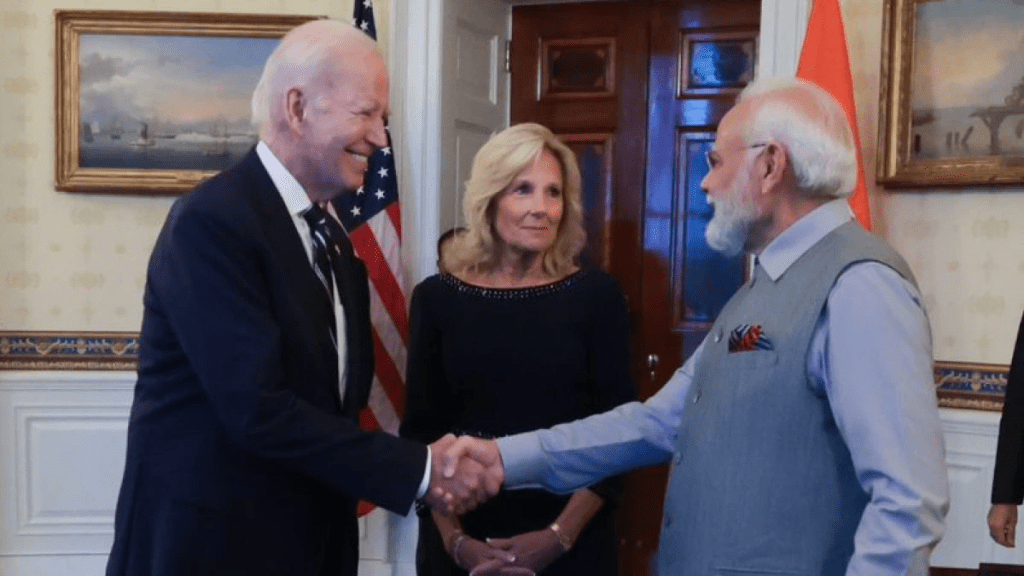
Presently, despite ongoing worries about human rights in India, U.S. President Joe Biden and Indian Prime Minister Narendra Modi are anticipated to expand defence and technology collaboration between their nations during Modi’s formal visit to the White House.
As per the Reuters, Washington views India as a crucial ally and wants it to provide a strategic counterbalance to China. With 1.4 billion people, India is the most populous nation in the world, and Prime Minister Modi is determined to enhance the influence of India on the global order, especially in the spheres of defence and technology.
National security advisor Jake Sullivan told reporters on Tuesday that during the visit, Biden is likely to express hesitations of the American democracy’s concern with the looming human rights violations persistent in the Indian subcontinent, largely towards minority sections. “We do so in a way where we don’t seek to lecture or assert that we don’t have challenges ourselves,” Sullivan stated.
The United States, however, must abandon the notion that shared values can serve as the cornerstone of a healthy relationship in order to take advantage of these complementary material interests in the realm of technology and trade interests especially against the rising power of China and the Yuan currency. It must diverge from justifying its high tolerance for New Delhi’s behaviour on the basis of a bet on long-term convergence and rather focus on the transactional nature of the two nations’ relationship. As India plans to head the G-20 summit this year, it will awfully retain from provoking any narrative that disturbs the thin fabric of its diplomatic relations, and which will prevent the nation from shining in limelight in a multi polar order, where it seeks to resurge as a global power.
About the Author
Nakul Rai Khurana is a second-year law student at Jindal Global Law School pursuing his bachelor’s in arts and law. His interests lie in legal and social developments around the world.
Image Source: https://www.indiatoday.in/india/story/pm-modi-us-visit-live-updates-yoga-day-joe-biden-kamala-harris-2395667-2023-06-21
 NICKELED AND DIMED