
By Suteekshna Dubey
Abstract
The budgetary allocation of FY 2023-2024 witnessed an increase in defence budget, with a goal to strengthen the nation’s defence prowess by reducing dependence on imports. A favourable shift in policy framework can be observed that has resulted in steady flow of capital and investment opportunities. This article will discuss the changes in Government’s approach to allocate resources and promoting domestic manufacturing to boost self reliance in the defence sector.
Military Expenditure has emerged to be one of the critically observed components of public expenditure and an important field of economics under defence economics. This expenditure affects the economic policy of a country rendering major share and strategy being subjected to the same. A good measure for the military sector in a country is Military Expenditure as a share of GDP and a share of government expenditure, respectively.
The initiatives undertaken by the Government of India portray a clear vision for the indigenous defence industry and the tremendous rise in export potential in engineering services and component sourcing. India’s defence market saw robust growth over the past decade. Government capital spending quadrupled from $3 billion in 2000 to $12.2 billion in 2010. Earlier, India would increasingly search for more options beyond its traditional supplier, Russia, for weapons procurement and had approached France, Israel, the United Kingdom and the United States. However, during the last decade, these procurement mechanisms and purchases have been thought through due to rising obsolescence and delayed procurement.
Defence public-sector undertakings (DPSUs) – Indian companies that are licensed to produce the contracted equipment have a key role to play in these inter-governmental procurements. For. Eg. the Indian Air Force’s fleet of Russia Sukhoi Su-30 MKI fighter jets manufactured under licence by Hindustan Aeronautics Limited (HAL) in India through the transfer of designs and subsystems from the Russian original-equipment manufacturer (OEM).
DPSUs were the only defence firms with a sizable presence in the country. They are highly vertically integrated, a factor that weighs against developing an elaborate base of defence suppliers. With further developments, Indian companies like Larsen & Toubro, Mahindra, and Tata and OEMs such as BAE Systems, Boeing and Israel Aerospace Industries have started to build market positions in air, land, naval and communication systems. This brings sizable change in the industry but DPSUs still remain amongst the dominant manufacturers.
En-route Self Reliance
SIPRI’s (Stockholm International Peace Research Institute) recent factsheet on “Trends In World Military Expenditure, 2021” has ranked India as the third highest military spender in 2021. Focusing on indigenization and procurement of defence products, from domestic resources, the expenditure on defence procurement from foreign sources has reduced from 46% to 36% in the last four years i.e. from 2018-19 to 2021-22.
Despite these observations in SIPRI reports to promote domestic manufacturing, only 30% percent of India’s defence equipment is manufactured in the country. Defence industry experts have unified in calling for the indigenization of research and development, design thinking, and technology, as well as more private sector involvement, to enhance India’s domestic manufacturing capabilities and promote self-reliance in the manufacture of defence goods.
One of the crucial steps for becoming self-reliant is Capital Expenditure and meeting a rising challenge from India’s competitors – China and Pakistan by creating infrastructure and adopting modern technology. In the previous few years, the government has reduced exports while promoting domestic manufacturing in India’s defence sector. The PLI Scheme was launched by the government in September 2022 to promote the production of drones.
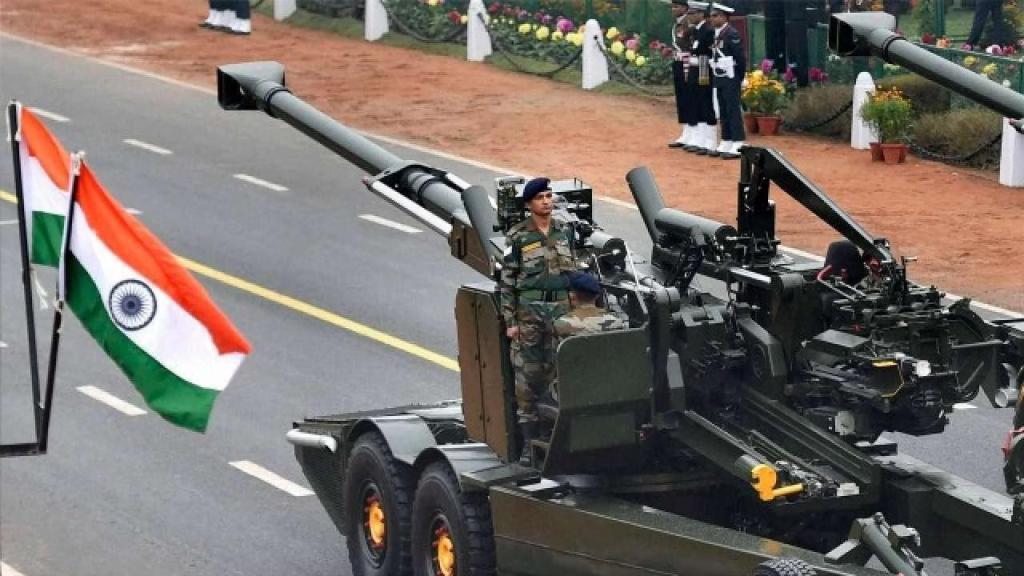
Building a self-reliance model, several Government of India initiatives have escalated our defence industry which is capable of manufacturing wide variety of high-end requirements such as Tanks, Armored Vehicles, Fighter aircraft, Helicopters etc. with a view to rapid progress towards achieving complete Aatmanirbhar in the manufacturing of defence equipment. Some of the examples are; the 155 mm Artillery Gun System “Dhanush”, Light Combat Aircraft “Tejas”, the Surface Air Missile System “Akash”, Arjun, Cheetah Helicopter etc.
· To foster innovation and technology development, an innovation ecosystem for defence titles Innovations for Defence Excellence (iDEX) was launched in April 2018 in Defence and Aerospace by engaging Industries like MSME’s and Startups.
· Defence Industrial Corridors was also established to attract investments in the Aerospace and Defence sector and established a comprehensive defence manufacturing ecosystem in the country.
A Budgetary Glance:
In the budget expenditure of 2023-24, Research and Development in Defense, allocated to DRDO has been enhanced by 9% (total with Rs. 23, 264 Crores) to foster innovation, encourage technology development and strengthen the Defense Industrial Ecosystem in the Country, iDEX and DTIS have been allocated Rs. 116 Crore and Rs. 45 Crore with enhancement of 93% and 95% over 2022-23.
National Data Governance Policy was announced for innovation and research by startups and academics further enabling access to anonymized data which will give a boost to the Defense Start-ups and other schemes.
A new international order will be established as a result of the recent conflict between Russia and Ukraine, one in which social media, information warfare, economic sanctions, and the value of independence will all play significant roles. India has thus realised the value of independence of the defence industry and new initiatives for indigenous militarization have been introduced to promote domestic manufacturing and self-reliance.
Conclusion:
India is emerging to be an attractive destination for military manufacturing and with adopted state-of-the-art technology it has the potential to emerge as one of the leading and self-reliant manufacturers in the defence and aerospace industry. It is evident from the budgetary allocations discussed above and propounded by various defence experts, that India should thrive to instil these policies in their entirety and focus more on research and development.
The idea of indigenization of defence manufacturing is not contemporary, but dates back to the early 2000s when the need was felt due to dependence on foreign manufacturers, especially on the backdrop of a series of aggressions being witnessed by the neighbouring countries. A study by the Federation of Indian Chambers of Commerce and Industry, published that if India would have reduced its military imports by between 25% and 75% by 2009, this strategy would boost indigenous production and 30-50% cost saving for the government.
The time has come to awaken from sleep, take action, and usher in a new era.
About the Author
Suteekshna Dubey is a Second Year Law Student (3-Year LL.B. Programme) at Jindal Global Law School. Her interests lie in developments in manufacturing, aviation, technology sectors and its impact on public policy.
 NICKELED AND DIMED