
By Tanish Srivastava
Abstract:
Pakistan is facing a crisis. It sees constant energy cuts, a budget deficit, the ever growing need for loan bailouts, political instability and terror financing on its western border. for As the country faces one of its biggest security crises ever, it becomes increasingly more important to understand the history and the future prospects of the Pakistani state. This article attempts to examine the history crises in Pakistan and the factors behind them.
Pakistan is currently in a crisis, one that is owed to the incompetence of the judiciary, and the lack of systems of public accountability. The disproportionate share of the military in the country’s politics is the only constant in the Pakistani state’s foreseeable future. It is important to look at the country’s history to understand the origins of these issues and how they developed, what the people reacted with and the effect on the economy. This paper aims to analyse:
- The Failure of Civilian institutions
- The military’s role in politics
- Effect on the Pakistani economy
- Future prospects for peace
I. The Failure of civilian institutions
The Pakistani judiciary’s inability to hold the military, and other corrupt elite accountable is a major factor in the collapse of the Pakistani state. The civilian governmental structure that democracies are meant to follow is severely challenged in Pakistan; there has never been a prime minister in Pakistan who has completed a full term. This is not to say that Pakistani democracy is not present among the masses, even the military rule tries a semi democratic way of reaching the masses, using mostly religion to reach the masses, because of the support that is needed from the 230 million strong population of the country.
The eternal fight between the conservative religious against the moderate and relatively secular side of Pakistani politics does not seem to have reached a consensus. On the one hand, military leaders such as General Ayub Khan and General Pervez Musharraf wanted a more moderate Pakistan, one where the role of Islam in the country’s politics seems to be limited, and on the other hand there are leaders like Zia-ul Haq, who was allied with the most conservative islamic parties, parties who basically propose an Islamic revolution in the urban middle class. During the shift from moderate military rule, to islamic military theocracies, to the democratically elected corrupt elite, the civilian institutions, the media and the entire democratic construct of Pakistan seemed to have failed to ensure a proper democratic civilian government. The problem however, is not just of a democratically elected head of government, it is also to make sure the head of government is competent enough to keep the country and its economy afloat in the long term.
Fuel subsidies and improper taxation to appease the public and gain votes have all been short term remedies, and the failure of the government to protect the interests of the masses against those of the elite is not just a product of government officials participating in corrupt exchanges with the elite, it is also a product of government officials being the elite in the first place. This also applies to the constant military intervention in the politics of Pakistan, where the military is less of a body for the country’s security, and more a grouping of business elites (given the vast amounts of land owned by the military) and a glorified and expensive political party.
II. The military’s role in politics
The military in Pakistan has proved time to time that it is the only competent organisation in the country, given the failure of civilian institutions, the judiciary and the economy. The foreign policy of Pakistan also has to keep in mind the relevance of the military, for example, any attempts to reconcile with the Indians puts the military under direct threat, not because of the threat from the Indian military, but one from Pakistani domestic politics. If the Pakistani population is not under constant threat, what relevance does the military maintain? What could the effects on the budget be? And would the mass be less under the influence of the military?
Pakistan has come under major phases of military rule. General Ayub Khan for example, took power in 1958 in a bloodless coup. He had ideas of a pakistan with relatively less influence of religion in the country’s politics. Contrary to the beliefs of General Ayub khan, another general gaining power was General Zia Ul Haq, who has been known in history as a figure responsible for an extreme islamisation of Pakistan in the 70s and 80s. Zia ul haq openly supported Islamist militias and changed the legislature of pakistan to be more extreme in accordance with religion. The infamous Hudood Ordinance was passed under the reign of General Zia Ul Haq. These laws introduced an era of extreme Islamisation, where the laws were applicable, ironically, to non-muslims in the country. This included punishments that were blatantly sexist, for instance, Pakistan became one of the few countries in the world where a woman would be punished for being raped, if she did not provide 4 witnesses to the crime. Being raped was officially a crime for women in the country, with punishments such as lashes in public, or being stoned to death were enforced, judged on the verdict of Islamic courts set up by General Zia Ul Haq.
Contrary to his policies, another military dictator, General Pervez Musharraf, believed in an enlightened moderate Islam. He believed that the Muslim world and the non muslim world needed to come to a consensus, where it was the job of the united states and the west to providing justice in the muslim world and also socio-economic aid to the muslim world, and the job of the muslim world to not terror finance and to eliminate the practice of Islamic extremism.
The recent events that took place in Pakistan last year are also speculated to be a result of military intervention. Former Prime Minister Imran Khan, head of the Pakistan Tehreek-E-Insaf (PTI) is known to have contentions with Pakistani military elites after his parliamentary vote of no confidence is still believed by many to be a plot by the military. This extent of intervention of the military in Pakistani civilian institutions proves the incompetence of the judiciary and its failure to hold the corrupt elite accountable for their crimes. If there is to be a democratic civilian governance structure for the Pakistani state, the first limitation to counter would be military intervention.
III. Effect on the Pakistani economy.
The Pakistani economy is in freefall. Inflation has soared, at its highest in decades at around 31.5%. Common daily household items and food have doubled, even tripled, their normal prices. Growth rates are plummeting, the government is providing subsidies that are a means of gaining a voter bloc in the short term but are detrimental to the economy in the long term. The loans from the IMF are close to default, and proportionate increases in the budget allotted to mere interest payments are on the rise. The Pakistani economic crisis is very much related to the political instability in the country, leaders are concerned about short term policies, aimed at securing their power but not policies good for Pakistan in the long term. Fuel subsidies are a very important example of that, where Pakistani leaders to appease the masses decide to spend more of the budget on providing fuel subsidies in the country, rather than use money for socio-economic development or the paying back of loans. The uncertainty that comes from the political instability in Pakistan also makes it an improbable destination for Foreign Direct Investment (FDI) from abroad and also makes it difficult for institutions like the International Monetary Fund (IMF) ro provide loans to the Pakistani government, which in turn makes the available sources for loans limited to other states, ones that charge exorbitant rates such as Saudi Arabia and China. China and Chinese banks are now almost one third of all of Pakistan’s external debts, and the interest rates and payback time are not as comfortable as the International Monetary fund.
Political instability, corruption and the short term interests being prioritised over long term interests in Pakistan have time and time again pushed the economy into crisis. The situation right now is a perfect example of all the problems that Pakistan faces, with the military intervening at every chance they get, The governments fighting each other, a corrupt bureaucracy, and civilian institutions failing to hold anyone accountable.
IV. Future prospects for peace
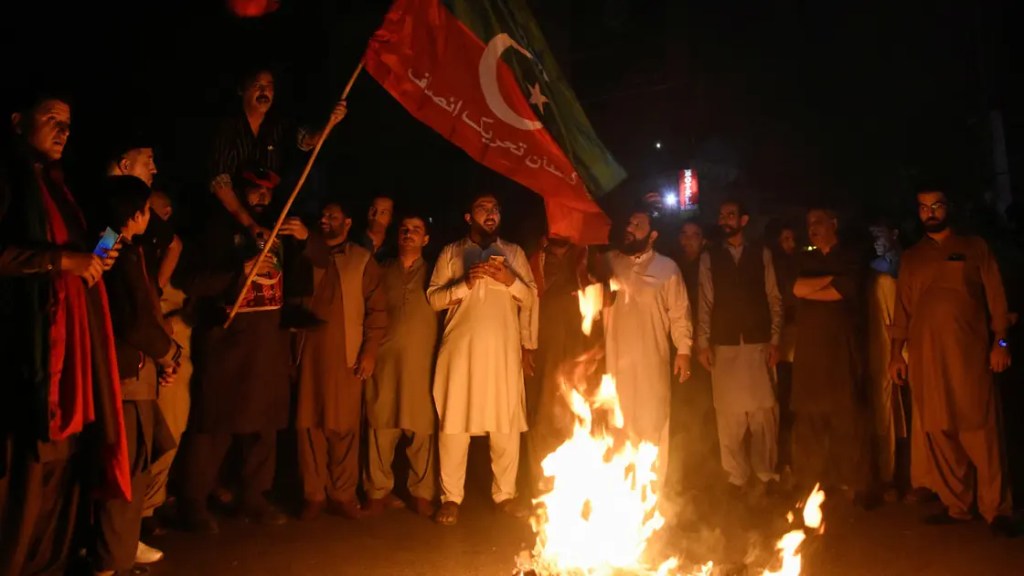
What we are seeing in Pakistan right now is protests against the current Shehbaz Sharif government from supporters of Pakistan Tehreek-E-Insaf, which is Imran Khan’s party. The supporters believe that Imran Khan’s ouster from office was a foreign conspiracy by the Americans as alleged by Imran Khan, and that the Pakistani military worked to install the Sharif government. Whatever the case may be, Pakistan is in a crisis. The Tehreek-E-Taliban Pakistan (TTP) is constantly claiming land and attacking Pakistani police posts and mosques. The economy is in a freefall, and inflation is at its highest in decades. There are protests country-wide against the current government. The former Prime Minister was shot, and almost arrested in his compound, with constant shelling from the authorities. In these times of crises, it is important that there is a fundamental change in the Pakistani state structure. If the military still keeps its disproportionate share in power, and if the governments keep taking populous decisions instead of important long term plans, then the Pakistani state will keep its place in the infinite cycle of crises after crises, something that the Pakistani population might be finally understanding. Pakistan’s future undeniably affects countries such as India, Afghanistan and China, but as these countries look for broader prospects globally, it is time that Pakistan does the same, with, of course, much needed reform.
About the author:
Tanish Srivastava is a first year student at the Jindal School of International Affairs and is very interested in issues related to security and economics.
 NICKELED AND DIMED