
By — Sumedha
Abstract
This paper critically examines the Narmada Valley Development Project, with particular focus on the Sardar Sarovar Dam, to assess its ecological impacts, social displacement, and the role of judicial intervention. Drawing on environmental assessments, tribunal reports, and court decisions, the study highlights extensive forest submergence, disruption of riverine ecosystems, and the collapse of traditional fisheries. It further documents the large-scale displacement of predominantly Adivasi and rural communities and the persistent failure of rehabilitation and resettlement obligations mandated by law. This paper argues that the Narmada case exposes the limits of judicial oversight in reconciling development with ecological sustainability and social justice.
Introduction
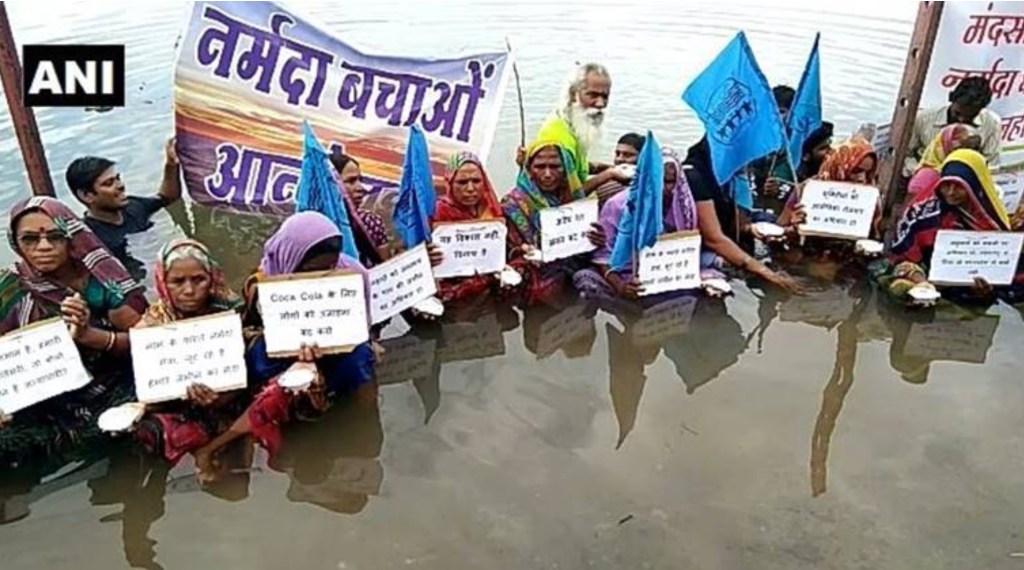
The Narmada Bachao Andolan (NBA) is a people-led movement opposing India’s abhorrent construction of large dams on the Narmada River. It argues that projects like the Sardar Sarovar Dam will cause irreversible ecological harm and social disruption. Sardar Sarovar’s construction entailed massive flooding of villages and land, which resulted in destroyed fisheries, waterlogging, salinization, and deforestation. NBA figures estimate the displacement of about a million people, who include mostly poor farmers and tribal communities. These claims have led the NBA to litigate repeatedly.
Environment concerns
The Narmada River, originating in Madhya Pradesh, travels westward through Maharashtra and Gujarat and eventually drains into the Arabian Sea. Dozens of dams and reservoirs on this basin will inundate vast areas of floodplain, forests, and farmland due to the river covering vast areas of land in the country.
Key environmental concerns include:
● Forest and habitat loss: An estimation of over 13,000 hectares of forest will be submerged by Sardar Sarovar alone. The planned compensatory afforestation, if it is at all carried out in reality, cannot replicate the original biodiversity. In practice, plantations were often created far from the river with different soils and species, undermining any ecological replacement. Climate diplomacy emphasises that dam construction entails massive flooding of productive land and a threat to wildlife’s natural habitat and deforestation.
● Aquatic ecosystems and fisheries: Due to the blockage of the river’s flow, large dams disrupt fish migration and alter water quality. The Sardar Sarovar reservoir will trap sediment and change water salinity patterns downstream. Experts report that the Narmada estuary’s once-rich hilsa fishery has collapsed because insufficient freshwater now reaches the sea. Similarly, native mahseer fish have disappeared from many stretches; villagers say daily catches have fallen to one or two kg, forcing them to leave fishing. These losses endanger the food and livelihoods of thousands of riverine families.
● Waterlogging, salinity, and river geomorphology: Reservoir backwaters raise upstream water tables, submerging land and causing salinization. A World Bank panel or the Morse Report warned that up to 40% of the irrigated command area would suffer waterlogging, reducing crop yield. Climate analysts also note that the project’s impact on lower-river geomorphology and estuary, like sediment starvation and salt intrusion, was never properly assessed. Downstream dry-season flows have been radically cut, leading to permanent and detrimental changes in downstream ecology.
In sum, the NBA highlights that these large dams have caused irreversible damage to fragile ecosystems. Field reports and legal reviews document extensive submerged forests and farmland and loss of rare species habitat, and declining fish stocks downstream. Authorities have also been at fault for deferring environmental studies. For example, the Union Ministry of Environment granted only conditional clearance for Sardar Sarovar in 1987, after World Bank financing had begun; even then, impact studies were conducted during construction.
Social Consequences
The NVDP’s social impacts center on the displacement of rural and especially tribal Adivasi communities. Under the original tribunal award, affected families were to receive alternative land-for-land and be rehabilitated before inundation. In practice, millions of people have lost their homes, fields, and forests, often with inadequate restitution.
● Scale of displacement: The NBA estimates roughly one million people will be uprooted by all Narmada dams. For Sardar Sarovar alone, about 35,000 families in Madhya Pradesh and 3,600 in Maharashtra lie in the submergence zone at fullheight. These rural communities typically depend on farming, forest-gathering, or fishing to make up their livelihood. In many submergence villages, the best of agriculture and horticulture, and the entire village lives, including but not limited to homes, schools, temples, etc., were inundated. Families lost standing banana, maize, cotton, sugarcane, and wheat crops, leaving them destitute at harvest time. With customary lands gone, many displaced Adivasis, the previously persecuted, were furthermore denied secure resettlement.
● Livelihood loss: The sudden loss of land and water has destroyed traditional livelihoods. Farmers who once grew multiple annual crops now have no fields; fisherfolk now catch only one or two kg per day, forcing them into low-paying labor or migration. Tribal people, cut off from forest grazing and tube wells, report broken wells and stunted cattle. The entire riverine economy is disrupted downstream communities can no longer rely on regular flows for irrigation or fishing.
● Inadequate rehabilitation: Although the Narmada Tribunal Award and later court orders required land-for-land resettlement, implementation has been poor. Right Livelihood observers state bluntly that resettlement and compensation have been totally inadequate. Courts have repeatedly stressed that affected people must get alternative land and promised benefits six months before submergence. But in reality, most victims have not received such land. Even by the early 2000s, the majority [of oustees] had yet to receive rehabilitation. Many were instead offered partial cash payments or plots far from traditional homes. Survey reports and tribunals have documented ongoing rights violations: for instance, an independent tribunal in 2010 found that three state governments persistently failed to honor their duty to compensate displaced families.
Combined, these factors have produced severe hardship. Tribals and villagers have lost ancestral lands and community ties, often with little prospect of rebuilding their livelihoods. NBA critics argue that this violates basic rights to housing, livelihood, and cultural security. Displaced families continue to organize hunger strikes, protests, and legal actions to secure their owed land or fair treatment.
Legal Battles and Judicial Interventions
The NBA has waged a sustained legal campaign centered on constitutional and environmental protections. Courts have repeatedly intervened on issues ranging from dam construction to environmental clearances and rehabilitation. Major judicial actions include:
● Supreme Court, 1995: In response to the NBA’s petition, the Supreme Court ordered a temporary halt to the dam’s raising in 1995 because required impact assessments were incomplete. The Court noted that construction was proceeding without finished studies of social and ecological effects.
● Supreme Court, Kirpal J., 2000: In its landmark October 2000 verdict, the Supreme Court allowed Sardar Sarovar to reach its full planned height but only under strict conditions. The Court approved incremental 5-meter raises and confirmed the Narmada Water Tribunal Award’s mandates that affected people must receive equivalent land for lost land, and must be resettled and rehabilitated at least six months before inundation. It empowered official bodies like the Narmada Control Authority to clear each stage. Thus, while the NBA lost the final dam-height battle, the verdict reinforced legal rights on resettlement and environmental review.
● Post-2000 compliance suits: Despite the 2000 decision, the NBA and others continued to challenge government lapses. For example, in 2003, the Housing & Land Rights Network (HLRN) reported that states had raised dam levels to 95–100m without completing land allotment. NBA filed further petitions urging the Court to enforce its conditions. In 2011, the Madhya Pradesh High Court ordered that filling of the Indira Sagar and Maheshwar reservoirs be suspended until land-based rehabilitation was provided.
● Environmental clearance litigation: NBA’s campaign also targeted regulatory clearances. The movement highlighted that India’s Ministry of Environment had only conditionally cleared the Sardar Sarovar project in 1987, after work had begun. Courts and tribunals later mandated strict enforcement of clearance conditions. In 2018, NBA-affiliated activists petitioned the National Green Tribunal, citing permanent and detrimental changes to downstream ecology from reduced water releases.
Conclusion
Overall, the NBA’s legal efforts yielded mixed results. The Supreme Court rulings confirmed the necessity of environmental and social safeguards, and orders by high courts and the National Green Tribunal have checked abuses like illegal mining and unauthorized filling. However, broadly, there are disastrous and detrimental major gaps. Even after judicial intervention, the grievance of the displaced largely went unaddressed. Many displaced families still lack land titles or full benefits owed under the law. The NBA continues to press courts and government agencies to enforce commitments on land allotment, tribal rights, and environmental compliance.
About the Author:
Sumedha is currently a student at OP Jindal Global University in her third year of law school. With a strong interest in social sciences, she is keen to explore topics of intersections of climate and society. She is looking forward to explore and enhance her writing and knowledge on the socio-legal field.
Image Source: https://www.legalindia.com/narmada-bachao-andolan/
 NICKELED AND DIMED