
By — Shreya Parameshwaran
Abstract:
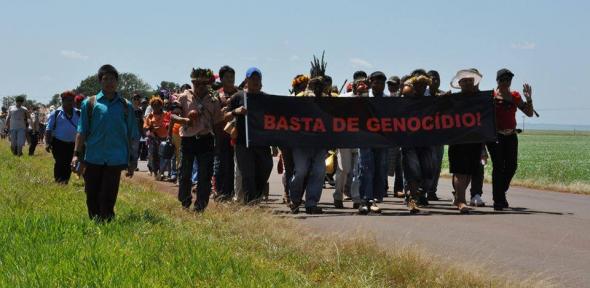
Guarani-Kaiowá confront existential challenges due to agribusiness in Mato Grosso do Sul, Brazil, especially in regard to land loss and the conversion of their tekoha to monocultures of soy, sugarcane, and cattle.Marcos Veron’s murder exemplifies “Kaiowcide”, violence, evictions, and the world’s highest youth suicide rates amid malnutrition on overcrowded reserves. The former agroforestry systems that sustained the fragmentation of the Atlantic Rainforest and its biodiversity are now deforested and over-pesticided. However repressive the systems are, the surviving aspects of the Guarani-Kaiowá people’s child’s reko and ecological knowledge of their people, still, constructive the resilient mosaics systems. These systems are of utmost importance for land conservation and culture to survive. The integration of indigenous land protection and management into policies is of utmost importance.
Introduction: Colonization and displacement:
‘This here is my life, my soul. If you take me away from this land, you take my life.’
This deep insight was expressed by Marcos Veron, a well-known Guarani-Kaiowá leader, in 1997. Marcos had been leading his people, the Takuára community for years in their nonviolent struggle to be returned to their ancestral lands, Tekoha Guaiviry. Marcos’s statement captures the irrevocable bond between his people’s identity and territory-a bond that the contemporary Brazilian state has further carried and ferociously attempted to destroy. In 2003, shortly after he had spoken these words, Marcos Veron was brutally murdered by the help of ranch hands and a policeman for his crime of returning home. His tragic tale is not unique but a symbol of the ongoing battle of the Guarani-Kaiowá, where the oppression of a community is inextricably bonded to the destruction of the environment. The Guarani-Kaiowá are indigenous people who reside primarily in the state of Mato Grosso do Sul (MS), Brazil. They have been dispossessed of their lands for decades, their lands which have been occupied or destroyed through ranching, soy plantations, and other big agribusiness operations. Land loss has heavy social repercussions. The displaced people lose access to land, experience hunger and malnutrition, reduced areas of cultivation and usually find themselves in roadside camps or severely constricted reserves. For the Guarani-Kaiowá, the suicide rate among children and youths is extremely high and directly linked to hopelessness as future, tradition, and land appear lost.
Brazil’s Guarani-Kaiowá are confronted with an existential crisis wherein colonization, land struggle, and ecological devastation deeply affect both their very existence and indigenous diversity. These simultaneous environmental and social dangers reflect how the ongoing repression of indigenous peoples depletes essential ecological knowledge and conservation efforts, with disastrous outcomes for cultural inheritance, human rights, and the future of Brazil’s rainforests. Verón’s words capture the intense identification with land, survival, and identity for his people. Displacing Guarani-Kaiowá from their own land is not just a legal matter; it is one of existence.
Loss of biodiversity and destruction of environment:
For centuries, these people used advanced agroforestry, hunting, and fishing methods to maintain the rich Atlantic Rainforest ecosystem, all heavily embedded in religious faith and family tradition. This sustainable use created a mosaic landscape of cultivated landscape, controlled forest, and biodiversity corridors that maintained both community subsistence and ecosystem balance. But a prolonged disturbance was caused by Replacement of biodiverse following the Paraguayan War (1864-1870). These policies began to expel these communities from their ancestral territories in a coercive manner, a process aimed at placing land at the disposal of national development and private owners. The displacement accelerated in the mid-20th century, fuelled by the expansionist drive of agribusiness. To pave the way for this new economic system, huge areas of ancestral lands were thoroughly transformed into cattle pastures and massive monoculture soy and sugarcane fields. This extensive land-use transformation obliterated the forests they had protected for hundreds of years and caused intense fragmentation of indigenous homelands, cutting short cultural and physical ties to land and undermining their traditional ways of life.
The environmental consequences of colonization are stark. The replacement of biodiverse natural ecosystems with sugarcane, corn, and soybean monocultures has devastated habitats and contaminated waters with pesticides. Indigenous systems of resource management, such as agroforestry, polyculture, and nature reverence formerly protected vulnerable species and soil fertility. Today, these wisdoms are weaker as deforestation persists and agribusiness interests accumulate land conflict, precipitating direct violence as well as long-term conflicts over the land. This environmental crisis threatens numerous plant and animal species, some which are presently threatened or endangered because of habitat destruction within the region.
The Violence, rights, and resistance:
However what makes the Guarani-Kaiowá people’s situation more poignant is social violence coupled with environmental destruction. Pushed onto filthy government reserves, many families have been subject to armed invasions, forced evictions, and chemical bombardment by agribusiness and security forces. The battle for land rights continues, as Brazilian legislation formally ensures demarcation of indigenous lands, yet bureaucratic missteps and political opposition particularly during the Bolsonaro regime stalled actual gains. Violent assaults like the Caarapó Massacre illustrate how efforts to reclaim ancestral land are countered with deadly force and how there is a climate of fear and chronic insecurity.
Life for Guarani-Kaiowá cannot be separated from land. Their religious cosmology, common good, and cultural identity all rest on having access to tekoha ancestral land imbued with ecological and spiritual importance. The continuous violence and systematic denial of basic rights and their genocidal dimensions is what researchers and activists define as “Kaiowcide” against the Guarani–Kaiowá,consisting of the deprivation of territory, involuntary imprisonment in overcrowded reserves, and the systematic persecution of leaders and communities with suicide and homicide rates among the highest in Brazil. In addition to human tragedy, the violence directly impacts biocultural heritage loss, destroying valuable ecological knowledge important to the sustainable use of forests and species conservation.
Conservation Solutions and knowledge:
Despite adversity, the Guarani-Kaiowá are at the forefront of biodiversity defenders, resisting displacement by direct action, legal activism, and international solidarity. The sophisticated ecological governance of the area, the research of which has also included partners, includes the identification and the protection of keystone, cultural, and biologically diverse species. With the aid of biocultural memories and traditional ecological knowledge, the Guarani-Kaiowá shamans and knowledgeable holders perform forest management using agroforestry and polyculture, and protection of culturally important fauna and flora, which create water cycle and soil fertility sustaining habitat mosaics, and the protection of the threatened fauna and flora of the area, mosaic of culturally significant plants and animals. These activities complement evidence which has also shown that Indigenous territorial lands, under secure tenure, curtail forest loss and promote biodiversity, and also sustain, in a greater proportion to the surrounding area, a bioculturally diverse ecosystem. The concept of tekoha embodies the spirit of living with nature, an integration of spiritual relations with jara (guardian of beings) and circumscribed resource management. The incorporation of this local knowledge into national policy of conservation is deeply informative on how to cease the degradation of ecosystems, increase climate resilience, and restore habitats within the Atlantic Rainforest, and similar places.
Conclusion: Rights, Recognition and Solidarity:
The future of Brazil’s indigenous peoples and natural inheritance are tied together. The desperate demands for demarcation, official recognition of traditional ecological knowledge, and a halt to violence are not human rights issues but basic requirements for healing the biodiversity. In political ecology’s perspective, we see these forests are not merely natural resources but living, culture-filled landscapes imbued by millennia of cultivation. Thus, the existence of such communities as the Guarani-Kaiowá, and indeed the future of such biomes as the Amazon, depend on a triple-handedness of necessities: strong international solidarity, unshakeable government responsibility, and above all, the empowering of indigenous peoples to resume their rightful place as the legitimate guardians of their own homelands.
About The Author:
I’m Shreya Parameshwaran, a law student dedicated to the intersecting fronts of social and environmental justice. My journey in the legal field is driven by a commitment to upholding human dignity, protecting land sovereignty, and challenging the systemic inequalities that endanger both people and the planet. I am passionate about using legal research and writing to amplify the voices of marginalized communities on the frontlines of ecological conflict. Whether through documenting land rights struggles, analysing policy failures, or advocating for international solidarity, my work seeks to bridge the gap between legal theory and lived reality, striving to build a world where the law serves as a steadfast tool for dignity and protection for all.
Image Source: https://www.lapora.sociology.cam.ac.uk/countries/brazil/guarani-kaiowa-indigenous-people
 NICKELED AND DIMED