By – Siddarth Poola
Abstract
The story of the Democratic Republic of Congo is rarely discussed, but it is a tale as old as colonial times. One that lets the real culprits off the hook. This article will talk about how the violence in the Congo has been manufactured and amplified by an extractive global political economy that treats land, water, forests, and people as mere inputs for profit. The plunder of minerals and ecosystems driven by multinational companies, complicit states, and foreign military and political interests, has not only destroyed environments and livelihoods; it has helped create conditions for mass atrocity, displacement, and what many experts now rightly describe as genocide. This is an environmental-socio catastrophe: ecological devastation and human slaughter are two sides of the same extraction coin. I name who benefits, who kills, and why we must refuse the neutral language that hides culpability.
Introduction
When mining companies clear forests, when militias seize control of cobalt pits, when state forces or neighbouring regimes arm proxies to secure supply routes, the violence is not incidental. It is deliberate. The Congolese people did not die of an “ancient ethnic rivalry.” They died because land and resource grabs collapsed food systems, destroyed health infrastructures, and financed armed groups that killed, raped and expelled civilians. The mines that feed our phones, laptops, and batteries have a human cost that is also an environmental cost: poisoned rivers, killed forests, displaced communities, and the obliteration of food security that turns conflict into a slow, grinding genocide.
Extraction With Benefits
The scale is staggering; Conflict in the DRC has been associated with an estimated excess death toll in the millions since the late 1990s, driven by direct violence and by hunger and disease that accompany war. More recent reporting and rights investigations show recurring mass killings, sexual violence used as a weapon of war, and the forced displacement of millions, often in mineral-rich eastern provinces where armed groups fight to control extraction and trade. These are not collateral effects; they are outcomes of a political economy that prizes access to natural wealth above human life.
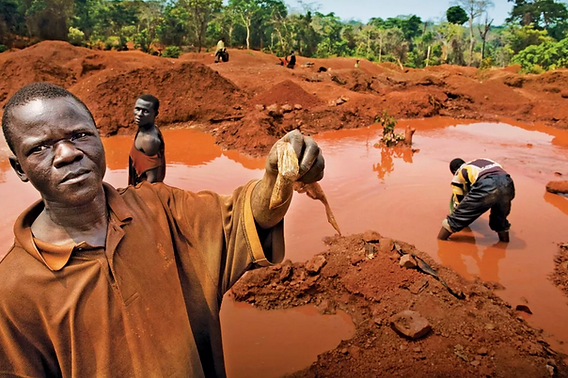
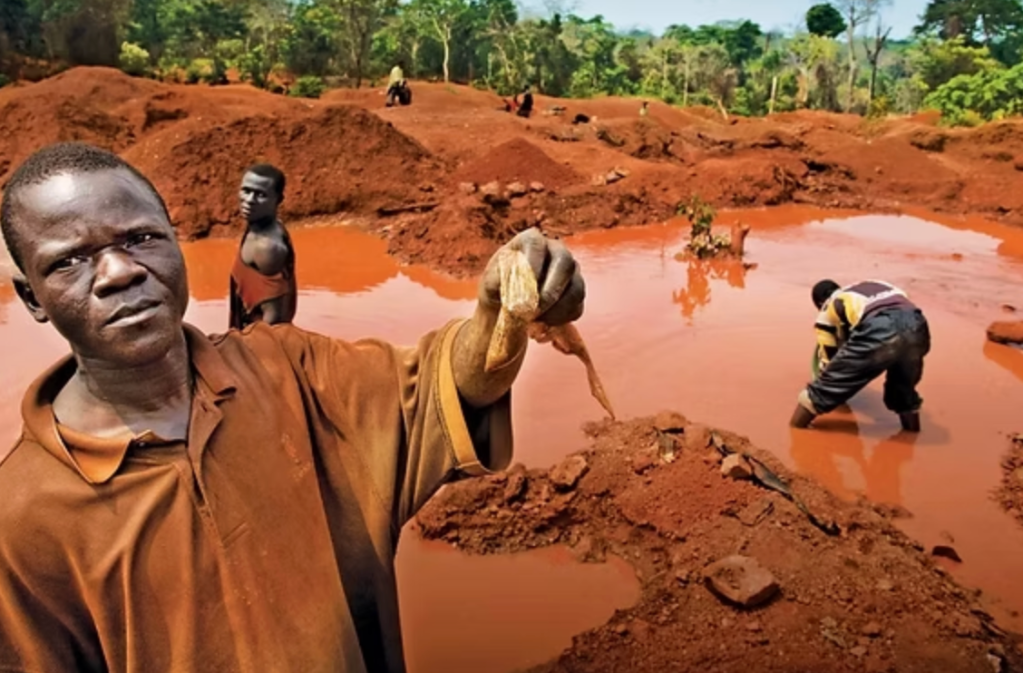
The environmental front is essential to understanding the motive behind the atrocities. Large-scale mining, agribusiness concessions, and illegal deforestation materially alters landscapes. Rivers are silted and poisoned by tailings; wetlands are bulldozed or filled. Coastal and forest communities lose fisheries, agricultural land, and medicinal plants, which are foundational subsistence tools. Once livelihoods are ruined, people become easier to coerce, buy off, or drive out. Armed outfits that control a mine will protect their prize by any means necessary: intimidation, terror, forced labour, murder. The same actors who profit from minerals also profit from displacement: land cleared by force for extraction or for investor-backed plantations becomes newly available for appropriation.
Supply Chains, Kill Chains
Who profits? The ugly and real answer is a lot of people. At the front end are militias and ethnic warlords who tax mining, traffic in minerals, and sell security to bigger players. Next are local elites and complicit state actors who provide access and protection. Beyond them are multinational mining firms and smuggling networks, and behind them sit global electronics, automotive, and green-tech supply chains that bulk-buy cobalt, coltan, tin, tungsten, and gold. Western and regional states are not innocent: they have backed, armed, or turned a blind eye to actors who secure mineral routes crucial for global markets. As analysts and human-rights organisations have shown, forced evictions and abuses linked to industrial cobalt and copper mining have been documented again and again, practices that displace whole communities while enriching a few; the U.S. Department of Labor and other agencies have reported endemic forced labour and dangerous conditions in cobalt production zones. The neat rhetoric of “green transitions” or “critical minerals for the energy transition” becomes obscene when it is paid for with dispossession, toxicity, and death.
No actor deserves leeway: corporations that buy minerals without adequate due diligence; financiers who provide capital while ignoring human-rights red flags; neighbouring governments and international actors who arm, finance, or tolerate proxy forces; and local elites who collude in land and resource grabs are co-perpetrators. They sustain the economy of violence that has all the structural features of genocide when population groups are targeted, displaced, starved, sexually enslaved, and murdered to secure access to land and resources. Several analysts and advocates have argued that atrocities in parts of eastern DRC meet the thresholds for genocidal intent, intent that is constituted not only by immediate mass killing but by the systematic destruction of groups’ ability to live on their land and sustain themselves.
Environmental degradation also fuels long-term demographic and health catastrophes. Silted rivers and toxic tailings mean fewer fish and contaminated drinking water; forest loss reduces available wild foods, materials, and medicines. Agricultural land converted to mine concessions or poisoned by runoff reduces yields. Health systems, which are already fragile because revenues are siphoned off or because conflict prevents investment, can’t cope. When violence erupts, clinics close, vaccinations lapse, and displaced populations crowd into camps where disease spreads. Starvation, disease, and exposure kill on a scale comparable to bullets. Counting the dead as a single category of “war casualties” erases the slow, environmental logic that made those deaths possible.
There is also a direct, transactional link between extraction and armed violence. Armed groups finance themselves through the illegal sale of minerals; these revenues buy arms and sustain militias. Control of mines and transit routes becomes the central strategic objective. Where a multinational corporation or an investor wants access, local authorities or foreign proxies become willing accomplices (or are coerced into compliance). Mining concessions have been used repeatedly as bargaining chips in political deals; entire territories have been carved up to reward patronage networks that then use violence to keep control. The result: resource scarcity, environmental collapse, and genocidal violence are not incidental byproducts but are tools.
Turns Out “Nothing” Is Also a Policy Choice
Neutrality isn’t going to help anyone but the corporate bigwigs, so let’s look at some possible (but maybe grandiose) solutions. First, extractive companies and downstream buyers must be legally and financially accountable for abuses in their supply chains. “Voluntary” codes and corporate social responsibility are not enough. Legally enforceable human rights and environmental due diligence, criminal prosecutions where appropriate, and asset freezes or import bans tied to proven abuses are necessary. Second, international institutions must condition assistance and trade privileges on tangible reforms and on reparations for communities who have lost land, water, and livelihood. Third, protection of civilians must be genuine: peacekeeping and security assistance should prioritize civilian safety and not merely stabilize routes for extraction. The UN and regional actors must do more than issue statements; they must ensure accountability for commanders and sponsors of armed groups. Fourth, community land rights and environmental protections must be strengthened: secure tenure, legal recognition of customary land, and safeguards for ecosystems are ways to block the clearance and dispossession strategies that underpin violence.
None of this is fanciful. There are documented precedents where accountability has made a difference: legal actions against complicit firms, sanctions on individuals who traffic in minerals, and public pressure campaigns that have forced companies to rework supply chains. Yet the international community has been inconsistent, often prioritising geopolitical or commercial interests over justice. This has to change. The Congo’s environment is not an instrument to be mined for the benefit of distant consumers; it is home and life for millions. To treat it otherwise is to sign off on a slow, extractive genocide.
Conclusion
Consumers and citizens in the Global North must stop treating minerals as morally neutral raw materials. Our smartphones, electric cars, and medical devices derive much of their value from Congolese minerals extracted in contexts of violence. Calling for “ethical sourcing” is not mere feel-good consumerism; it must be a demand for traceability, transparency, and, when necessary, refusal. Civil society must push for binding rules that make it impossible to profit from dispossession and ecological ruin.
The violence in the Congo cannot be separated from the ecological devastation wrought by decades of rapacious extraction. The genocide that scholars, activists, and survivors describe emerges from the same logic as the bulldozers and tailings ponds: human life is subordinated to extraction. It is time to say plainly what the evidence shows: the perpetrators include not only the armed groups and commanders who pull triggers and commit sexual violence, but the corporations, financiers, complicit governments, and buyers whose thirst for minerals converts environments into killing fields. Condemning the Congo’s catastrophe in neutral language is no longer sufficient. We must name the extractive economy as a primary perpetrator, pursue justice for its victims, and stop consuming the products of their destruction.
If we fail to do so, the Congo will keep bleeding for our gadgets, for our vehicles, for our comfort, while the world averts its eyes. That is complicity. To end the genocide, we have to starve the markets that feed it, enforce accountability at every level of the supply chain, restore and protect ecosystems, and return stolen land and dignity to the communities who never asked to bankroll our modern conveniences. Anything less is moral abdication.
About the Author:
I am Siddarth Poola, an undergraduate student doing law in Jindal Global Law School, with a deep interest in Water Sports.
Image Source : https://nickledanddimed.com/wp-content/uploads/2026/01/25894-df1038_8cec41748dd54fb8842d1d91e903991fmv2.png
 NICKELED AND DIMED