
By – Chinmayi J.
Abstract
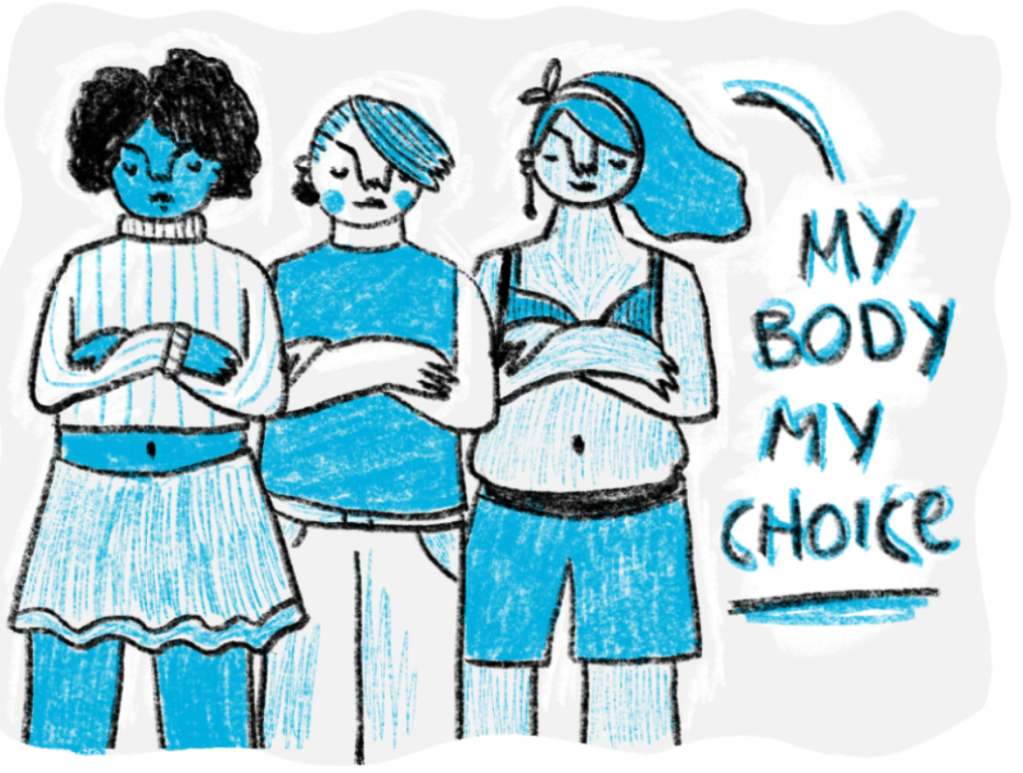
A fundamental issue in feminist and gender justice discourse is bodily autonomy. However, concepts such as the state, capitalism, caste, race, religion, and patriarchy all interact to shape this unequal distribution of autonomy. This article explores bodily autonomy as a contentious area within the gender and social spectrum, contending that social norms, the law, medicine, and moral regulation are the means by which control over bodies is exercised. It draws attention to the systematic erosion of autonomy that women and gender minorities face in areas like public life, healthcare, sexuality, and reproduction. The article presents bodily autonomy as a collective political struggle crucial to social justice and gender equality, going beyond an individualized interpretation of “choice.”
Understanding Bodily Autonomy
Bodily autonomy refers to the right and ability conferred to an individual to make uncoerced and educated choices with regards to their body. These choices include decisions related to reproduction, health, sexuality, labour, gender expression, and movement. Judith Butler argues, bodies are not mere biological entities; instead, they are constructed socially and politically. Hence, it is difficult to separate bodily autonomy and the power structures that govern and define the bodies that are regulated and the bodies that are respected. Hence, bodily autonomy cannot be understood in isolation from the power structures that govern it. These frameworks not only govern but also define which bodies ought to be respected and which ones are subjected to regulation.
It is no news that women’s bodies have often been treated as sites of politics and social meaning rather than spaces of personal sovereignty. The global patriarchal order has long been upheld by mechanisms that impose control over women’s bodies, whether through norms of fertility or those of modesty and respectability. As a result, bodily autonomy gained the role of not just a personal right but that of a political assertion of agency, which challenges the very systems that deny women full subjecthood.
Gender, Power, and the Regulation of Bodies
Gender is a key actor in the determination of the governing of bodies. Women are conditioned via the means of social norms and expectations to create feelings about how to view their bodies. This is done through monitored behaviour, moral policing, and impositions on their choice of clothing. These norms find their way into women’s lives in the form of family pressure and social stigma in the informal realm, while in the formal realm, they come in the shape of institutions like law and education. Foucault argues that modern power operates through discipline and normalisation just as much as it does through force, therefore producing “docile bodies” that internalise regulation.
Certain bodies face disproportionate subjection to this disciplinary power. Women’s bodies constantly require themselves to justify their bodily presence. This force can be noticed in the deep-seated notions of every institution that the bodies interact with, from moral policing in public spaces to dress codes in educational institutions.
Gender minorities are subjected to even more scrutiny, as their bodies challenge the frameworks that set up heterosexual and binary norms. Therefore, gender hierarchies are reinforced by the regulation of bodies while appearing neutral or culturally justified.
Reproductive Autonomy and Moral Policing
One of the most contested dimensions of bodily autonomy is reproductive autonomy. Moral, religious, or nationalist arguments frequently restrict access to contraception, abortion, fertility treatments, and maternal healthcare. These forms of restriction reflect the belief that women’s reproductive capacities serve social or state interests rather than individual choice.
Women’s bodies are reduced to instruments of demographic management when their reproductive decisions are controlled by the state. Marginalized women, who are already faced with barriers to healthcare access and heightened surveillance, are even more disproportionately affected. Reproductive labour, both biological and social, has historically been regulated while being simultaneously devalued. Therefore, reproductive autonomy is inseparable from the broader struggles against structural inequality.
Sexuality, Consent, and Ownership of the Body
Despite being closely linked to bodily autonomy, sexual autonomy is still one of the most regulated facets of women’s lives. Feminist theorists point out that consent is frequently influenced by power disparities rather than true freedom, despite the legal emphasis on consent. Social narratives often cast blame on survivors of sexual violence and question women’s credibility.
Honor cultures and moral frameworks that associate virtue with physical control also restrict women’s sexuality. Because their sexual autonomy is frequently denied legal recognition or social legitimacy, queer and trans people face additional obstacles. These relationships highlight the conditional nature of body ownership, which is bestowed selectively in accordance with conformity to prevailing standards.
Medicalization and the Loss of Agency
In discussions about bodily autonomy, medical institutions play a complicated role. Healthcare has the capacity to empower people, but it has also been a place of exclusion and control. Gender-affirming care is overly scrutinized, women’s suffering is often disregarded, and reproductive choices are questioned. According to Foucault’s analysis of medical authority, bodies are no longer sites of agency but rather objects of expertise.
People frequently lose their ability to make decisions as a result of the medicalization of gendered bodies, especially when it comes to mental and reproductive healthcare. The World Health Organization highlights consent, autonomy, and dignity as core values of a rights-based approach to healthcare. In the absence of such a strategy, medicine runs the risk of strengthening the very hierarchies it purports to reduce.
The State, Surveillance, and Bodily Control
Through legislation, surveillance, and public policy, the state significantly influences bodily autonomy. The movement and presence of bodies in public areas are governed by identification systems, moral laws, and police tactics. This is because control over one’s body is essential to freedom and dignity, in which legal scholars contend that privacy and bodily autonomy are inextricably linked.
Under the pretense of safety or decency, surveillance disproportionately targets women and marginalized genders. These actions reinforce the notion that autonomy must be overseen by turning bodies into places of governance. The state frequently mirrors prevailing power structures rather than opposing them, as feminist legal theory indicates.
Intersectionality and Unequal Autonomy
Not everyone experiences bodily autonomy in the same way. Caste, class, race, disability, and citizenship are examples of intersectional factors that significantly influence who can control their body. Kimberlé Crenshaw’s concept of intersectionality illustrates how marginalized women’s bodily vulnerability is exacerbated by overlapping oppressive systems.
In a similar vein, Angela Davis emphasizes how structural and historical injustices restrict the autonomy of working-class and racialized women. Bodily autonomy runs the risk of becoming a privilege for a select few rather than a universal right if these intersections are not addressed.
Reclaiming Bodily Autonomy as a Collective Struggle
Bodily autonomy is frequently framed in today’s discourse as a personal decision that each individual must make. But this framing hides the structural prerequisites for autonomy. Due to capitalism depending on disciplined bodies and unpaid reproductive labor, feminist scholars contend that bodily control is fundamental to capitalism itself.
Collective political action, as opposed to individual assertion, is necessary to reclaim bodily autonomy. To confront systems that profit from bodily regulation, feminist movements, queer activism, labor struggles, and calls for accessible healthcare must come together. In this sense, autonomy means changing society rather than withdrawing from it.
Conclusion
Bodily autonomy is the pivot upon which the entire question of gender and society turns, showing just how deeply politics is inscribed upon the body. In matters of reproduction and sexuality, in medicine, and in the surveillance of the state, the politics of bodily autonomy is drawn into the contradictions of meaningful liberty in patriarchal and unjust social formations. The defense of bodily autonomy does not simply revolve around individual rights; rather it involves dismantling the societal framework that legitimizes the right to exercise power over another person’s body. Thus, the feminist movement toward a future where autonomy is valued within the context of women’s lives will also have to be inclusive, intersectional, and focus on social change.
Author’s Bio
Chinmayi J. is an undergraduate student of law at O.P. Jindal Global University with a passion for feminist legal theory, and gender justice. She is passionate about exploring the intersections between activism, structural inequality, and alternative justice models.
Image Source – https://www.youthcoalition.org/bodily-autonomy
 NICKELED AND DIMED