
By — Varsha M
Abstract:
The separation of Ladakh from Jammu and Kashmir in 2019 was initially welcomed by the local people. However, Ladakh’s indigenous majority population was left without any significant legislative authority and essential ecological protections, leaving its fragile Himalayan ecosystem vulnerable to the escalations in unsustainable tourism, militarisation, and climate change. The people of Ladakh require genuine autonomy over their governance to sustain and revive their traditional systems while balancing the region’s development with environmental conservation. International examples like the Inuit and Sámi indigenous groups underscore the beneficial impact of entrusting Indigenous peoples with autonomy for conservation.
Introduction
In 2019, Ladakh was carved out as a separate union territory from Jammu & Kashmir, and this was initially welcomed by the Ladakhi people. It evoked hope for autonomy in making tailored policies for their own development after years of feeling overlooked by the Srinagar administration. However, the union-territory came without a legislature, and many of the old protections vanished. The abrogation of Articles 370 & 35A didn’t just remove the special status of Jammu and Kashmir; it also removed multiple safeguards for the residents in terms of land, jobs, or governance. Now governed directly by a Lieutenant Governor and an appointed bureaucracy, Ladakh’s own leaders have almost no say in their budget or policy, leaving only a “hollow” level of autonomy.
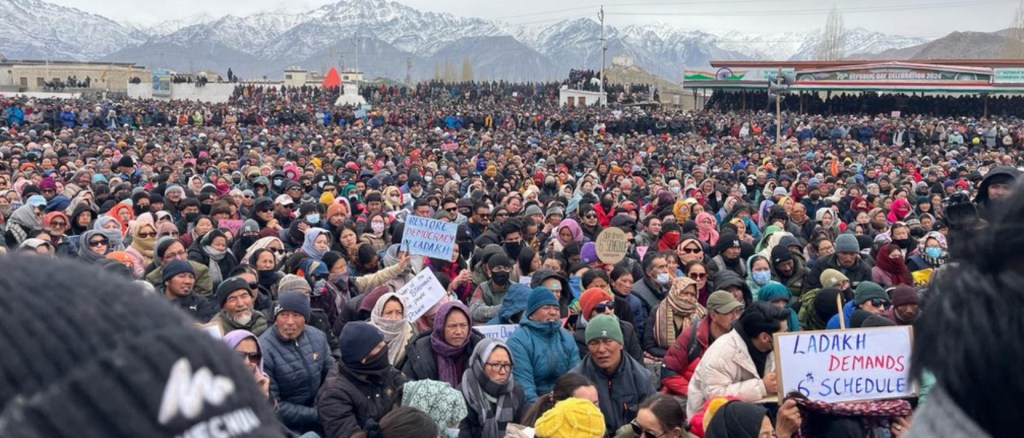
This disappointment has sparked a political movement demanding statehood for Ladakh and its inclusion under the 6th Schedule of Article 244 of the Indian Constitution. The 6th Schedule allows the creation of Autonomous District Councils in particular states, and enables them to enact laws on land, forests, water, and village administration, among other matters, subject to the Governor’s assent. To qualify for this, an area must have at least 50 – 60% tribal population, and over 97% Ladakh’s population belongs to the scheduled tribes.
The demands of the Ladakhi people, therefore, comprise their constitutional rights, ecological survival, and self-governance, which are issues intrinsically linked to the region’s fragile mountain environment, on which their livelihoods depend. Indigenous rights and biodiversity conservation are two sides of the same coin.
The Fragile High Altitude Environment:
Ladakh’s geography is a trans-Himalayan cold desert, making it uniquely vulnerable to environmental changes. The area has over 2,200 glaciers that feed the tributaries of the Indus and Zanskar rivers, which are important sources of drinking water and local irrigation. Unfortunately, the rapid pace of climate change has reduced the glacial areas by around 40% since the Little Ice Age, resulting in a drastic reduction in meltwater recharge, and declining groundwater levels with an increased risk of perennial springs drying up.
The issue of water scarcity has hence become a serious concern in Ladakh, with residents increasingly reporting that wells are drying up, as younger generations recall that the springs from their childhood are disappearing. Additionally, there is an increase in glacial retreat, accompanied by hazards such as sudden flashes of meltwater or glacial lake outbursts, leading to floods. Currently, there continue to be streaks of unusual weather extremes in dry years that stress communities and crops. A researcher warned that any disruption to the glaciers supplying around 40% of the Indus Basin water “directly threatens water availability downstream.”
To make things worse, the spike in Ladakh’s tourism is stressing the region’s environment. The routes across treks, and Leh are becoming crowded with new hotels and vehicles. Moreover, Tourists consume significantly more water than locals, forcing all the lodges and homestays to drill deep borewells in an attempt to meet water demands, as the fragile groundwater aquifers are unable to replenish themselves quickly enough to meet our needs. In addition to this, the temperatures have begun to warm rapidly, requiring the use of electronics such as air conditioning and insulation, which were previously not a necessity.
Meanwhile, increased militarization of the borderlands also brings in additional costs. As the army bases expand, more troops, vehicles, power plants, and waste burning increase the levels of atmospheric black carbon emissions, and accelerate melting in the already vulnerable glaciers. The new external development efforts in Ladakh are not designed sustainably with an aim to protect the land or the people. The tourism, military buildup, and even some conservation projects continue disrupting Ladakh’s sensitive ecological balance.
Traditional Knowledge and Sustainable Practices
Indigenous peoples have long been understood to work in harmony with their environments, balancing their ecology and livelihoods. This traditional knowledge and socio-cultural institutions are also a part of the Ladakh communities, which help them build resilience and adaptability during harsh seasons.
Historically, the villages of Ladakh have managed their water and grazing resources through traditional practices deeply embedded in their culture and religion. For instance, each village elects several officials-such as a Goba, head of the village, or a Chhurpon, water official-whose mandate is to organize the irrigation system among their communal canals and adjudicate community disputes.
Besides that, innovators and pioneers in Ladakh have developed sustainable energy-efficient technologies, such as the “ice stupas” invented by Sonam Wangchuck. They are artificial cone-shaped glaciers, designed to capture and store winter meltwater, and gradually release it during springtime. However, these resilient indigenous practices currently face challenges due to urbanization, sociopolitical changes, and climate change.
External systems like the Panchayati Raj or modern jobs have eroded traditional roles, like those of the goba or lorapa. The central government policies, evolving market dynamics, tourism, & new livelihoods influence young people to leave villages for cities, weakening the continuation of traditional labor-sharing systems, fundamental to Ladakh’s agriculture. The people of Ladakh argue that reviving and empowering these indigenous practices is key to maintaining “lower rates of deforestation, increased carbon storage, and higher levels of biodiversity, while preventing future exploitative practices.
Reasons for Unrest
After the abrogation of Articles 370 & 35A, there were no more limits on who could buy land or apply for jobs in Ladakh. A political leader expresses, “We realized that A.370 was actually protecting us… Now, outsiders can settle here, buy land, and compete for jobs, threatening our unique identity & fragile ecosystem.” This endangers old agrarian reforms, with lower checks and restrictions on tourism and mining projects. Additionally, the residents are concerned with rapid development, ranging from large hotels to border security infrastructures.
To address these issues, the Leh Apex Body and allied groups have collectively come together under the leadership of Kargil’s representatives to express demands for a statehood status, Sixth Schedule status, a separate Public Service Commission, and increased political representation.
The Indian government has responded to these demands with limited concessions, including job quotas and a new residency clause. However, the core demands remain unfulfilled. In September 2024, the Ladakhi people took to a silent and peaceful march to Delhi in protest; however, the situation escalated tensions in Leh as the police opened fire on protesters, killing four. One of the prominent leaders of the movement, Wangchuk, was detained under the National Security Act, which was widely criticized as excessive.
Global lessons and the way ahead
What Ladakh is facing right now mirrors other global movements where Indigenous people have fought for legal recognition and their ability to defend their environments. In Canada’s Nunavut, there is an Inuit-majority territory where the government allows co-management boards, giving the Inuit people equal say in decisions regarding natural resources, land, and wildlife, and it was founded on their self-determination. Similarly, in Scandinavia, the Sámi parliaments (in Norway, Sweden, Finland) provide forums for the Sámi people to protect the reindeer herding lands and fishing rights, while also lobbying against mines and dams on their territories.
Additionally, across the Amazon, the reserves managed by indigenous communities perform far better than government-run parks in the preservation of local biodiversity. Examples like these highlight how improved levels of ecological conservation can be achieved by delegating authority to indigenous communities over their own lands. Subsequently, allowing the people of Ladakh this right via constitutional autonomy, a title of statehood, or its inclusion in the Sixth Schedule can empower the people of the region to sustainably govern their realities and cultural values.
Conclusion
In view of all these factors, there is more to the unrest in Ladakh than a struggle for titles or power; it is a question of survival. The demand for inclusion under the Sixth Schedule by the indigenous people is very significant for the protection of their way of life and self-determination over their land, mountains, and water. Merging development concerns with sustainable natural resource management is the only way this can be achieved. In order to avoid a silent social crisis, the state has to stop looking at this region as a resource frontier and focus on empowering the residents as custodians to conserve the fragile ecosystems. Only then can Ladakh be repositioned as a model for rights-based conservation.
Author’s Bio
Varsha M is a third-year law student at Jindal Global Law School and a columnist in the Environment & Social Issues cluster at Nickled & Dimed. Her interests lie in environmental governance and climate justice.
Image Source: https://thewire.in/rights/we-demand-statehood-shutdown-in-ladakh-as-protesters-call-for-inclusion-in-sixth-schedule
 NICKELED AND DIMED