
By – Varsha M
Introduction
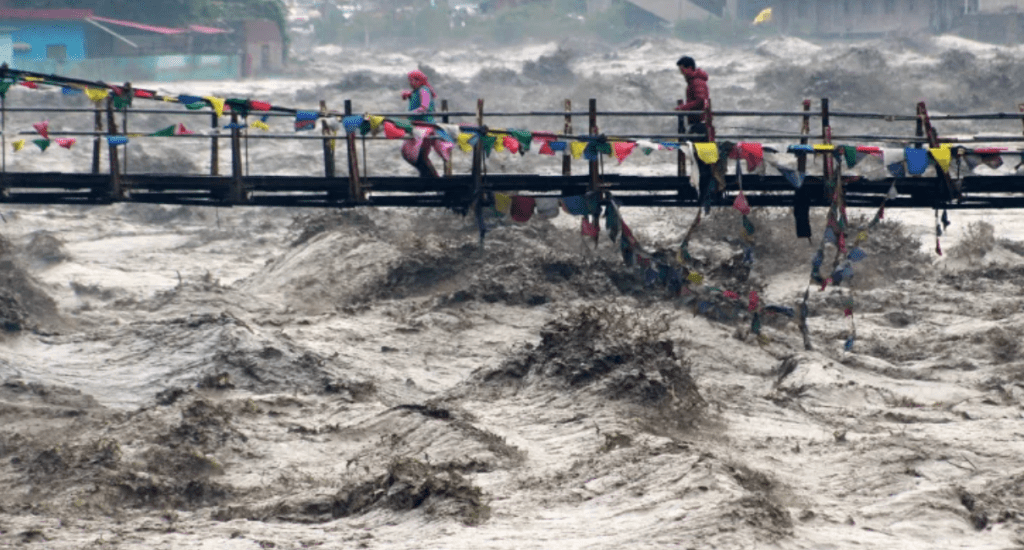
In the past month, Punjab, Himachal Pradesh, and Haryana have faced severe flooding after the heavy monsoon rains drove the Sutlej, Beas, Ravi, and Ghaggar rivers to overflow. As a result, over 1,900 villages were submerged, nearly half a million acres of crops were destroyed, and atleast 48 lives were lost. The Punjab state as a whole was declared a disaster-hit state, with damages estimated at around ₹60,000 crore.
However, these events cannot be simply understood as “natural disasters.” While the main instigator for the tragedies may have been rainfall, it overlooks significant anthropogenic factors that influence their extent. These factors include irresponsible human activities in land and water use, infrastructure, and governance, which have indeed shaped and amplified the consequences.
In India, the disasters are becoming less about what the monsoons bring and more about how our systems have chosen to live with water, hills, and rivers. Merely referring to them as “natural” obscures any accountability, preventing the possibility of meaningful reforms necessary to prevent them.
Fragile Hills, Fragile Choices
Regions like Himachal Pradesh and Uttarakhand already have sensitive ecologies and have been pushed to the brink due to irresponsible development. The state continues to build roads and bridges across floodways, often without drainage systems.
Their hydropower tunnels blast through unstable slopes, and pilgrimage routes are commercialized into congested shantytowns, as they draw tourists far beyond the region’s carrying capacity. What was once considered development is now a direct cause of disrupting the Himalayan ecosystem beyond recovery. Each road, tunnel, or intensified farming zone erodes its equilibrium with infrastructure increasing run-off, and deforestation triggering landslides. The crisis at hand isn’t just about carbon emissions and natural calamities, but exploitation rooted in a material system that prioritizes profits over sustainability or conservation.
The Supreme Court Bench of Justices J.B. Pardiwala and R. Mahadevan, on 28 July 2025, held that, “If things proceed the way they are as of date, then the day is not far when the entire state of Himachal Pradesh may vanish in thin air from the map of the country”. The unchecked illegal mining and deforestation in Himachal, further destabilise the terrain. Therefore, when torrential rain hits these hills, it drags mud, concrete, and debris downstream, creating flash floods that devastate the plains downstream, like Punjab.
Punjab is known as the land of rivers and regularly experiences floods. However, the floods this year and in 2023 were not purely natural, but also a result of unsustainable human developments. In 2023, floods in the region affected 1,400 villages across 18 districts. This was largely due to heavy rainfall in Himachal Pradesh, along with excessive water release from dams rather than local conditions. Thus, even the floods in Punjab are not just natural disasters, but are consequences arising from human actions.
Dams as Disaster Multipliers
Flood management in Punjab has also been severely undermined because of the mismanagement of its dams. The Bhakra Beas Management Board (BBMB) and the authorities of Ranjit Sagar Dam ignored the early warnings from the Indian Meteorological Department, which had notified them about heavy rainfall. During the heavy rainfall, the dams ended up magnifying the flooding in the Punjab districts by suddenly releasing excess water from reservoirs to protect their infrastructure.
The lack of transparency in the governance of the dams is striking, as the Communities downstream have no real-time access to information about storage levels or release timings, leaving them unprepared for spontaneous surges. Rather than an accident, this is a clear representation of systemic failure. The Bhakra Dam, which was famously built post-independence as a ‘temple of modern India’ by Nehru, exemplifies flawed hydrological planning. Since its construction, its storage has been severely compromised by siltation, reducing its storage capacity by 25%.
Despite being operational since 1963, there have been no desilting actions undertaken due to the high expenses, creating a siltation crisis, compromising flood management, and heightening flooding risks in downstream communities.
Global Lessons in Preparedness
While India continues to struggle with dilapidated dams, countries around the world are changing their policies. The United States has been working on removing dams in areas like the Klamath River to focus on restoring it. This project tries to restore the river’s local aquatic ecosystems while connecting thousands of river miles. Such projects highlight to us how it is possible for aging or harmful dams to be dismantled when risks and benefits are re-evaluated. India does not have to repeat its past mistakes, and instead should attempt to learn from global systems that have presented ways to coexist with water and climate extremes.
For instance, after the 1953 North Sea flood in the Netherlands killed 1,835 people, the state launched the ‘Room for the River’ program. This program strategically allows flooding in certain regions during heavy rainfall, as a way to adapt to the changes in water levels rather than trying to resist or clog rivers with more levees. Such approaches in natural resource management recognize our river systems as dynamic bodies, rather than as obstacles that we have to permanently restrain.
Similarly, Japan offers another sustainable management model. The country uses advanced early-warning systems for all localities and has built a very effective response culture over the decades. The warnings aren’t just announced, but are also integrated into their community life through their routine nationwide drills. Therefore, citizens, from schoolchildren to office workers, are taught about evacuation routes until it becomes their second nature. Such an approach to prevention and governance has resulted in far fewer casualties from typhoons or floods compared to South Asia, despite having similar levels of vulnerability. Hence, preparedness is not left to chance, but is built into the governance and culture.
India, by contrast, may have the science but not the systems. Even though the Indian Meteorological Department routinely issues heavy rainfall warnings, they rarely reach the citizens due to a lack of protocols, evacuation orders, or even community drills. For any early warning systems to be effective, continuous and collaborative community efforts are required, instead of one-time actions, key stakeholders and communities need to be trained to act on the information conveyed by these facilities.
The Way Forward
For India to be able to prevent further tragedies, it needs to take up urgent reforms, including Transparent water governance where real-time dam data on storage and release is publicly accessible. There should also be conservation of natural buffers by preventing activities like illegal mining or deforestation, along with restoring life-saving natural infrastructure like floodplains and wetlands.
Additionally, the state should work on planning resilient systems with the enforcement of strict zoning in hills and urban areas to prevent construction on floodways and fragile slopes. Since local people are always the first responders, it is essential to equip them with the training and resources which is as critical as sustainable engineering works.
Naming the Disaster
Additionally, using the term “natural disaster” when referring to these events blurs our understanding of significant causes behind them, and subsequently their accountability. Hence, when floods are represented as inevitable occurrences, the negligent practices of dam operations, constriction, and illegal mining in areas like Himachal go unscrutinized.
These floods were a product of the intersection of ecological distress and the failure of governments to equip them with blasted hills, silted reservoirs, encroached floodplains, and irresponsible management of water releases. Therefore, by appropriately naming them, we take the first step toward accountable policies that value the ecology or natural landscapes that actually keep us safe.
There will always be areas that are more prone to rainfall and flooding; however, the impacts they bring can either be momentary or disastrous, depending on whether we take a sustainable approach in development. The current situation is clear, where prevention becomes a more political issue than a providential one. Therefore, we are left with the question we are left of whether India will recognise these challenges as solvable policy failures, or continue to let “natural” disasters excuse preventable situations.
Conclusion
The so-called “natural disasters” that India has faced in the recent months are, in truth, the outcome of ecological neglect and governance failure. The floods in Punjab, Himachal Pradesh, and Haryana highlight that it isn’t rainfall alone, but factors like unsustainable developments or mismanagement of dams, that turn hazards into catastrophes. Until India stops dubbing them “natural” disasters, it will continue to overlook administrative negligence and repeat its mistakes.
In addition to ensuring accountability, India needs to focus on preventative measures by addressing systemic gaps in early warning systems. Improving community efforts, such as emergency drills and education on protocols, is necessary to better equip key stakeholders with the means to combat these disasters.
Author’s Bio
Varsha M is a third-year law student at Jindal Global Law School and a columnist in the Environment & Social Issues cluster at Nickled & Dimed. Her interests lie in environmental governance and climate justice.
 NICKELED AND DIMED