
By – Muskan Hossain
Abstract
Deepa Mehta’s Fire (1996) remains a landmark of post-colonial feminist cinema, challenging the patriarchal family and exposing the fragility of cultural nationalism. Through Radha and Sita’s intimate rebellion, the film critiques how women’s independence after 1947 remained bound to tradition and sacrifice. The backlash against Fire revealed how women’s desires are policed as threats to “Indian culture.” The film reminds us that independence is an ongoing struggle, unfolding in homes and bodies as much as in history books.
Introduction
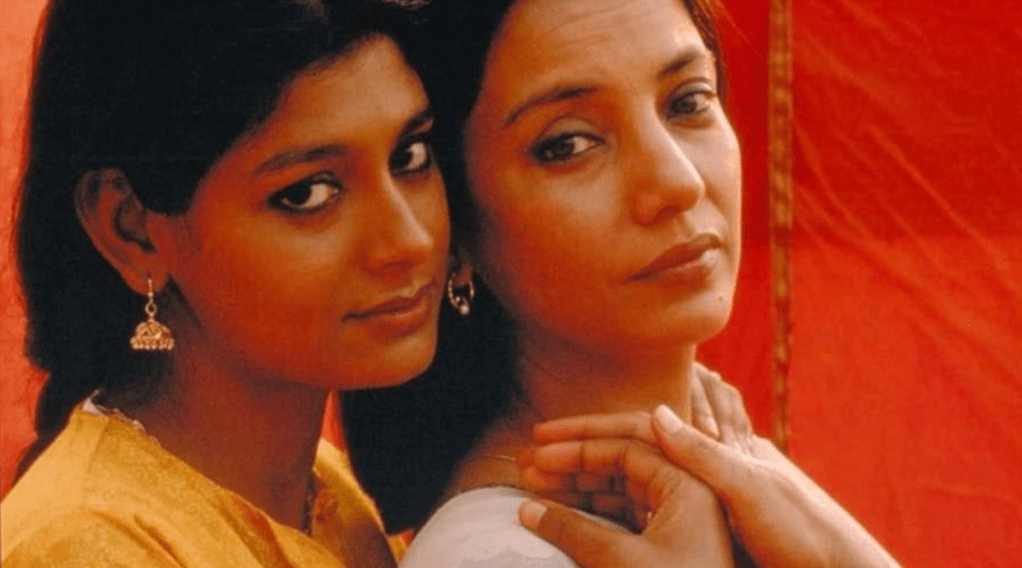
When Deepa Mehta’s Fire released in 1996, it set off a blaze far beyond the cinema halls. The film was not merely a love story between two women, Radha (Shabana Azmi) and Sita (Nandita Das); it was a direct confrontation with the patriarchal structures that had long been normalised in Indian society. Nearly three decades later, revisiting Fire allows us to see it not only as a pioneering film about queer female desire but also as a crucial text in understanding post-colonial feminism- how women’s independence in South Asia has often been incomplete, tethered to the demands of family, nationalism, and heteropatriarchy.
Desire and Domesticity
At the heart of Fire is the domestic space, the family home in Delhi, where Radha and Sita live with their husbands. Radha, dutiful and restrained, has been conditioned to endure her husband Ashok’s ascetic rejection of intimacy. Sita, in contrast, is newly married to Jatin, who openly neglects her for his lover Julie. In this shared suffocation, the two women discover companionship, then intimacy, and eventually love.
The radicalism of Fire lies not in its depiction of lesbian desire per se, but in how it insists that women’s happiness cannot forever be subordinated to “sacrifice” and “duty.” As one reviewer notes, “their affair is less a transgression than an act of reclaiming selfhood”. For Radha and Sita, intimacy is not rebellion for its own sake but a necessity for survival. Brinda Bose likewise argues that Mehta portrays desire as “a recourse against patriarchal oppression… the protagonists’ love and escape are matters of necessity.”
Post-Colonial Parallels
Seen through a post-colonial feminist lens, the film mirrors the paradox of Indian independence itself. In 1947, the nation was freed from colonial rule, but as many feminist scholars have argued, independence for women remained circumscribed by cultural nationalism. Partha Chatterjee famously described the nationalist project as splitting the “inner” (home, women, culture) and the “outer” (politics, economy, men). Women were tasked with preserving tradition, while men negotiated modernity.
Fire dramatizes this paradox. The women are confined to the inner realm- cooking, serving, caring- but when they begin to reimagine freedom on their own terms, they destabilize the very foundation of the patriarchal family. Their independence is not about waving flags or making speeches, but about choosing whom to love, how to live, and whether to obey.
The Backlash: Who Owns “Culture”?
The release of Fire provoked violent protests in India, with right-wing groups vandalizing cinemas and declaring the film against Indian culture. The Hindutva backlash was fueled in part by Mehta’s choice of character names. Their outrage revealed precisely what post-colonial feminism critiques: that “culture” is often wielded as a weapon to control women’s bodies and desires.
The irony was glaring. A country that prided itself on independence could not tolerate women asserting independence from their husbands. The state, which claimed modern secular values, hesitated to defend the film from censorship. The backlash laid bare the fragility of post-colonial nationalism, its reliance on the figure of the self-sacrificing, heterosexual wife as the moral guardian of the nation.
Fire as Feminist Resistance
What makes Fire enduring is how it stages resistance not through overt political speech, but through the quiet rebellion of intimacy. Radha and Sita do not demand the end of marriage as an institution, nor do they join a political movement. Their act of resistance is profoundly personal: they simply refuse to suppress desire any longer.
In this sense, Fire resonates with what post-colonial feminist theorist Chandra Talpade Mohanty has called the “politics of everyday life.” Women’s struggles for freedom often unfold not in parliaments or protests, but in kitchens, bedrooms, and whispered conversations. By situating its rebellion in the home, Fire insists that the personal is indeed political.
Progressive Yet Complicated
It is tempting to see Fire as wholly progressive, but the film is not without contradictions. For instance, it frames queer love largely as an escape from failed heterosexual marriages. This has led some critics to argue that it risks presenting lesbian desire as “secondary” or derivative. In other words, freedom becomes reduced to sexual autonomy, leaving class, religion, and caste largely unexamined.
Still, these tensions make the film powerful. Like independence itself, liberation is not portrayed as a clean break but as a contested, unfinished process.
A Post-Colonial Feminist Text
As a post-colonial feminist text, Fire underscores three critical themes: the limits of national independence, the policing of women’s bodies as cultural symbols, and the radical potential of female solidarity. The film shows how freedom from colonial rule did not automatically extend to women within the home, how women continue to be cast as bearers of “tradition,” making their defiance appear as an attack on the nation, and how, by turning to each other, Radha and Sita exemplify alternative kinships outside patriarchal expectations. The flames are destructive, but they are also transformative.
Why Fire Still Matters
In today’s India, where debates over women’s autonomy, queer rights, and “Indian culture” persist, Fire remains disturbingly relevant. The same accusations hurled at the film in the 1990s- “Westernized,” “against tradition,” “obscene”, are still used to silence women and queer communities today.
But Fire also endures as a reminder that independence must be continuously redefined. Political sovereignty means little if women are still trapped in loveless marriages, silenced by family honor, or punished for desiring differently. Post-colonial feminism challenges us to see freedom not as a historical event in 1947, but as an ongoing struggle unfolding in homes, bodies, and relationships.
In the final scene of Fire, Radha walks out of the burning house, scarred but alive, into the possibility of a new life with Sita. The metaphor is unmissable: sometimes, to claim independence, one must walk through fire. Deepa Mehta’s film refuses to let us forget that the fight for women’s liberation did not end with the departure of the colonizer. Instead, it continues in the intimate spaces where women insist on choosing for themselves, even when the world tells them not to.
Author’s Bio
Muskan Hossain is a third year student pursuing a BA (Hons.) Liberal Arts and Humanities, at OP Jindal Global University. An avid reader, and an aspiring journalist, she has a keen interest in gender studies, culture, and political theory, and aims to explore the intersections of tradition and modernity in contemporary India.
Image Source: https://filmcriticscircle.com/journal/film-analysis/fire/
 NICKELED AND DIMED