
By – Varsha M
Abstract
Climate-induced floods, droughts, and rising sea levels are displacing millions across South Asia. Rural populations in India and Bangladesh have lost their homes and livelihoods and are forced to move into overcrowded cities for survival. Women and marginalised groups suffer disproportionately, while legal and policy frameworks in the countries fail to account for them. Without recognising climate migration as a form of adaptation, national and global responses such as COP28’s Loss and Damage Fund, aimed at addressing the impacts of climate change, risk leaving behind the very people who are most affected, climate migrants.
Introduction
The climate crisis is no longer a threat; it is a reality for millions, especially in South Asian countries. In the Sundarbans, Assam, Bundelkhand, and Bangladesh’s riverbanks, people are losing their homes and the landscapes that rooted their lives. Today, a large number of forced displacements are not consequences of wars or economic deprivations, but of the increasing climate crisis caused by floods, droughts, rising sea levels, and crop failure that destroy their homes and livelihoods.
A 2025 journal ‘Climate’ classifies India and Bangladesh as “climate migration hotspots“. This classification has become a sad testament to how the climate crisis reshapes lives in the region from the bottom up.
Climate as the Catalyst
The most vulnerable groups in the climate crisis include small farmers, rural communities, and tribal populations. These sections of society depend on natural resources like rainfall, fertile soil, or fish stocks in the seas for their sustenance and livelihood; even a slight change in climate brings devastating consequences for those dependent on it.
For example, in the Bundelkhand region of central India, there is progressively less rainfall every year, as the temperatures continue to rise, causing a crisis over decades. It has become a hotbed for droughts, facing nine between 1998 and 2009, while other districts like Lalitpur and Mahoba in Uttar Pradesh suffered at least eight. This has led to failed crops, deepening debt, and loss of livelihoods for many farmers who are now forced to give up agriculture altogether and work in diamond mines or migrate to urban hubs like Surat, Delhi, and Bangalore.
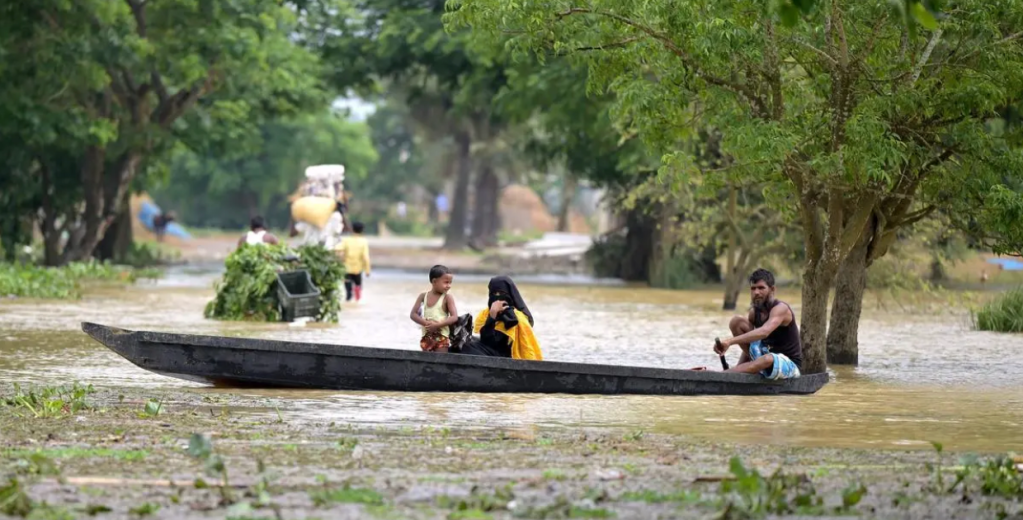
A similar story unfolds in the Charpauli village of Bangladesh. It is located along the eroding banks of the Jamuna River, where flooding is an annual issue. In May 2022, in merely a week, riverbank erosion destroyed around 500 houses and left thousands homeless and displaced. As ETH Zürich researcher Jan Freihardt notes, displacement begins with people shifting within the village, but over time, entire households migrate to cities like Dhaka as a last resort.
Furthermore, the men in affected households, often the sole breadwinners, frequently leave their homes behind to look for work in big cities. Consequently, women and the elders are left behind to face significant challenges in maintaining the household and providing for their families until the money comes home. Additionally, the DGAP report on Gender, Displacement, and Climate Change states that women displaced by disasters are 14 times more likely to die during climate events and face higher risks of sexual violence in temporary shelters and informal camps. Women from conservative families even choose to stay behind to avoid socially unacceptable living conditions in urban hotspots, like living with men in the same room. This leaves them especially vulnerable to natural disasters, where they end up losing their lives, being subject to disproportionate impacts of climate change, especially those at the intersection of marginalized social and economic groups.
Such cases exemplify how climate migration is often permanent and involuntary, with long-term socio-economic consequences for those who fall victim to it.
Overcrowded Cities
Metropolitan cities like Delhi, Mumbai, and Dhaka are the ones absorbing this human fallout; cities that are hardly equipped to adequately accommodate it. When migrants move to urban cities, many face exclusion from host communities, which are already constrained by scarce resources like housing, water, sanitation, and jobs. Therefore, climate migrants often end up living in slums or informal settlements, in flood-prone areas, or on the outskirts of the cities. They take up low-wage and insecure jobs, lacking legal recognition or public services.
In addition to this, migrants often lack the necessary documentation like voter IDs or residence proof, which often qualify them for welfare schemes, entitlements, or even voting. Without the same, their low standards of living are reinforced, highlighting their invisibility in city planning. Stigmas regarding migrants in the city deepen if they come from a marginalized caste, tribal, or linguistic background. Such identity markers lead to further social exclusion within the informal urban areas, where established residents see them as outsiders.
The big urban cities are themselves vulnerable to climate change, in cases of urban flooding, heat waves, and water shortages, which make them increasingly unlivable. For instance, coastal communities of Mumbai, like the Koli fishermen, see displacement by both climate and urban development pressures. These developments force them to leave their fishing grounds due to rising sea levels, polluted coastlines, and extravagant real estate expansions. The pressure from both climate and market forces shows us that there exists a more comprehensive socio-economic crisis when migrants increasingly enter cities that are themselves in ecological decline.
Legal and Policy Gaps
Even though the severity of the climate crisis is clear, both India and Bangladesh fail to provide the necessary legal recognition needed for climate migrants. India’s policies continue to treat migration as an issue of economics or development, instead of recognizing it as a climate-induced compulsion. Although a Climate Migrants Bill was introduced in 2022 in the Indian Parliament, there remains no foreseeable development stemming from it.
Bangladesh, on the other hand, fares slightly better in acknowledging climate displacement through the Bangladesh Climate Change Strategy and Action Plan (BCCSAP) and the Mujib Climate Prosperity Plan; however, measures for adequate protection, resettlement, and employment guarantees for the migrants remain lacking.
In both cases, migrants continue to be legally invisible and unsupported, as they are denied rights and entitlements such as ration cards, housing schemes, or access to education and healthcare after displacement.
Regional Inaction
India and Bangladesh share climate vulnerabilities and multiple river systems. The Ganges-Brahmaputra-Meghna Delta is one of the world’s most climate-vulnerable regions. Still, there remains no bilateral framework or cooperation strategy to address the climate-induced migrations.
The Loss and Damage Fund, established at COP28, gives both countries an opportunity to fund displacement solutions. However, without local legal frameworks and data on vulnerable populations, such funds are unlikely to reach the people who need them most.
Conclusion
Migration has always been part of human societies. However, in today’s world, it has become mainly an act of survival rather than an opportunity. As the impact of climate change grows severe, the livelihoods of rural populations collapse, with millions already on the move. Yet, in many countries, there continues to be an absence of legal recognition, planned relocation, or coordination in addressing them. They are forced to move invisibly into cities that are unprepared to account for them.
Addressing it requires India and Bangladesh, together with the global community, to recognise migration as both a consequence and a major form of adaptation to climate change. That means building legal protections, resilient urban housing, and multilateral support systems that treat these migrants not as victims or burdens, but as frontline climate survivors.
Author’s Bio
Varsha M is a third-year law student at Jindal Global Law School and a columnist in the Environment & Social Issues cluster at Nickeled & Dimed. Her interests lie in environmental governance and climate justice.
 NICKELED AND DIMED