
By Aditi Gupta
Abstract:
This article critically examines the redevelopment of Dharavi—Asia’s largest slum—through the Navbharat Mega Developers project, a joint venture between the Maharashtra Government and the Adani Group. While the project promises improved living conditions and infrastructure for over one million residents, it raises complex questions around displacement, identity, environmental degradation and economic sustainability. The redevelopment plan, though framed as a mission to “restore dignity,” risks erasing Dharavi’s unique social fabric and thriving informal economy. Issues such as the use of toxic landfill sites for relocation and the destruction of ecologically crucial salt-pan lands highlight deeper concerns about prioritising profit over people and the environment. The article emphasises that genuine transformation must involve inclusive planning, environmental responsibility and respect for the local community’s socio-economic dynamics. Without this, the project risks becoming a symbol of corporate overreach rather than a model for equitable urban renewal.
Dharavi: A Slum of Paradoxes and Potential
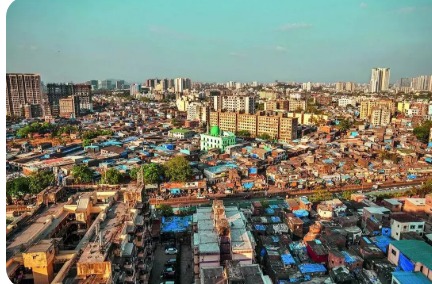
Dharavi, located in the heart of Mumbai, is often referred to as Asia’s largest slum. Known locally as a bastee or basti, it is marked by its open sewers, shared toilets and tightly packed homes—yet it thrives as a hub of social, political and economic activity. Despite material poverty, Dharavi is rich in community, resilience and innovation. It even served as the backdrop for the Academy Award-winning film Slumdog Millionaire.
With over one million residents, many of whom migrated due to push-pull factors of urban migration, Dharavi is both a product and a victim of Mumbai’s rapid urbanisation. As property prices in Mumbai continue to soar, developers and policymakers have long set their sights on Dharavi for transformation. Its proximity to the international airport and major railway lines only adds to its appeal. However, while foreign investors have previously tried to convert the area into high-rise luxury apartments, others have pointed to Dharavi’s sustainable practices and unique urban dynamics as a model for solving urban and environmental crises.
This article explores the ongoing redevelopment under the Maharashtra State Government and Adani Group’s joint venture, Navbharat Mega Developers and examines the implications for Dharavi’s residents and identity.
Adani’s Role and the Navbharat Mega Developers Project
In 2023, the Adani Group won the tender for one of India’s most ambitious urban renewal projects: the Dharavi Redevelopment Project, rebranded as Navbharat Mega Developers (NMDPL). With a ₹23,000 crore (approx. $619 million) bid, the project is being executed through a Special Purpose Vehicle (SPV) comprising the Maharashtra Government (20% stake) and an Adani Group entity (80% stake). It is touted as India’s largest urban transformation initiative to date.
Adani Group Chairman Gautam Adani stated that the project’s goal is to “restore dignity to over one million residents of our country.” The plan involves replacing hazardous and congested housing with well-equipped flats that include independent kitchens and toilets.
The rationale for redevelopment is based on dire public health conditions—open drains, poor sanitation and a high risk of waterborne diseases. Heavy metals and toxins frequently contaminate the water supply due to corroded infrastructure. Still, urban planners and researchers worldwide continue to look to Dharavi for lessons in resilience and resourcefulness, notably gaining attention from King Charles in 2009 when he declared it to be a model for the world.
Moving out of Dharavi: The Challenge of Relocating its Identity
One of the most critical challenges is the relocation of Dharavi’s residents. For many, their homes double as workspaces—tiny hutments where pottery, leather goods and recycling businesses operate. These spaces are more than shelter; they are the core of their social identity and economic life.
Dharavi is an intricate mosaic of languages, castes, religions and cultures. Despite the dangers of unregulated construction and asbestos roofing, residents have developed highly interdependent, self-sufficient communities. Many are deeply dissatisfied with the resettlement plans. According to eligibility criteria, only those who lived in Dharavi before January 1, 2001, will be rehabilitated on-site; others will be offered housing under the Pradhan Mantri Awas Yojana—outside Dharavi.
The Maharashtra government has proposed using 125 acres of the Deonar landfill, one of Mumbai’s most toxic and degraded sites, for housing the displaced. This biohazardous land has poor sanitation, degraded air quality and a long history of environmental violations. Displacing people from Dharavi only to resettle them near toxic waste contradicts the stated aim of “restoring dignity.” This strategy appears less about transformation and more about converting valuable land into a corporate asset.
Environmental Costs and Salt-Pan Land Controversy
Another contentious element of the project involves salt-pan lands—low-lying coastal areas that naturally protect Mumbai from floods. Despite their ecological importance, three salt-pan zones were allotted to Adani to construct rental accommodations for ineligible Dharavi residents.
The government allocated a total of 256 acres across three Mumbai locations for this purpose without adequately addressing the environmental consequences. A Public Interest Litigation (PIL) alleges that regulatory changes made by the central government in August of 2024 permitted residential construction on these lands, sparking outrage among environmentalists.
While the project claims adherence to strict Environmental, Social and Governance (ESG) standards—including plans to plant thousands of trees—critics argue that these efforts cannot compensate for the destruction of critical flood buffers and biodiversity zones. Residents and stakeholders have raised concerns that ecological and social costs are being ignored in favour of real estate profits.
Furthermore, a state-appointed committee in 2009 had already raised red flags, calling an earlier ₹15,000 crore proposal a “sophisticated land grab driven by personal greed.” The committee warned that although pucca houses would be built, they would come at the cost of dismantling livelihoods and a unique social fabric. The fear now is that these warnings remain ever more relevant today.
Dharavi’s Hidden Economic Engine
Beyond its living conditions, Dharavi is a powerhouse of informal economic activity. It is home to thousands of micro, small and medium enterprises (MSMEs) in sectors like plastic recycling, textiles, leather and pottery. These enterprises contribute over $1 billion annually, with some even exporting products internationally.
However, the redevelopment project lacks clarity on how it will support the relocation and regeneration of these businesses. For many, the success of their shops depends on Dharavi’s dense networks, cheap rent, and local customer base, which are factors that may not be replicable elsewhere.
Jockin Arputham, founder of the National Slum Dwellers Federation, once said, “I am a slum dweller, not a slumdog.” He emphasised that Dharavi’s intricate systems cannot be replaced by western models of planning, substituting rich networks with generic housing models. As India’s urban population continues to grow, Dharavi offers valuable insights into scalable, grassroots-level urbanism.
Conclusion: The Road Ahead for Dharavi
Dharavi stands at a pivotal moment. The potential for a brighter future is undeniable, but it hinges on inclusive planning, meaningful consultation with residents and transparent execution. The redevelopment could either be a model for equitable urban transformation or a cautionary tale of gentrification and displacement.
To succeed, the Navbharat Mega Developers project must go beyond infrastructure. It must protect livelihoods, honour community ties and preserve the economic ecosystem that thrives within Dharavi’s narrow lanes. Only then can the transformation truly reflect the dignity and aspirations of the people it claims to uplift.
Author’s bio: Aditi Gupta is a graduate of B.A. (Hons.) Liberal Arts and Humanities with a major in Political Science and International Relations. She is interested in pursuing further studies in international relations, environmental studies and economics.
Image Source: Dharavi redevelopment project to use drones and LiDAR technology for digital survey, ET RealEstate