
Meghana Narayanan
Abstract:
This article examines how funeral sites in India are deeply gendered spaces and argues that women’s participation in traditionally male funeral roles acts as an everyday form of resistance to patriarchy. Using the example of the Salem District’s Dravidar Viduthalai Kazhagam (DVK) women, it explores how the feminization of rituals can drive meaningful structural change. The analysis draws on feminist theory and scholarship to frame these acts as powerful interventions against entrenched gender norms.
Introduction
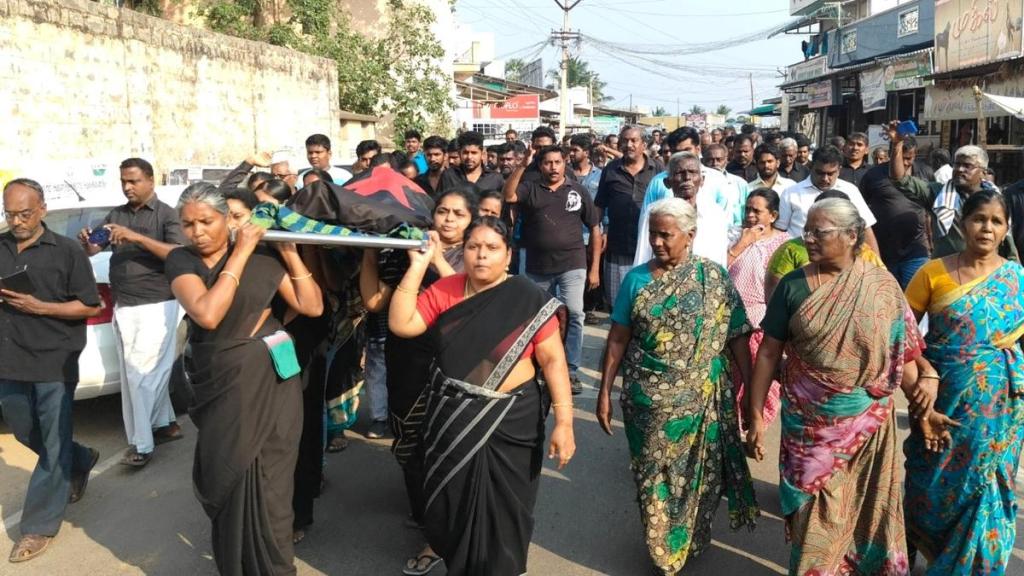
In defiance of centuries-old traditions, a group of women from the Salem District, belonging to the Dravidar Viduthalai Kazhagam (“DVK”), have been trudging along, carrying the dead on their shoulders for the past 15 years; an act that has stunned many, as if a miracle is unfolding before their eyes. The disbelief stems from the fact that historically, women have not been allowed to perform funeral rites or carry the dead. This article examines, through a feminist lens, how women’s participation in funeral rites acts as a subtle resistance to patriarchal norms that reinforce gendered expectations and limit women’s participation in sacred spaces.
The question of death is one that is of universal significance. As such, much like every other aspect of society, the site of the funeral is gendered. The restriction on women’s participation in funeral and burial rites exists across many religions. For instance, Hinduism has rituals like Antyesti and Asthi Visarjan, wherein it is the eldest son’s solemn duty to light the funeral pyre of his parents. In most traditions, women are often excluded based on a few common reasons: emotional sensitivity, perceived spiritual vulnerability, and beliefs about their susceptibility to negative or impure energies during such rites.
‘Grievability’ is also often attributed to women, with their role at the funeral site being restricted solely to mourning, as they are deemed too “emotionally fragile” to perform funeral rites. Conversely, grieving men and men who publicly mourn, are often seen as symbols of emasculation. This gendered division of roles at funerals limits women’s agency and reinforces the broader patterns of traditional gender roles evident across all spheres of life.
Subtle Acts, Powerful Resistance
Bell hooks argues that feminist resistance often arises from the lived experiences of pain and oppression, especially when institutions like religion, family, and society at large serve to reinforce these power dynamics. In the context of funeral rites, women’s desire to take part in such rituals traditionally reserved for men, stems from the pain of not being able to fully participate in their loved ones’ last rites, especially when such participation is denied by other family members. As such, movements to defy these traditional norms, such as the one carried out by the DVK women, are a direct response to the realities that women face in their everyday lives.
The DVK’s subtle, everyday acts of resistance are reflective of James C. Scott’s theory of ‘Everyday Forms of Resistance’. While big, open acts of rebellion against patriarchy might be too risky due to dominant power structures, women engage in quiet defiance by reclaiming roles traditionally reserved for men, like undertaking these rituals. These small acts, such as leading prayers or carrying dead bodies, may not confront the broader institutional structures directly, but they challenge patriarchal control and gradually shift societal expectations. By rejecting the imposed roles and asserting authority in subtle, non-confrontational ways, women practice a form of resistance that both empowers them and undermines traditional gendered divisions in religious and cultural practices.
This quiet defiance, however, often comes at a cost. Drawing on Sara Ahmed’s idea of the “willful woman”, those who refuse to comply with traditional expectations are frequently seen as difficult, deviant, and even dangerous. In the case of the DVK women, their participation in funeral rites has marked them as outsiders within their own communities. Sudha, a DVK member, recalled being boycotted by her own family: her father and brother refused to acknowledge her after she took up the task of carrying the dead. Such reactions show how acts of subtle resistance are not simply personal choices but politically charged gestures that challenge deep-seated gender hierarchies. By stepping into spaces traditionally denied to them, these women embody willfulness as a feminist strategy, forcing society to confront and reconsider its rigid norms. Hence, the act of resistance itself has to be cautious in its approach. For instance, while the DVK women spring into action when there is a death in any organisation member’s family; they always respect the family’s wishes and never proceed if the family is uncomfortable with their involvement. This shows that their acts follow a more subtle, slow method of uprooting the patriarchy, rather than imposing their values on others.
The Feminization of Rituals
The act of the DVK women burying the dead, in this context, is a refusal to be erased; it is rage turned into ritual. This ‘feminization of rituals’ offers a vision of how our traditional practices: forms of worship, rites of passage, and celebration— can become powerful instruments of personal and social renewal. David Kertzer talks about the utilisation of rituals as a revolutionary strategy, by stating that “rituals help revolutionary political stances and organisations through providing legitimacy, creating solidarity, and leading people to understand their political universe in certain ways.” As such, rituals become a transformative process through which women emerge as active subjects rather than passive objects, as sources of strength rather than symbols of weakness, and as agents of liberation rather than victims of oppression.
Feminization requires active efforts to break down gendered barriers in both private and public funeral rites. In formal, public spaces, where funeral rituals have traditionally been dominated by men, women must assert their right to participate fully, not just in peripheral roles. This can begin with the inclusion of women in leadership positions during funeral rites, allowing them to perform key acts traditionally reserved for men, such as lighting the pyre, reciting sacred texts, and leading mourning rituals.
In the private sphere, where gender roles have often been more flexible, the goal is to bring this egalitarian practice into the public realm. The traditions of preparing the deceased, conducting prayers, and managing the rituals could be shared equally between men and women, ensuring that spiritual authority and ritual leadership are not defined by gender. Women who take on these roles within their homes, whether as daughters, mothers, or wives, should have the same opportunities to assume leadership in public funeral practices.
The gendered culture of grieving is then reconfigured to support a stronger pro-women politics within the resistance movement. Beyond fostering political cohesion, women, through their active participation in the public redistribution of grief, also reshape the gendered meanings attached to these political actions. In doing so, they not only challenge the conventional associations of mourning with passivity and emotional excess but also assert grief as a powerful tool of agency, resistance, and collective transformation.
Conclusion: The Way Forward
Audre Lorde’s quote, “Your silence will not protect you”, speaks to the necessity of breaking silence in the face of oppression. In the context of funeral rites, women have historically been excluded from leadership roles, relegated to secondary tasks, and told their emotional nature makes them unsuitable for spiritual authority. To this day, the DVK women have buried over 100 bodies across the state. These smaller acts of resistance are not just about funeral rites, but a deeper rejection of gender silencing.
For women, especially those long silenced by patriarchal norms, refusing imposed roles becomes an act of political resistance. Drawing on Judith Butler’s theory in Gender Trouble, when women step into roles traditionally reserved for men:such as carrying the dead, leading funeral rites, or lighting the pyre—they do not merely fill a vacancy; they actively destabilize the gendered order itself. Such acts expose the performative nature of gender roles, revealing that these so-called traditions are neither natural nor immutable, but maintained through repeated, exclusionary practices.
The refusal to remain silent, particularly in the context of death rituals, is a radical reassertion of agency in a space where women have historically been rendered invisible. Funeral rites are not only acts of closure but powerful cultural performances that define who holds authority over life, death, and memory. When women claim these rituals, they intervene directly in the production of social meaning and collective memory, refusing to let the final rites of loved ones remain the domain of patriarchal control.
True transformation, however, cannot rely solely on individual acts of courage. There must be deliberate institutional reforms to dismantle the gendered exclusions embedded within ritual practices. This includes formally recognising women’s right to perform last rites, creating community frameworks that encourage and normalise their leadership in mourning practices, and re-educating religious and cultural institutions to resist the gender binary altogether. Importantly, public ritual spaces must actively facilitate women’s participation, not merely permit it as an exception. By integrating women into these acts of spiritual authority, society can begin to undo the historical erasure of women’s voices from sacred spaces, ensuring that agency in death becomes as much a site of equality as agency in life.
Author’s bio: Meghana Narayanan is a third-year BA LLB (Hons.) student at Jindal Global Law School. Her interests include Intellectual Property Rights, examining the intersection of law and gender, and analysing how corporate structures shape women’s rights.
 NICKELED AND DIMED