
By : Gauri Yadav
Abstract:
Hijras, once revered, were systematically marginalised under colonial rule through laws like the Criminal Tribes Act of 1871 and Section 377 IPC, which criminalised their identities and livelihoods. While NALSA v. UOI (2014) marked legal progress, the Transgender Persons (Protection of Rights) Act, 2019, continues to echo colonial biases, prioritising state control over gender identity. Analysing Kamala Das’s, ‘The Dance of Eunuchs’ and Oberoi Chinoy’s, ‘Transgender Pakistanis: The Open Secret’, this study highlights how colonial-era stigma persists in legal, social, and cultural narratives. By contextualising their struggle within a broader historical and legal framework this article underscores the urgent need for decolonial approaches to gender recognition and rights.
Introduction:
Hijras represent a distinct gender identity diverging from conventional male or female categorisation, often manifesting their identity through feminine attire and presentation. Historically, Hijras, revered for their ability to bestow fertility and blessings upon newlyweds and infants in exchange for “badhai”, have left their mark throughout India’s rich history, from ancient epics like the Ramayana to the sensuous guidance of the Kama Sutra. In the Ramayana, they are portrayed as devout followers of Lord Rama, patiently awaiting his return from exile. Venerated as the great “Khwaja Siras”, they were entrusted with guarding the shirt of Prophet Muhammad in Cairo and the Great Mosque in Mecca. Some princely states even formally recognised Hijras and allocated them land. From being sought after for blessings and orchestration of religious ceremonies, they were criminalised and thrown out of their own homes due to colonial laws. These legislations, though now repealed have indelibly reshaped perceptions and status of Hijras, particularly in the Indian context.
This article investigates the legal status of hijras in both pre-colonial and post-colonial contexts while also delineating the enduring colonial influences in contemporary times, with reference to Kamala Das’s poem “The Dance of Eunuchs” and Oberoi Chinoy’s documentary “Transgender Pakistanis: The Open Secret”
Hijra Communities: Historical Persecution
Even though the term “transgender” wasn’t coined until the 1960s, individuals had long challenged conventional gender binaries. As early as 1533, the Buggery Act was enacted in England, criminalizing all transgender individuals. In the late 19th century, the British passed a series of successive acts like Section 377 of the Indian Penal Code 1871, the Criminal Tribes Act 1871. Under these legislations, the cultural significance of ‘badhai’ was dismissed. The ceremony was equated to begging and deemed Hijras an ‘obscene’ public nuisance. Misgendering feminine Hijras as men, colonial officials regarded hijras as “professional sodomites”. This is a direct affront to the colonial legal framework built upon heterosexual, procreative norms and nuclear family. They were categorised as “wandering people” due to their short-distance journeys to neighbouring villages. This classification of mobility as criminality reflected a broader pattern observed in the panic surrounding “criminal tribes”.
Additionally, colonial administrators baselessly accused Hijras of child abduction and castration, deeming them inherently criminal. This legislative shift had significant repercussions for hijras, who were now stigmatised as “sexually deviant barbarians”. The scope of “criminal tribes” encompassed sex workers, nomads as well as Hijras. The police were granted sweeping powers to apprehend hijras without the need for a warrant. Stripped of their previously held positions of authority and respect, they were compelled into cleaning upper-caste homes and prostitution. The North-West Frontier region was thus labeled as a “warlike” zone, inhabited by people considered “jungly.” Frontiers, both in physical and abstract terms, played a significant role. Physically, they were marked as areas of bodily violence. In an abstract sense, they were arenas for debates concerning imperial sovereignty, legal structures, and political frameworks. These frontiers were considered zones of exception, where a more aggressive and overt facet of colonialism became apparent, where acts like the Murderous Outrages Act of 1877 and the Thugee Act of 1836 were enacted.
Both Section 377 IPC and CTA relied upon forensic medical science to provide ‘rational’ evidence linking non-normative sexuality and criminal acts to support court hearings. A salient instance illustrating this reliance on forensic science is Queen Empress v Khairati, where a distended anus and signs of syphilis were used to establish the non-normative sexuality of the subject. This forensic-based transformation of their identity shifted them from their traditional celebration as Khwaja Siras to a discourse of nuisance and pollution imported from England. Additionally, “Registers of Eunuchs” were drawn documenting various details of eunuchs such as name, residence, districts “frequented” etc. However, these registers serve as colonial artefacts in the endeavour to bring about the “gradual extirpation” of the hijra by preventing castrations and initiations.
The Telangana Eunuch Act of 1919, influenced by the CTA, criminalised male child castration and curtailed traditional eunuch roles. This legislation aimed to suppress castration practices deemed inhumane. Additionally, it barred eunuchs from participating in weddings, religious festivals, and public events, as well as receiving compensation for their services. The Immoral Traffic (Prevention) Act of 1956 targeted sex work, particularly among hijras facing societal barriers to other sources of income. The Karnataka State Police Act of 1963 empowered local police commissioners to register individuals suspected of various activities, including castration and “unnatural offences,” echoing the language of the 1871 Criminal Tribes Act. Moreover, echoes of colonial-era laws endure in contemporary legislation, exemplified by Karnataka’s 2011 “Section 36A – Power to Regulate Eunuchs,” allowing local police commissioners to register those suspected of offences reminiscent of the 1871 CTA.
Present-Day Realities
It was hot, so hot, before the eunuchs came
To dance, wide skirts going round and round, cymbals
Richly clashing, and anklets jingling, jingling
– Kamala Das (Summer in Calcutta)
In the year 2014, the Supreme Court of India rendered a landmark judgment in the case of the National Legal Services Authority of India v. Union of India, affirming the right of transgender individuals to exercise agency in determining their self-identified gender. Subsequently, the Transgender Persons (Protection of Rights) Bill 2016 was introduced, later replaced by the 2019 version, which ultimately culminated in the Transgender Persons (Protection of Rights) Act, 2019. Notably, this Act introduced a more inclusive definition of transgender identity, departing from the rigid requirement of surgical intervention as a prerequisite for gender recognition. However, several salient points of contention have been raised. Firstly, it does not advocate for the establishment of a gender-neutral legal framework, immortalising the colonial binary conception of gender identity. Secondly, it criminalises begging, perpetuating the colonial notion of equating “badhai” with begging, an essential means of subsistence for many transgender individuals, further exacerbating their socioeconomic vulnerability. Thirdly, the Act lacks an effective remedy under criminal law for offences against transgender persons and overlooks the provision of reservation entirely. Most significantly, the Act mandates that transgender individuals attain certification from the District Magistrate, undermining their inherent right to self-identify their gender without the need for medical expertise, contravening the clear guarantee articulated in NALSA v UOI.
The enduring influence of colonial legislation casts its shadow upon the Hijra community in the present day. To gain a deeper insight into the challenges faced by Hijras, stemming from the echoes of colonial legacies, analysing contemporary art and literature becomes crucial. Oscar–winner Sharmeen Obaid-Chinoy in her documentary ‘Transgender Pakistanis: The Open Secret’ draws a horrific picture of severe transphobia gripping every nook and corner of the country. In an unexplored dimension of life in Pakistan, this documentary focuses on the stories of three trans women, Maggie, Chahat and Sana, each representing a separate way of life. A shared concept amongst all the members of the community featured in the documentary was the normalisation of the glares and slurs thrown at them for stepping out into the public space for their normal day-to-day activities. Even when we constantly criticise the British for their abhorrent behaviour, we employ their ways of thinking. It is concerning how deeply ingrained these colonial notions are in our thinking, and how difficult it can be to shed them even after decades of independence. Sana and Maggie’s experiences highlight the lengths they have gone to secure identity cards for safe and dignified employment. As shown in Chinoy’s research, law enforcement, particularly the police have repeatedly refused to document reports of sexual violence against individuals like Maggie and Sana due to the stigma surrounding their work, labelling them unfairly as ‘habitual sodomites’ and ‘unnatural prostitutes’, making use of colonial language
Another noteworthy contemporary artistic expression is that of The Dance of the Eunuchs,a notable poetic composition found in Kamala Das’s debut work ‘Summer in Calcutta’ (1965), which delves into the complex experiences of eunuchs within Indian society. Kamala Das, renowned as the first Hindu woman to candidly explore matters of sexual desire and love, addresses individuals referred to by various terms, including ‘Hijras,’ ‘Eunuchs,’ ‘Neutrals,’ ‘Asexuals,’ ‘Middle-sexed,’ and ‘Deviants.’ She interweaves her own feelings of alienation with the experiences of eunuchs. It highlights her challenges in finding fulfillment as a woman, given conflicting expectations from family, society, and radical peers. The composition vividly portrays the hardships, poverty, neglect, and humiliation faced by eunuchs, offering a poignant depiction of their suffering. They endure dehumanization reinforced by various societal institutions, including family, society, media, and medical practices. Kamala Das allows readers to explore the psyche of eunuchs through this unique poem, which captures the essence of their existence. The poem portrays eunuchs performing under the scorching sun to make a living, offering insights into their thoughts and emotions. Their relentless dance, performed without rest, becomes a symbol of their suffering, divine injustice, and melancholy.
Conclusion:
In essence, the Indian State currently struggles to accommodate the diverse range of gender identities, a task that was effectively managed prior to British colonization. The profound impact of institutionalized stereotypes, which were propagated by both the British and Indians, is strikingly evident in the challenges faced by individuals like Maggie, Sana, and Chahat in the documentary, as well as in Kamala Das’s narratives. To conclude, it is apparent that the Indian State often overlooks the diverse voices and expressions of gender within India. Just as same-sex desire in India is recognized under various names, the landscape of gender expression also encompasses different paradigms. It is imperative for the State to comprehend the functioning of these communities and their intersections with broader society, facilitating their access to equal rights and opportunities.
Author’s Bio
Gauri Yadav is a third-year BA LLB Honours student at Jindal Global Law School. She is passionate and keen on the subjects of Jurisprudence, Gender Studies, Sociology and Constitutional Law.
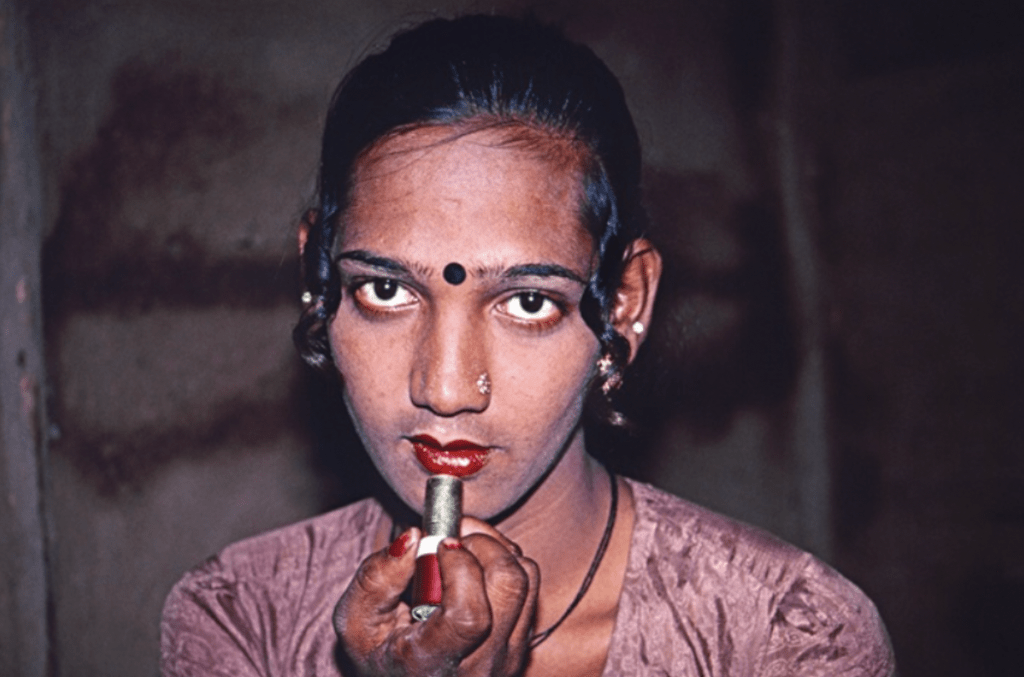
Image Source : https://www.artnet.com/artists/takeshi-ishikawa/hijras-a-IEUk3WUMVXWErq8hTmdFzA2
 NICKELED AND DIMED