By Shaurya Agarwal
Abstract
The relentless extraction of crude oil over a long period, coupled with a lack of investment in public infrastructure, has resulted in poverty and severe environmental degradation in the Niger Delta of Nigeria. This situation has been exacerbated by governmental corruption, leading to the inequitable distribution of oil wealth across regions, fostering tensions and clashes. Continued exploitative operations by international oil companies like Shell, along with domestic oil firms, are identified as the primary cause of this degradation. Amid the global push for a transition to renewable energy, and given the economically and ecologically exploited state of the delta, this piece explores what a just transition could look like for Nigeria. Various factors, including organised crime and the lack of infrastructure, further complicate the current situation in the Niger Delta.
Introduction
Nigeria, one of Africa’s most oil-rich countries and the continent’s largest economy, ironically remains one of the most energy-poor nations in the Global South. This can be seen in the trade data from OEC (Observer Economic Complexity) for the fiscal year 2022-2023, which shows that crude oil was the country’s largest export and refined oil was its largest import. This establishes the lack of investment in the processing capacity of government refineries in the country. Since BP (British Petroleum) and Shell discovered crude oil in Nigeria in 1956,(citation needed) it has been vital to the country’s economy, contributing significantly to government revenue and exports The government‘s overreliance on earnings from oil had profound implications leading to artificial overvaluation of the currency, increasing imports and underdevelopment across several sectors.
The post-independence period was marred by political instability as it saw military coups and a devastating civil war (1967-1970). The military remained dominant in governance until 1999, with only brief periods of civilian rule. One reason for this upheaval is Nigeria’s lack of a common national identity. Before colonial rule, Nigeria was home to diverse ethnic groups that were grouped together under colonial governance. As a result, there has been a lack of a common notion of citizenship, with people’s lives primarily centred around long-standing local communities. The transition to civilian rule in 1999 was a turning point, marking the longest period of democratic governance in Nigeria’s history. Today, Nigeria stands as a multi-ethnic federation of 36 states. However, the political landscape continues to be dominated by the ruling All Progressives Congress party (APC) with ongoing challenges of corruption, governance, and ethnic tensions.
The ‘Oil Curse’: How Dependence on Oil Has Prevented Economic Diversification
The discovery of oil transformed Nigeria’s economy from reliance on cash crops like cocoa, rubber, and groundnuts to complete dependence on oil production. As a result, Nigeria’s economic growth became highly volatile, closely tied to global oil prices. Poor governance exacerbated the “resource curse” with government officials capturing the majority of oil revenues while leaving the Niger Delta marginalised. Despite earning over $400 billion from oil since the 1970s, living standards for its people have declined. Crucial sectors like agriculture, education, and health have suffered due to oil dependence. Moreover, the artificial overvaluation of the currency has turned the country into an import-reliant economy, causing significant unemployment.
Nigeria’s first refineries were built by Shell-BP near Port Harcourt but were later purchased by the government leading to the formation of Nigerian National Petroleum Corporation (NNPC) in 1977. Despite the setting up of four government-owned refineries in the years of early independence, all these refineries remain dysfunctional today due to mismanagement. Multinational corporations like Shell have focused on exporting crude oil instead of investing in local refineries. Despite efforts to diversify the economy in 2024; Oil still accounts for 50% of government revenue, and roughly 75% of exports hence significantly shaping the currency reserves. Nigeria has the raw potential to produce 2 million barrels per day but currently produces roughly 1.5 million barrels of crude oil per day and has been lagging due to the vandalisation of oil pipelines in the niger delta where residents protest against the environmental degradation caused by the multinational companies in partnership with the state. Furthermore, policies such as the oil subsidy proposed by the government have been distortionary and affected the country’s growth, reinforcing the narrative about the need to move away from oil.
Oil Subsidy: A Double-Edged Sword?
Oil subsidies were first introduced after the global oil price shock of 1973 to make fuel affordable for the general population. However, over time, subsidies became a burden for the state as the Nigerian National Petroleum Corporation (NNPC) would trade crude oil for refined petroleum, which was then sold to the public at a significant loss. By 2022, the Nigerian government was spending ₦400 billion ($500 million) monthly on subsidies. The costs could no longer be justified as resources dried up. President Bola Tinubu scrapped the subsidy abruptly in 2023, causing fuel prices to triple. The ruling party argued that removing the subsidy would save millions of tonnes of CO2 emissions annually as it would make the citizens adopt less energy incentive processes to complete their daily operations. However, based on the massive fuel shortage, inflation and economic recession, this move caused the subsidy to be quickly reinstated. This year, Escap, a consultancy, estimates that it will consume around 5.4 trillion naira ($3.3 billion), accounting for 2.3% of GDP—four times the health budget and nearly half of the state’s oil revenues—diverting public funds that could benefit sectors like education and health. This can be further validated by the fact that annual public spending per head by the Nigerian government in 2024 on education and health remained at $6 and $4 respectively for the most populated country in the African continent.
Public Protests and Movements in the Niger Delta
The inequitable distribution of oil wealth has fueled internal conflict, leading to violent clashes in the Niger Delta. Today, over 71 Million Nigerians live in extreme poverty less than 2.15 USD a day. An estimated 98 per cent of households lack access to quality cooking and lighting fuels. This situation compels families to depend wholly on inferior and health-damaging kerosene fuel. The overwhelming population of Nigeria is desperate for clean cooking energy. In response, activist Ken Saro-Wiwa led the Movement for the Survival of the Ogoni People (MOSOP ) in the 1990s, protesting against Shell and environmental degradation in the Niger Delta. Ken Saro voiced public concern in the niger delta and demanded that the government invest in developmental infrastructure within the niger delta such as schools and hospitals instead of just exploiting it for oil. The protests culminated in violent crackdowns by the Nigerian military government, leading to the execution of activist Ken Saro-Wiwa in 1995. MOSOP submitted the Ogoni Bill of Rights to the Nigerian government. The bill outlined the Ogoni people’s demands for political, economic, and environmental rights, to protect their culture from the Nigerian government and oil companies.
Another movement for the same cause emerged in the mid-2000s called the Movement for the Emancipation of the niger delta (MEND). This led to violent clashes between ethnic groups and government forces, with groups vandalising pipelines and claiming the oil as their own, arguing that the companies invited by the government have no rights to it. This act of defiance by the people in the Niger Delta in the form of MEND quickly converted into a militant movement. Where several locals have armed and organised themselves into a mob which would generate profit by selling a semi-refined version of the looted oil. An increase in such oil thefts lead to a fall in the country’s oil production further contributing to its inability to meet its OPEC+ targets for two consecutive years of 2022 and 2023. These layers of organized crime contributed to environmental degradation as the blowing up pipelines has frequently led to operational failures such as oil spills that had a catastrophic impact on the local ecology.
Environmental Degradation and Consequences
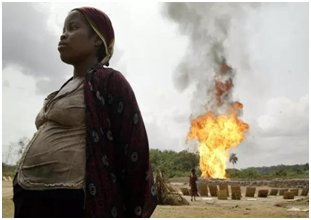
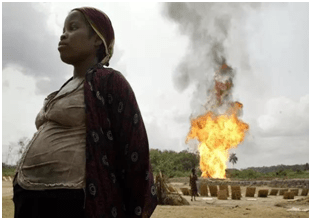
In 2008 two large spills, a result of operational faults, hit the Bodo community in Ogoniland in the Niger Delta. Tens of thousands of barrels of oil were spilled. This resulted in Ogoniland communities being exposed to hydrocarbons daily. As their drinking water was contaminated with benzene, a substance known to cause cancer, at levels over 900 times above the World Health Organisation guidelines. Some of the other most environmentally damaging incidents of operational failures and oil spills that transpired in Nigeria include the Texaco Offshore Blowout in 1980 which resulted in an estimated spill of 400,000 barrels of oil, marking one of the largest spills in Nigeria’s history. In 2019 alone, approximately 36,334 barrels were spilt across 601 incidents, reflecting a significant increase in spill volume compared to previous years. Oil spills can render certain fishing areas unusable, forcing fishermen to travel farther or find new locations, which may not be as productive. The health risks are also immense, with residents facing heightened dangers of cancer, skin diseases, and respiratory issues due to long-term exposure to pollutants. Many communities, left with no choice, are forced to drink contaminated water.
Legal actions have followed the environmental devastation. In 2012, 11,000 Nigerians from Bodo launched a lawsuit against Shell in the London High Court, seeking compensation for the damage caused by the 2008 spills. This resulted in Shell agreeing to pay £55 million to the community and committing to clean up the affected lands and waterways. In 2021, Shell paid $111.68 million to settle a separate case with the Ejama-Ebubu community in Ogoniland. Despite these legal victories, the scale of the environmental damage requires long-term clean-up efforts. A 2011 U.N. report criticised both Shell and the Nigerian government for allowing 50 years of pollution to persist, estimating that full restoration in Ogoniland alone would require an initial $1 billion and could take up to 30 years to complete. The growing security concerns in the region caused Shell to sell its onshore Nigerian oil and gas subsidiary to a consortium of five mostly local companies for up to $2.4 billion.
The environmental impacts of these operational failures on the local ecology have also made the country more vulnerable to the effects of climate, causing more intense and untimely rainfall. Events like flash floods, landslides, and gully erosion have also worsened across the landscape of the country. This underscores the need for the initiation of more projects like the Nigeria Erosion and Watershed Management Project (NEWMAP) that aim to mitigate these environmental impacts through community-based approaches and innovative land management strategies.
The Impact of Increasing Domestic Oil Production
The divestment of onshore investments by international oil companies has created a vacuum in production, which is now being filled by local Nigerian industries. A key example is the construction of the $20 billion Dangote refinery, which, once completed, aims to meet Nigeria’s domestic refined oil needs and reduce reliance on imports. However, organised crime groups threaten the refinery’s progress, fearing the loss of their illicit oil trade. To ensure increased domestic production is sustainable and beneficial in the long run, the government needs to enforce stricter policies on sustainable development and provide incentives for less carbon-intensive practices. As reports from the Environmental Defense Fund show a critical increase in gas flaring and leaks since Nigerian companies took over. They further highlight that overseas corporations accounted for 35% fewer oil spills than Nigerian companies that have replaced them after the disinvestment of IOCs.
Just Transition: Policy for Change
A “just transition,” as defined by the ILO, implies transitioning to a greener economy while ensuring equitable stakes in growth for everyone, emphasising fairness and inclusivity. Nigeria has adopted certain energy diversification policies to meet its Nationally Determined Contribution (NDC) target to reduce its emissions by 20% relative to a business-as-usual trajectory by 2030, and up to 45% by the same date, conditional on the provision of international support. Along with a switch to renewable sources of energy and cleaner fuels, the employment creation remains another pertinent challenge for Nigeria. One of the measures taken up by the government to enable a just transition includes the Energy Transition Plan, 2023. The plan aims to substitute the use of traditional fuelwood and Kerosene with LPG to try and achieve SDG 7 by 2030. Furthermore, the act lays out mechanisms to transition away from diesel and petrol generators which amount to the bulk of current generation capacity and further work for the initial expansion of gas generation capacity to establish baseload capacity for meeting increased electricity demand and later integrating renewables.
Another example of such a policy would be the Economic Sustainability Plan. Some key pointers of the plan include a $619 million commitment to the Solar Homes Systems Project, which will install solar home systems for up to 5 million households, serving 25 million Nigerians who are not connected to the national grid. Allocation of NGN 113 billion to promote the use of gas (CNG and LPG), which Nigeria sees as a bridge from more polluting fossil fuels to cleaner energy along with Mass Agricultural Programs for economic diversification. Lastly, the Climate Change Act mandates the creation of a national climate action plan, including carbon taxation and emission trading mechanisms.
Challenges in Policy Implementation
While the establishment of local regulatory bodies has helped protect the environment, whilst allowing for a better understanding of unique environmental challenges and community needs, several crucial challenges remain. Resource wastage, which involves duplicating functions, leads to inefficient use of both financial and material resources. This can hinder timely environmental protection measures and create bottlenecks in project approvals. Another challenge is bureaucratic confusion, where overlapping responsibilities among federal, state, and local agencies cause delays in Environmental Impact Assessments (EIA) and hinder timely policy execution.
Conclusion
Nigeria’s challenge is not simply the “oil curse” but achieving economic diversification beyond oil, subsistence agriculture, and informal pollutive activities across its subnational entities. Recent developments underscore the need for cooperation between the government and private players to attract investment and generate employment. As businesses increasingly shift to renewable energy due to uncertain availability of refined oil and volatile pricing of the same. A better public-private partnership is needed to curate development and make Nigeria an attractive destination for foreign investors. Sustainable development policies along with efforts to curb oil pipeline vandalism, will be crucial in restoring the environment and stabilising the economy. Environmental degradation in Nigeria has dire consequences, affecting not only the ecosystem but also public health, economic stability, and social cohesion. While legal actions and clean-up efforts offer some hope for affected communities, sustained efforts are essential to fully restore the environment and protect the livelihoods of those most impacted.
Author’s Bio
Shaurya Agarwal is currently in the final year of his liberal arts program at the Jindal School of Liberal Arts and Humanities. His research interest lies in the areas of environmental economics and public policy.
Image Source: https://rsisinternational.org/journals/ijrias/wp-content/uploads/2023/10/4.png
 NICKELED AND DIMED