
By Haley Vasu
Abstract
The diversity of feminism can best be studied through its phases, or “waves”, especially in the United States. Through these waves and their changes, there remained one constant- music. It would thus be amusing to study the different types of feminism, signified not only through its periods or waves but also through music that inspired and fuelled these movements.
Feminism as waves
The first wave of feminism saw the rise of reformist or liberal feminism, striving for political equality. The second wave saw the rise of radical feminism, which challenged social inequality, exposing everyday sexism and injustices. The third wave witnessed the birth and proliferation of what is today known as intersectional feminism, in which Kimberlee Crenshaw and Judith Butler played an important role. The fourth wave, however, is mainly characterised by the role of the internet in its propagation and is what we are witnessing today. However, the ‘wave’ concept can be ‘reductive’– constraining one to think that only one type of feminism existed at one point in time, when it was not really the case, and there was often some overlap where each was inspired by the previous one and incorporated its predecessor’s elements. Despite its criticism, understanding feminism through waves helps shed light on the predominant ideas and practices at one point. It gives almost a timestamp to an ordinary reader of history. Through these waves and their changes, there remained one constant- music. It would thus be amusing to study the different types of feminism, signified not only through its periods or waves but also through music that inspired and fuelled these movements.
The framing process
Music has been monumental throughout history as a medium through which people express themselves. It brings people together based on their shared experience, as they enjoy music and probably even get inspired by it. Authors and researchers call this process ‘framing’, which involves ‘message construction, representation, and analysis aimed at influencing the audience’s behaviours.’ essentially, in this process, aspects of reality are emphasised. It helps create shared meanings for a massive group, in our instance- women and society, which enables artists to influence people with their art. They do this by framing a narrative and crafting meaning in their art, specifically songs. Imagine a frame, to take it literally, a hollow wooden frame. Now think of television, through which specific parts of reality are shown, for instance, grievance endured by a particular part of society. What this then does is expose a part of reality to the audience. When the audience participates in it, they adopt a different perspective and take suggestive actions, which music did to the feminist movements. Eyerman (2002) very aptly highlights the role of music in such movements as being ‘key’ because even the distant observer would have the ‘collective memory of songs’. Come to think of it, it is true- when you hear a song, you reminisce the time you most heard it, and it invokes the same feeling in you it did back then. The power to invoke specific feelings through songs and trigger a collective memory is what artists during the feminist tapped into and used to their advantage- spurring collective action, igniting and fuelling a sense of belonging to a community and contributing to it.
Music in the liberal feminism era
Liberal feminism is said to have been most prevalent from circa 1848-1920, typified by the ‘first wave of feminism’. Women sought political equality during this time and achieved legislative changes. The first organised movement was started with Elizabeth Cady Stanton and Lucretia Mott at Seneca Falls, New York, in 1848, seeking the right to vote for women. However, it wasn’t until 70 years later, through the ratification of the 19th Amendment in 1920. Music played a crucial role during this period since the police had banned ‘votes for women’ speeches, so groups throughout the country used music to express themselves and unite people for this cause. Women’s Suffrage in Sheet Music shows a collection of music during the movement. Songs like ‘Yankee Doodle’ and ‘America’, both American patriotic songs, were sung with changed lyrics. From parlours to prisons, everywhere. These were in the third person, addressed to the audience, inciting some action and change.
Music in the radical feminism era
The rise of radical feminism was sometime around 1970-1990 when the wave concept did not hold. It is difficult to segregate. Overlaps indeed happen. It is imperative to note that radical feminism departed from its predecessors, liberal feminists, fundamentally. Not only did they seek social equality instead of political equality, but they also rejected the formal structure of society itself. That structure took female subordination for granted and considered it ‘so normal as to be often invisible’. Thus, radical feminists became tasked with convincing women that what they were facing was indeed oppression. People started questioning everyday sexism, the existing gender roles and their rights and freedoms. It began from being what Betty Friedman called ‘a problem with no name’ to a movement that acknowledged issues like marital rape, date rape, double and triple jeopardy, and womanism, to name just a few. Iconic songs like You Don’t Own Me by the 17-year-old Lesley Gore, which was second on the Billboard Hot 100 in February of 1963, and Helen Reddy’s I Am Woman (1971) both went on to become unofficial feminist anthems of their respective times. Others included Nancy Sinatra’s These Boots Are Made for Walkin (1966) and Aretha Franklin’s Respect’(1967). The first-ever women’s music festival also took place in 1973. From simply a medium to convey themselves because speech was banned, music became a bonding factor. According to Smithsonian Magazine, it was an opportunity for thousands of women to gather and ‘find validation in their identity’ and experience the feeling of ‘being in the majority for a night.
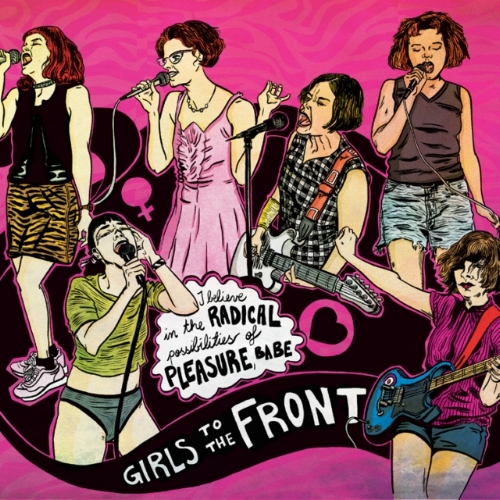
The idea of “womanist is to be feminist as purple is to lavender” that Alice Walker soon spread. People acknowledged that their focus was white upper-class women, and they worked to change this. The lens through which people viewed feminism shifted from ‘just gender to gender, race, class and sexuality’, as an article very succinctly put. It was the era where girl groups were dominating- Spice Girls, TLC, Salt-N-Pepa, and Destiny Child, to name a few, were ruling the charts and supporting women’s rights through their songs. The iconic underground feminist punk rock group Riot Grrrls and Bikini Kill were all the frenzy back then, distributing zines containing information on sexual harassment, abortion clinics, and the like during their concerts. To acknowledge the problem of victim shaming, they would often write the words ‘slut’ and ‘rape’ on their bodies. While Riot Grrrls still fell in the white women strata, on the parallel, Rapper Queen Latifah was gaining traction in the Black feminist community. Combined with the fact that she was also queer, she became an icon for intersectional feminists, as well. Not just that, alongside artists like Madonna and Mary J.Blige, she became someone who broke the stereotype of women being weak, and passive in popular culture. Through her lyrics and interviews, she called out domestic violence, catcalling, and misogyny, while her song, Ladies First, became a rap feminist anthem. Her songs used both first person and second person pronouns, where the latter addressed women directly and encouraged them ‘ not to settle for domestic abuse and disrespect’, as the author of this book notes. In the late 90s and early 2000s, singers like Shania Twain still catered to this audience. Her song “Man! I Feel Like a Woman” (1997) encouraged women to be happy without any societal limits and be free, as per what it means to them. In the early 2000s, Beyonce’s If I Were a Boy showed how women are held responsible for a man’s misbehaviour. At this time when most songs were objectifying Black women.
The current era
Some believe we’re presently living in what is called “the fourth wave of feminism”. On the opposite side of the spectrum exists people like April Sizemore-Barber, a gender studies scholar, who remarked in an interview with Vox, “Now feminism is inherently intersectional feminism- we are in a place of multiple feminisms.” It is true there is no one dominant feminism ideology today that symbolises this era. What then characterises this era is simply the existence of the Internet as the commonplace. People identify this phase as one triggered by the rise of #MeToo. Songs like Meghan Trainor’s “All About That Bass” and Taylor Swift’s “The Man” continue to promote female empowerment, tapping into shared experience through the community frames, as discussed at the beginning of the article. While the former encourages self-sufficiency and love, refusing body shaming, the latter depicts the same challenges. Societal structure favours males over females, hindering female achievement.
Conclusion
In conclusion, music has been a constant through all the phases and forms of feminism- as a catalyst for social change through solidarity. It is through viewing feminism through the lens of music that we understand the impact, contribution and the extent of both.
Author’s Bio
Haley Vasu is a second-year law student at O.P. Jindal Global University. She loves to read fiction and have conversations over a good cup of coffee.
Image Source: Rebel Girl Image Feature
 NICKELED AND DIMED