

By Prabhroop Kaur
Abstract
Exploring the realm of biological metamorphosis, this essay attempts to unfold the narratives of
bioeconomy, where we harness biological resources to bring a transformative era for the planet.
Commencing a journey with exciting discoveries and opportunities is like a challenge in itself. Are you prepared to be an integral part of the biological revolution that is currently underway?
Picture a world where lively forests are diminishing because of the race to progress. The fate of today’s linear economic model, characterised by resource extraction, rapid production of goods and subsequent waste disposal has significant implications for the planet as well as its people. Unknowingly, the take-make-dispose mentality is leading us to demise.
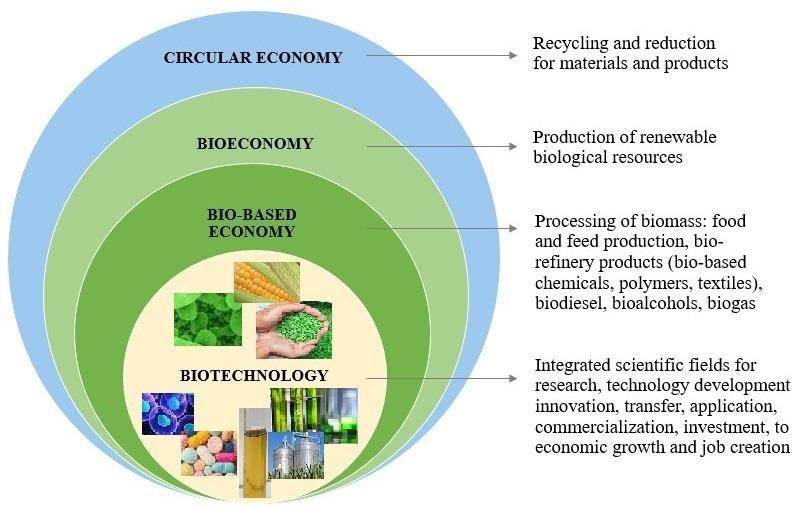
Source: Carmen Mateescu– Analysis on disciplines integration challenges for conducting research projects in biotechnologies. ResearchGate
Introduction
The food, land and ocean systems- accounting for 12% of global GDP and 40 per cent of employment – face relentless strain due to the prevailing business practices. This exploitation poses a threat to 80 per cent of the world’s species, moreover, the ripple effects spill over to societal vulnerabilities and unemployment. Corporations, once accustomed to “growth as usual” are now demanding a change of paradigm – mimicking nature’s regenerative cycles. The 2022 Global Biodiversity Framework adopted at the 15th Conference of Parties (held in Montreal), mandated organisations to measure their ‘Biodiversity Footprint’, a tool to keep track of their activities that have implications on biodiversity. It assists companies in disclosing their biodiversity footprint, identifying its causes and suggesting remedial actions.
This theme delves deep into two pivotal sectors – food and fashion – which among others, contribute to biodiversity loss within value chains, accounting for nearly 90% of such losses attributed to commercial activities
Food and Agriculture
Parallel to the linear economy model, monocultures dominate modern agriculture- both favour short-term consumeristic goals over long-term sustainability. Monocultures are large stretches of single crops, mimicking the linear model’s single-minded focus on output. Furthermore, both systems have a staggering inherent wastefulness- often leaving traces of inedible byproducts in the environment. Both monocultures and the linear economic model fail to appreciate the intrinsic value of resources, treating them as disposable rather than a part of the cycle. At the consumer end, six truckloads of edible food is wasted every second, accounting for a huge amount of global greenhouse gas emissions.
Fast Fashion
The fast fashion industry, at the centre of the linear economy, stretches way beyond trending clothing. The industry’s environmental impact is staggering, responsible for 10 per cent of global carbon emissions. Added to this come the immense social costs, The global industry engages approximately 75 million factory workers, operating amidst a lack of transparency in labour laws. These specific instances make it easier to believe that despite the drawbacks of the current economic model, organisations continue to abide by it, solely keeping profit at the epitome.
Is there an economic model that benefits both the planet and its people?
The potential solution lies in utilising the concept of Bio-economy – an economic model with responsible utilisation of bio-based resources at its core. This economic model seeks to prioritise the conservation of biological assets while generating value out of nature-based products to yield profits while ensuring sustainable development. Fortunately, the bio-economy approach leads humanity one step towards ‘Closing The Loop’, wherein the waste of one industry has the potential to become a resource for another. Therefore, it becomes very significant to intertwine the basics of the circular economy with the bioeconomy, creating a biobased value web that highlights the interlinkages between sustainable production and consumption of bio-based products.
From Ideas To Execution
The Food and Agriculture Organisation and the Global Environment Facility (GEF) implemented a bio-economy project in Pakistan, working with discarded agricultural waste from banana cultivation. Under this initiative, banana peels were converted into sustainable textiles. This project aligns with the core principles of bio-economy: reducing agricultural waste, generating additional income, and empowering rural communities.
Another instance is from a California-based startup- Mycoworks, which uses the root network of mushrooms, Mycelium to create plant-based leather with nearly the same look and feel. The innovation doesn’t stop here; nowadays a few companies also use pineapple leaves, often discarded as waste after harvest, that is transformed into pinatex- a sustainable fabric.
The interesting aspect is that these systems extend beyond mere environmental commitments, safeguarding the livelihood of small farmers and emphasising the value of traditional knowledge. These breakthroughs are not confined solely to the field of fashion or agriculture but are also emerging within the energy sector. Most importantly, the fundamental expectations should be met, while implementation methods may vary. From a global perspective, different countries are implementing bio-economies in manners tailored to their specific needs and circumstances.
A Global Perspective
Great Britain UK Bioenergy Strategy (2011)-
For the UK to meet its 2050 low-carbon targets, bioenergy is pivotal, and excluding biomass from the energy mix would incur an increase in decarbonization costs. Aligned with the 2011 UK Renewable Energy Roadmap, bioenergy is integral to meeting Renewable Energy Directive objectives by 2020. However, there are several unknowns for instance-, encompassing the actual carbon reduction contribution, availability and cost of sustainably sourced biomass, and impacts on land use and environmental factors. The Coalition Government has developed a policy based on in-depth cross-government examination. Tailored for professionals in bioenergy, it emphasises four principles: “genuine carbon reductions, cost-effective contributions to carbon objectives, and maximising benefits while minimising costs across the economy”. The strategy builds on the Committee on Climate Change’s Bioenergy Review, outlining responsible government policies to ensure bioenergy support under appropriate circumstances
India National Biotechnology Development Strategy (2007/2014)-
In September 2007, the Department of Biotechnology (DBT), Government of India, unveiled the First National Biotechnology Development Strategy. The implementation of the Biotech Strategy 2007 has opened up many new opportunities, breaking down traditional disciplinary boundaries and giving rise to both new prospects and challenges through the convergence of diverse fields. A detailed analysis of the Indian biotech industry was deemed appropriate, with projections for the industry’s future five to six years. In 2015, DBT unveiled “The National Biotechnology Development Strategy-2015-2020” (referred to as ‘Strategy-II’). Strategy II was intended to smoothly expand on Strategy I, to drive the biotechnology industry’s expansion following international norms.
EU Commission: A Bioeconomy for Europe (2012)-
Europe’s Bioeconomy Strategy, which was introduced in February 2012, aims to produce sustainable biological resources and transform them into necessary goods and bioenergy. The strategy, with objectives ranging from food security to climate change mitigation, was updated in 2018 to align with the 2030 Agenda, SDGs, and the Paris Agreement. The updated strategy emphasises three key areas of action: developing local bio economies throughout Europe, bolstering bio-based sectors, and comprehending ecological boundaries. The bioeconomy, a renewable segment of the circular economy, contributes to a carbon-neutral future, renewable energy targets, industrial modernization, and job creation. Lessons from the 2012 strategy underscore the need for continued investment mobilisation, policy coherence, public awareness, and a strategic, systemic approach. The upcoming Multiannual Financial Framework for 2021 allocates EUR 10 billion to boost research and innovation in the bioeconomy. Success requires collaborative efforts, innovation-friendly regulations, and strategic deployment of innovations.
USA National Bioeconomy Blueprint (2012)-
In 2012, the Obama administration doubled down on supporting scientific advancements in biology to tackle national issues. Their plan, the National Bioeconomy Blueprint, details how biological research can be used for things like better healthcare, cleaner energy, and more efficient food production. They highlight the economic potential of this “bioeconomy,” mentioning areas like genetically modified crops and industrial biotechnology.
The blueprint’s five strategic objectives focus on R&D investments, transitioning bio inventions to the market, regulatory reform, workforce development, and public-private partnerships. Provisions cover areas like renewable fuels, biomanufacturing, synthetic biology, advanced biofuels, rural job creation, and innovative biofuel feedstock approaches. The administration advocates a coordinated approach, emphasising translational efforts, regulatory improvements, workforce training, and collaborative partnerships for sustainable growth in the national bioeconomy.
Conclusion
The current linear model has painted a stark picture: depleting resources, deteriorating environment and widening social gap – on one hand, some people argue that the current model is inevitable, but the path forward remains a negotiation between diverse perspectives.
Ultimately, our choice is clear – we stand at a point where we can either continue down the unsustainable path or embrace bioeconomy as a potential for positive change.
Author’s Bio
Prabhroop Kaur is a second year student pursuing her Bsc at the Jindal School of Environment and Sustainability. A nature lover by birth, she enjoys creating content and spreading awareness about sustainable development through various channels. Being the proud owner of an upcycling venture, she has been able to cultivate a broad, like minded audience passionate about a sustainable future.
Image Source: https://commonwisdom.co.uk/how-to-save-money-on-your-farm-practical-tips-for-farmers/
 NICKELED AND DIMED