
By Sunidhi Gupta
Abstract
The involvement of women in United Nations (UN) peacekeeping missions has garnered increasing attention in recent years. This paper examines the multifaceted role that women play in UN peacekeeping efforts, focusing on their contributions, the challenges faced, and the broader implications for peace and security. By analyzing the evolving policies and initiatives aimed at promoting gender equality within UN peacekeeping, this study highlights the importance of incorporating women in all stages of peacekeeping operations. It explores the impact of increased female participation on conflict resolution, community engagement, and the overall effectiveness of peacekeeping missions.
INTRODUCTION
Women are an integral part of the society and their participation in the prevention and resolution of conflict enhances the security interests. Data states that the inclusion of women in the process of peace negotiation makes the success percentage 64% and the percentage for likelihood to fail and last for a minimum of 15 years is 35%. Evidence states that the United Nations, in particular, has remarked on the widening prospects of conflict management and inclusive resolutions of women’s participation in peace operations, which has helped attain an improved international peacebuilding strategy. This participation is not just in the military component of an operation but also in the military and justice components.
WOMEN REPRESENTATION OF WORLD FORUM
There is data which upholds the fact that the representation of women on political forums has seen a surge in recent years. In 27 nations across the globe as of July 2023, women held the position of Head of the State or the Government and the percentage of women serving in national parliaments worldwide is also 26.5%; in contrast, the percentage in nations experiencing conflict is still lower, at 23%. Women made up 23% of cabinet ministers worldwide as of January 2023, and 20% of those in nations where there is conflict. There are nine nations in the world without female ministers. In 2022, women had 35.5% of elected seats in local deliberative bodies worldwide and 24.5% in countries impacted by conflict, representing a larger percentage of women in local government than at the national level. In conflict-affected nations with legally enforced gender quotas, the percentage of female lawmakers stood at 27% in 2022. Women make up only 17% of lawmakers in the absence of quotas. Women held 29% of seats in elected local governments in 2022 in conflict-affected nations with gender quotas in place, compared to 16% in those without. Thirteen per cent of defence ministers worldwide are female.
Women’s representation plays a crucial role in the protection of human rights, maintaining the rule of law as well as becoming a voice for women to access justice. There is data to substantiate that there is an increase in women’s representation in humanitarian roles as well. There has been an increase in the appointment of professional judges and magistrates in 2021 to 43% from 34% in 2010, in criminal judicial institutions. In the context of transitional justice procedures, women made up 20% and 36% of commissioners on truth commissions in Mali and Colombia, respectively, and 55% of magistrates in Colombia’s Special Jurisdiction for Peace in 2022. With assistance from the UN, 22 out of 52 conflict-affected nations (42%), implemented changes in 2022 aimed at creating criminal justice systems that are efficient, easily accessible, and sensitive to gender issues. Apart from this, there has been a considerable increase in the role of women in the United Nations itself. Statistics show that when the percentage of women serving as Heads and Deputy Heads of Mission reached 48% in June 2021, gender parity was almost attained. However, by July 2023, the percentage had dropped to 39%, with a greater proportion of women holding Deputy roles. Further, as per the thematic review, 19 out of 43 climate security projects had girls and women as the central focus, in 2021. Following that, at least 9 additional projects had women focused on significant sub-components or elements. Thus, women are involved but the question is if the involvement is meaningful.
MEANINGFUL PARTICIPATION OF WOMEN AS PEACEKEEPERS
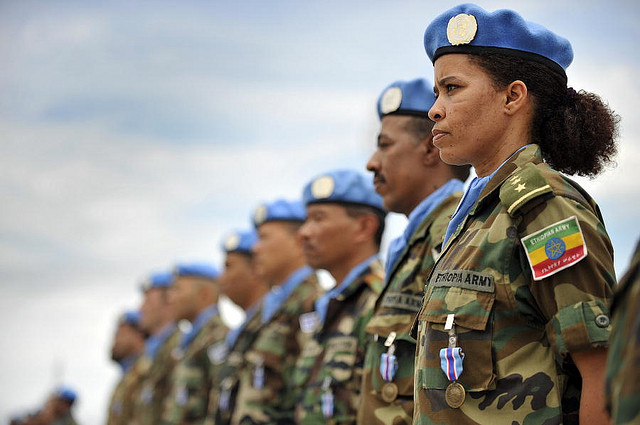
It has been proven that increasing the number of women serving in international peacekeeping missions enhances a mission’s efficacy and stability. Missions that employ a higher proportion of women are more likely to fulfil their objectives and establish enduring peace. Nonetheless, a wealth of research indicates that women’s “meaningful” participation, rather than merely quantity matters. There is a definition given by Elsie Initiative for Women in Peace Operations for what meaningful participation can be understood as when women contribute significantly and they are included in operational planning, decision-making processes, holding command and leadership positions and have equal training, promotion and career advancement opportunities as their male counterparts. There are various positives to increasing women’s participation which include improving the overall comprehensive strategy used in today’s peacekeeping operations by bringing a different viewpoint to the crucial planning and decision-making stages. In addition, female peacekeepers have a special set of tactical abilities that their male colleagues frequently lack, such as the capacity to physically screen and search females. The local population’s access to women peacekeepers is especially useful in situations when there are cultural constraints on inter-gender interaction and in locations that are off-limits to men.
Major General Kristin Lund shared her experience of how she had access to the whole population rather than 50% in her deployment in Afghanistan because she was a female officer. She explained how female peacekeepers frequently foster confidence and trust with the local populace, which in turn motivates them to cooperate with the force by reporting a range of offences, including sexual assault. A woman who has experienced male gang rape is more likely to approach a woman in uniform than a man. Additionally, she believed that raped men will approach a female soldier rather than a male. Because women are seen as less dangerous and more adept at defusing potentially explosive situations, their involvement in the peacekeeping mission is also associated with a decrease in misbehaviour accusations.
CURRENT SITUATION OF WOMEN IN PEACEKEEPING OPERATIONS
The current situation is an example of how even after knowing the results of deploying women officers, there is a routine underrepresentation. Twelve peacekeeping missions, under the direction of the UN Department of Peace Operations, are presently stationed all over the world to assist nations in negotiating the challenging transition from war to peace. As per the October 2022 data, “Contribution of Uniformed Personnel to UN by Mission, Personnel Type, and Gender,” just 3,789, or around 6.0%, of the 63,310 military peacekeeping forces deployed to these twelve operations are female. The representation has not been stagnant because the strength of women deployed as uniformed personnel in 1993 was less than 1% as compared to 2022. Despite this call to action, female participation has not increased significantly since the end of 2009. The Uniformed Gender Parity Strategy 2018–2028, which was agreed by UN member states in 2018, set a target of 15% female involvement in the military by that time. To achieve this ambitious aim, it also set annual milestones for the Secretariat. According to stats the 2022 target was set at 9%, but 1,909 female peacekeepers failed to meet the target. However, some countries have deployed a higher number of female peacekeepers. According to information as of October 2022, The United Nations Multidimensional Integrated Stabilization Mission in the Central African Republic (MINUSCA), with 781 troops, the United Nations Mission in South Sudan (UNMISS), with 776 troops, and the United Nations Organization Stabilization Mission in the Democratic Republic of the Congo (MONUSCO), with 746 troops, are the top three UN peacekeeping missions in terms of the proportion of female troops. Even when the highest is being considered, the percentage of female troops is 6.4% in MINUSCA, 5.9% in UNMISS, and 6.0% in MONUSCO.
Women’s meaningful engagement in UN peacekeeping missions is not increasing, notwithstanding a gradual increase in the number of female peacekeepers and the percentage of women in the military contingent. Regardless of their qualifications and expertise, women peacekeepers are frequently restricted to conventional positions like nursing, community service, administration, and domestic work. The lowest percentages of women are typically found in missions with a higher proportion of forces involved in combat, partly due to a reluctance to deploy female peacekeepers to hazardous conflict zones where there is a higher risk of sexual exploitation and abuse or a higher death toll from peacekeeping operations. In peacekeeping operations today, there is still a widespread assumption that women are incapable of defending themselves. This generally leads to the underutilization of women officers as they do not get to conduct patrols or interact with locals. The statement by Ambassador Melanne Verveer states that inclusion does not mean meaningful participation and that is what makes the difference at the end.
CONCLUSION
To conclude, there have been major changes in how women work as peacekeepers around the world and the opportunities have increased. However, still, there is a change required to instil gender parity and increase the meaningful participation of women. Therefore, there has been a policy recommendation to increase operational effectiveness in a report by an Institute for Women, Peace & Security. The policy explains, that guaranteeing that mission personnel interact with the appropriate players in a way that protects civilians and promotes peace, conduct thorough gendered conflict analysis, and complete a thorough gendered organizational analysis will enable PKOs to consider how militarized aggression among peacekeepers can undermine relationships with recipients and gather and incorporate local feedback methodically to better suit different cultural situations.
Author’s Bio
Sunidhi Gupta is a student at Jindal Global Law School in her third year of BA. LLB (Hons.).
Image Source: https://www.ivint.org/women-in-peacekeeping-roles-and-opportunities-in-diversity/
 NICKELED AND DIMED