
By Anoushka Rawat
Abstract
This article delves into the changing political landscape of Türkiye and the altering role of women, as political agents. Historically, women were active in the public sphere in terms of education, employment, and political representation. More than a century later, Turkish women find themselves in the midst of state-driven reinforcement of traditional gender roles. Gradually feminism branched out in Türkiye as two radically opposite groups namely- feminists and Islamist feminists. Both camps have sought and ensured substantive equality for women, even whilst Türkiye is experiencing a current wave of Islamic revivalism under President Recep Tayyip Erdogan.
Background
As the Turkish War of Independence ended in 1923, the founding father of the Republic of Turkey, Mustafa Kemal Ataturk, served as its first president, and a series of secular Western measures covered the Turkish panorama. The new secular civic code replaced the Islamic laws and consistently, women were now not placed under the purview of the latter. Accordingly, polygamy was banned, and the right to divorce, inheritance, custody and education were granted to women. This placed Türkiye way ahead of its Middle Eastern counterparts. Later in 1934, women were granted full political rights according to which they had the right to vote and to contest elections. Then in 1983, under President Kenan Evren, Türkiye legalised abortion. Consequently, Türkiye, owing to its leadership, was far ahead of Western democracies in terms of women’s rights.
In the Turkish Constitution of 1961, the principle of equality was expressly stated under the section, “Fundamental Rights and Freedoms”. Later in the Constitution of 1982, the same was placed under “General Principles”. This implies how gender equality was considered a part of the basic structure of the constitutional system, expressing the extent to which it could dominate the caveats of the constitution and the state apparatus. In accordance with the Constitution of 1982, Subparagraph I of Article 10 states, “All individuals are equal without any discrimination before law, irrespective of language, race, colour, sex, political opinion, philosophical belief, religion and sect, or any such consideration.” An addition was made through the provision of Subparagraph II which stated, “Women and men have equal rights. The State shall have the obligation to ensure that this equality exists in practice.”
Following in its footsteps of being contrary to its orientalist stereotype, Ankara hosted the Council of Europe’s Istanbul Convention in 2011 which was a prominent tool to prevent and combat gender-based violence. The international treaty also stipulates the formulation of domestic laws in accordance with it so that the policy implementation is comprehensive and coordinated. The following are the provisos as mentioned in the Convention:
- defines and criminalises various forms of violence against women, including physical, sexual, and psychological violence, stalking, sexual harassment, female genital mutilation, forced marriage, forced abortion and forced sterilisation;
- prevents violence by obliging parties to invest in awareness-raising campaigns and education, training for experts in close contact with victims, and treatment programmes for perpetrators, and to address the role of the media in eradicating gender stereotypes;
- protects victims by obliging states to establish appropriate support services such as a free national telephone hotline; shelters; medical, psychological and legal counselling; and help with housing and financial issues;
- sets an obligation for parties to collect data on gender-related crimes;
- addresses asylum and migration, as it requires gender-based violence to be recognised as a form of persecution when establishing refugee status;
- takes a cross-border approach, as some forms of violence, such as forced marriages, entail action in different states. The Convention makes it obligatory for state parties to extend their jurisdiction to cover crimes committed abroad by their nationals;
- introduces a different definition of ‘gender’, as ‘the socially constructed roles, behaviours, activities and attributes that a given society considers appropriate for women and men, as opposed to the usual definition based on the sex of the person;
- covers boys and men as well as girls and women as possible victims, domestic violence and forced marriage in particular.
On 14th March 2012, Türkiye became the first country to ratify the Istanbul Convention. Later in 2012, the Turkish domestic law to protect families and prevent violence against women (often termed law 6284) came into existence. Even though the latter remains in force, Türkiye withdrew from the Istanbul Convention in 2021.
Islamic Revivalism under Erdogan
The rise of Recep Tayyip Erdogan under the affiliate of Adalet ve Kalkinma Partisi (AKP; Justice and Development Party) has been linked with an upsurge in political Islam (and more broadly Islamic Revivalism). This has been prominently visible since the early 2000s. Furthermore, the formation of a conservative, right-wing, populist government under Erdogan has regularly advocated for “traditional family values”.
In 2016, President Erdogan urged women to have at least three children, adding that a woman’s life was incomplete if she failed to reproduce. Despite his emphasis on being a vehement supporter of working women, he stressed their professional life being an “obstacle” in the process of procreating. In another series of controversial remarks by President Erdogan was when he accused feminists of not understanding that “God created women for men”, and referred to birth control as treason and to abortion as murder. Another instance of this backsliding can be extrapolated from the remarks of the Directorate of Religious Affairs, The Ministry of Family and Social Services – which described the increase in violence against females (mostly domestic violence) during the pandemic as tolerable. The aforementioned exemplifies the strengthening of Islamic conservatism in the Turkish landscape.
Statistically, in recent years, according to official data, approximately four out of ten Turkish women have suffered sexual or physical violence. Secondly, a nationwide survey on violence against women conducted by Hürriyet Daily in 2013, observed that a total of 34% of men find violence against women as “occasionally necessary”, while 28% said violence could be used to “discipline” women.
This has severely impacted the ranking of the country in the Global Gender Gap Index. Türkiye is ranked 129th (out of 146 countries). It can also be attributed to the low political participation of women and worsening facilities for female health. Moreover, even though women constitute almost half of the population, the female labour participation rate stands at 34.5% as against 71.8% for men, according to official data released in July 2019. Income disparity between men and women is staggering too. Women’s income, on average, is just 30% of that of men. Through the aforementioned, it can be extrapolated how the sustenance of gender equality has been stifled under President Erdogan.
Conclusion
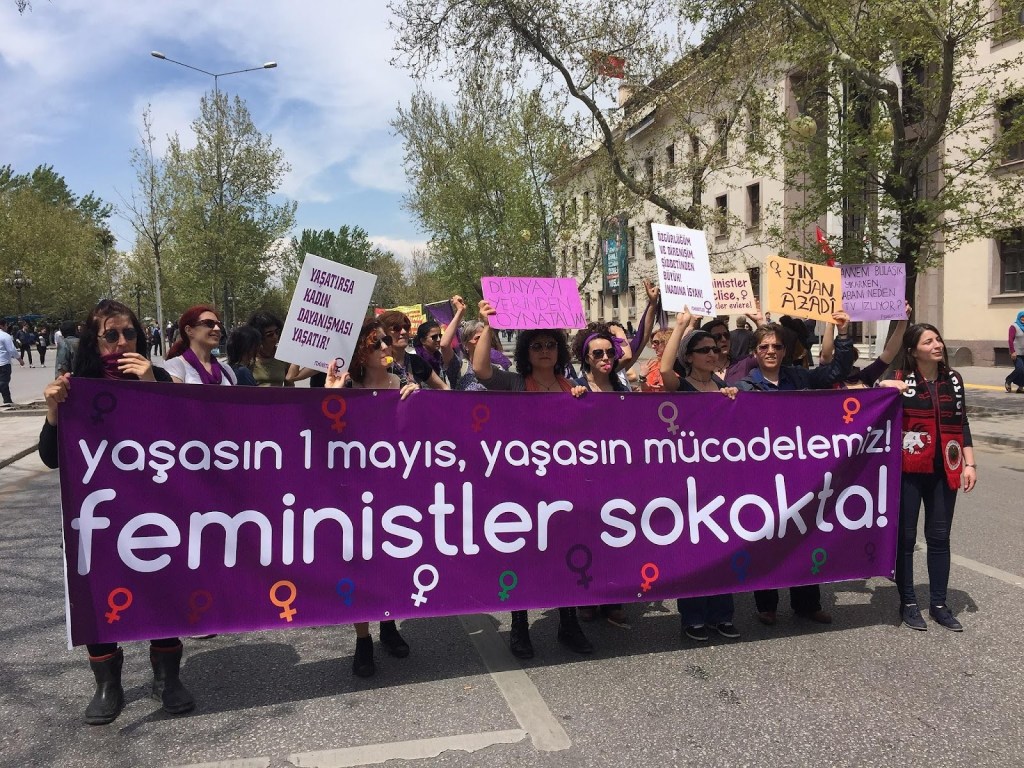
Recent years have witnessed a deterioration in women’s rights and consequently, an upsurge in activism revolving around feminist groups. The women’s rights groups were quick to recognize the dominance of the state’s ideology and its effects that percolate in society. This was previously seen through Kemal’s ‘state feminism’. Gradually, this Westernised lens of viewing women’s rights, led to the inception of Islamist feminism. Under the ambit of Islamist feminism, the members try to align the issues of gender equality, justice and rights of women within the Islamic framework. But, they do challenge the traditional and patriarchal outlook of Islam. This contrasting view of the two feminist camps has often led to contestations and hence, Turkish women-led activism shows the absence of coherence and unity.
Author’s Bio
Anoushka Rawat is a second-year student of Bachelors in Global Affairs, at the Jindal School of International Affairs. She is deeply interested in the area of gender studies and varied perspectives of feminism.
Image Source: Türkei: Böse ist, wer für Frauenrechte eintritt? | hpd
 NICKELED AND DIMED