
By Jui Chawan
Abstract
Access to good healthcare for the transgender community is yet to materialize in India. A negative societal perception of the transgender identity continues to impact the behaviour of healthcare professionals towards transgender persons. Is the recent establishment of OPD at Delhi’s RML Hospital for transgenders, a step towards inclusive healthcare?
The last week of September, Ram Manohar Lohia Hospital, Delhi, marked the beginning of a positive change in the history of public health institutions in India. For the first time in the country, a government-run hospital opened an Outpatient Department (OPD) exclusively for transgender individuals. This initiative is a welcome step against the backdrop of continued ignorance of transgender persons within the public healthcare system. But at the same time, it is imperative to note that this was initiated nine years after the National Legal Services Authority v. Union of India ruling and nearly four years after the enactment of the Transgender Persons (Protection of Rights) Act, 2019. In the background of this new development, the article aims to assess how the healthcare sector in India addresses the needs of the transgender community.
Legislative Obligations and The Government’s Inaction
Section 15 of the Transgender Persons (Protection of Rights) Act, 2019 imposes positive obligations on the Government to facilitate the creation of inclusive medical facilities for transgender persons. These include setting up ‘Human Immunodeficiency Virus Sero-surveillance Centres’; provision for medical services & counselling for sex reassignment surgery and hormonal therapy; drafting of a health manual for sex reassignment surgery as per the guidelines of the World Professional Association for Transgender Health (WPATH); review and modification of medical curriculum; making hospitals more accessible and providing comprehensive insurance coverage to transgender persons. The Central Government has taken very few steps in line with the law, like extending the Ayushmann Bharat Programme to transpersons in 2022, yet most of the other assurances remain only on paper. Singh & Chaurasia (2021) aptly noted that these legislations are “superficial” and there has been no proper plan undertaken by the government to ensure timely implementation of these policies.
On the other hand, some states have taken a positive step towards inclusivity. The State of Tamil Nadu introduced a policy offering free gender-affirmative procedures, and the State of Kerala, the first state to have a transgender policy, has promised to provide sex reassignment surgeries in government hospitals. Also, in Rajasthan, the State Government has promised to partially fund sex-reassignment surgeries and in Maharashtra, separate wards for transgender persons have been established in government hospitals. Although these seem to be good, their implementation remains an issue as most medical institutions in these states lack the resources and skills to comply with the policies.
Lastly, despite the progressive outlook of these policies, as per the 2019 Act, any individual, identifying as a transgender, needs to acquire a certificate from a District Magistrate to affirm her/his/their identity. A lack of such a certificate would make it impossible for such individuals to avail of benefits ensured by the government for transgender persons. This procedural requirement, mandated under the Act, isn’t drawn from the 2014 NALSA Judgment which upheld the right to self-determine gender identity. Since the majority of transgender persons do not possess appropriate documents or have no awareness of certification procedures, they end up with no certification recognising their gender. Hence, excluded from availing any benefits from schemes.
Furthermore, there has been no initiation on transgender health policy from the Indian Council of Medical Research abiding by the government’s instructions. Similarly, there has been no revision of the medical curriculum in the country which continues to be insensitive to gender nonconforming groups. A study conducted in 2022 observed that, though medical students are socially aware of transgender health issues, they lack the required medical knowledge on transgender health. This is a type of informational erasure faced by the transgender community since their bodies remain ignored in research and practices.
Inadequacy and Discrimination by Medical Institutions
A transgender person can suffer from specific health concerns in addition to the general issues, common to all individuals. These might include gender-affirming surgeries like hysterectomy, breast augmentation, vaginoplasty, penectomy, mastectomy, chest reconstruction and facial reconstruction; hormonal therapy; HIV/AIDS screening and treatment; counselling and mental health support for gender dysphoria. Sadly, the majority of government hospitals do not have the required specialisation and resources to provide for many of these facilities. Since the main focus of healthcare among the transgender communities is to prevent HIV and STDs, the government-run medical facilities have been provisioned with the requirements for screening and testing solely for that purpose which is evidently, a very narrow way to address transgender healthcare.
Additionally, as most doctors are unaware of trans bodies or have a negative attitude towards gender non-conforming persons, they remain at risk of being discriminated against, misgendered and ridiculed. There have been incidents where doctors have refused to treat trans-persons, and have also subjected them to humiliation and harassment. This is reflective of the prevalent transphobia among the medical fraternity. There have been reports of instances of insensitive treatment of transgender persons, where they have been “stripped to demonstrate STIs in teaching hospitals” and called “untouchable”
Ergo, transgender persons are distrustful of government hospitals and instead opt for self-medication or private healthcare providers. Self-medication is of prime concern as many transgender persons lack knowledge of their medical condition and the impact that different drugs have on their body, which may cause terrible side effects, which is detrimental to their health in the long run. On the other hand, the private health sector requires scrutiny due to the absence of protocols for transgender persons’ treatment and surgeries. As a result, transgender persons with bad experiences in the private health sector can seek no recourse in cases of medical negligence, particularly concerning gender-affirming procedures. There has been an unfortunate number of suicides following sex-reassignment surgeries due to medical negligence, and lack of pre and post-surgery care, counselling, and follow-up procedures.
A reflection on trans-experience with the healthcare system shows a deep-seated institutional erasure of trans-identities, wherein the extant infrastructure and policies only aid cishet people.
Social Barriers
The World Health Organisation’s (WHO) Constitution defines ‘Health’ as “a state of complete physical, mental and social well-being and not merely the absence of disease or infirmity” shedding light on ‘social well-being’. Similarly, the World Professional Association for Transgender Health (WPATH) also supports this idea highlighting that access to healthcare must not be assessed in isolation. Factors like socio-political environment, societal tolerance and equality all play a role in promoting the health and well-being of transgender individuals.
In India, transgender persons are still considered ill and often face social stigma. The lack of widespread societal acceptance of the diverse transgender communities makes their position vulnerable, resulting in social exclusion in spaces like education and employment. This forces many transgender persons into unsafe environments in search of employment, mainly sex work where they remain at a constant risk of harassment and violence. In these situations, access to healthcare facilities becomes more difficult.
Moving Ahead
In this current scenario marred with latent discrimination and exclusion, there need to be new policies and changes at different levels of the healthcare system. Firstly, healthcare professionals need to be sensitized regarding various non-conforming gender identities which would avoid misgendering and abuse. The inclusion of transgender persons’ health issues within the medical curriculum should be a priority. Furthermore, new policies on creating trans-friendly and inclusive healthcare spaces must be introduced. Thus, it would help to make health facilities more accessible to the transgender community and foster a relationship of trust between the community and healthcare providers. Moreover, infrastructural changes must be made to accommodate transgender persons by establishing specific wards and gender-neutral toilets.
Another important aspect to be addressed is funding and insurance coverage for transgender persons. Although there already exist some policies in this regard, more such initiatives must be introduced both at the national and state level, their accessibility and implementation must be prioritized. Additionally, more research and data on trans-health must be undertaken, aiding in better interventions and knowledge on trans-specific health.
Although the OPD at RML Hospital is a positive step towards addressing the issues, it is just a starting point. There need to be more initiatives like these across the country.
Author’s bio
Jui Chawan is a first-year LLB student at Jindal Global Law School. Her research interests lie at the intersection of political theory, development, postcolonialism, gender studies and marginalization.
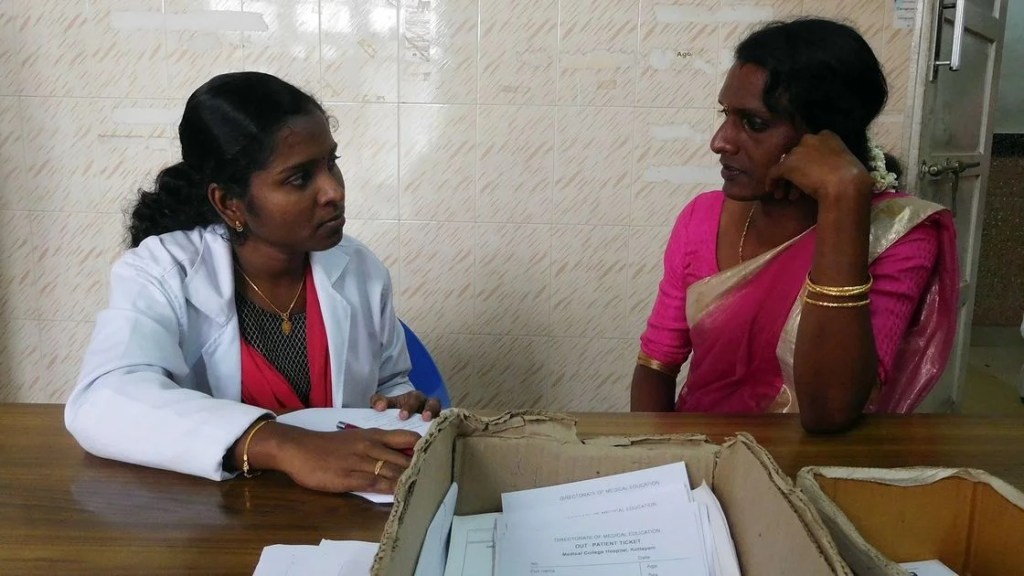
Image Source: Young Leaders for Legal Literacy Foundation https://ylcube.com/c/blogs/transgender-health-india/
 NICKELED AND DIMED